Jezero's rocks record three separate soakings
Rock on the inner edge of Jezero Crater was altered by water at least three separate times, a record that sharpens the case for the crater's ancient habitability.
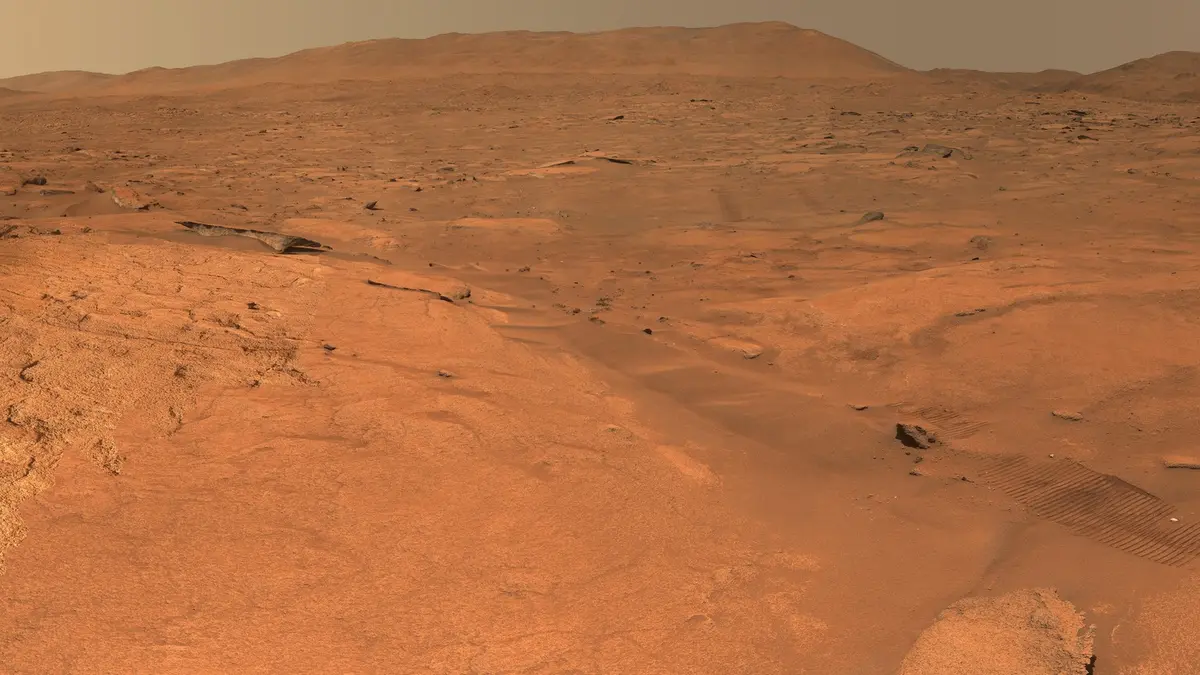
The surprise waiting on the crater floor
When NASA's Perseverance rover reached the inner edge of Mars' Jezero Crater in September 2023, its science team was expecting sedimentary rock. The area, known as the Margin Unit, hugs the shoreline of a lake that once filled the crater, and the orbital pictures suggested layers of lakebed mud. Instead the rover drove onto igneous rock - rock that forms from molten material deep underground or from volcanism at the surface, and which is a far better keeper of records because its mineral crystals lock in the moment they formed.
Those crystals have now produced a detailed account of the water that passed through. Reporting in the journal Communications Earth & Environment on Monday, the team describes rock that was altered by water on at least three separate occasions, each encounter leaving a different chemical signature behind.
Reading the rock grain by grain
The work rests on SuperCam, the instrument perched on the rover's mast, which identifies minerals from the light they reflect. When the team spots something interesting, SuperCam fires its laser at a target up to 21 feet (6.5 metres) away and reads the spectrum thrown off by the resulting plasma. Perseverance has analysed more than 185 bedrock targets in the unit this way, across roughly 870 feet (265 metres) of elevation.
The sequence that emerged runs from the top down. Higher up, the rock is coarse-grained and crystalline, dominated by the mineral olivine, with almost no sign that water ever touched it; that olivine formed in a body of magma deep underground and cooled slowly enough for large grains to grow, only reaching the surface after the rock above it eroded away. Lower down, on the old lakebed, the olivine grains are fractured with silica packed between them, and the fractures at the lowest elevations are filled with ridges of carbonate that now stand proud because the softer rock around them has worn away.
Three events, in order
The first soaking was carbon-dioxide-rich groundwater reacting with olivine to leave those carbonate ridges. The second may have been connected to the lake itself. The third was a later, hotter event: a set of mineral veins about 10 inches (25 centimetres) thick in one part of the eastern unit, carrying minerals such as calcium sulfate and fluorite. Fluorite is the giveaway, because it usually forms when hot water circulates through volcanic rock.
"Before we arrived at the Margin Unit, the main hypothesis - derived from orbital observations - was that the carbonate seen from orbit formed from interaction with the lake that existed in Jezero Crater," said Candice Bedford, a research scientist at Purdue University and the study's lead author. "But now we know that this location became a sort of crossroads for aqueous systems. The Margin Unit findings are important because Jezero Crater sits inside one of the largest exposures of carbonate on Mars, so what we learn here reaches well beyond this crater."
Silica is the other mineral that matters. "Turning olivine into carbonate can leave silica behind, and we see more of that silica in rocks that sat below the water line," said Eleni Ravanis, a planetary scientist at the University of Hawaii at Manoa and a coauthor of the study.
Why carbonate and silica are the headline
Neither mineral is a fossil, and NASA is careful not to claim one. But both are signposts. When water reacts with olivine on Earth the reaction can release hydrogen, which some microbes use as food, and it leaves behind carbonate and silica that can trap traces of the life that used it. Finding rock where that reaction ran repeatedly, in a place that held a lake, is the kind of target the mission was sent to find - the same rocks that Perseverance is now sealing into sample tubes for a future return to Earth.
The team can read the order of the three water events but not their dates. "If there is one thing I have learned after 10 years working with Mars rovers, it is that Mars constantly throws surprises at you," Bedford said. "It is very rare that things are as we expect them to be from orbital data. I hope this work helps reshape how scientists view the history of water in Jezero Crater and across Mars."
Our opinion
The important word in this paper is "crossroads". Planetary science has spent a decade treating Jezero as a lake basin, a single chapter of wet history to be dated and closed, and the Margin Unit refuses to co-operate with that story - it was dry igneous rock before any lake existed, then got soaked, then possibly soaked again by the lake, then cooked by hot water welling up long afterwards. That is a much harder thing to model, and a much more interesting one, because habitability that comes and goes in waves offers life several separate chances rather than one narrow window. It also raises the value of the sample tubes now sitting on the Martian surface: if a single set of rocks carries three different water histories, the laboratory work needed to pull them apart is exactly what a terrestrial lab can do and a rover cannot. The frustrating part remains that nobody has a funded way to go and collect them yet.