XRISM watches a pulsar siphon its companion's stellar wind
NASA and JAXA's XRISM observatory has watched a neutron star capture the stellar wind of a blue hypergiant, tracing plasma falling towards it at 335,000 mph.
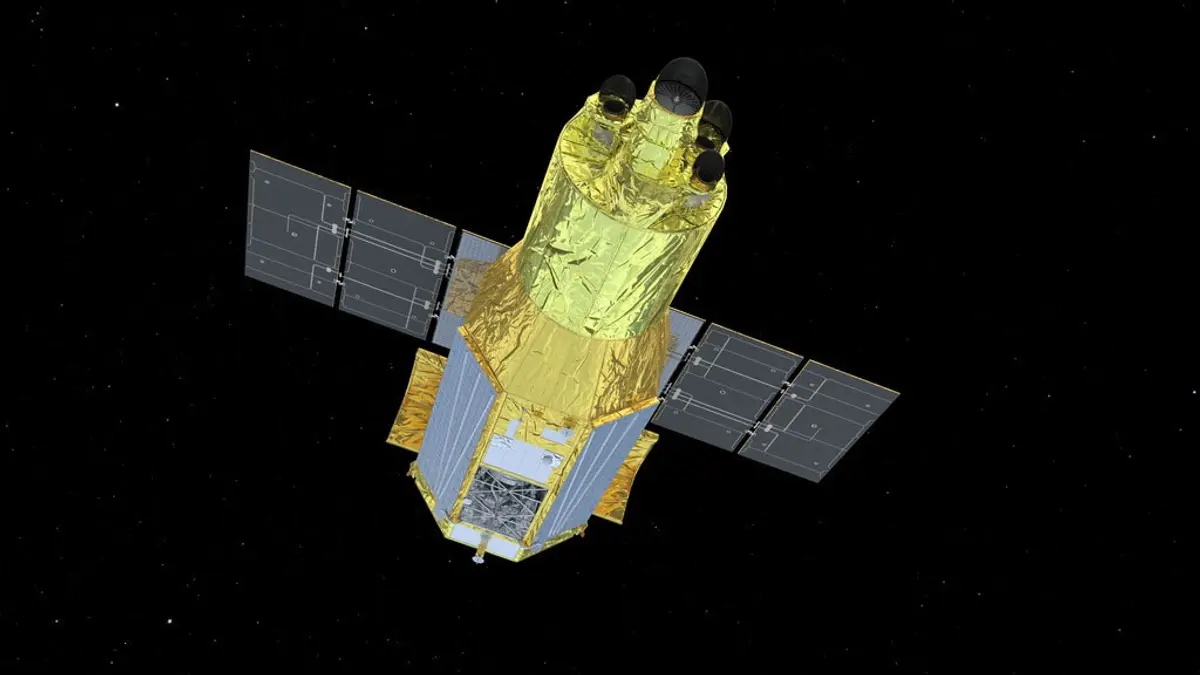
Astronomers using XRISM, the X-ray observatory Japan leads with NASA, have directly observed the stellar wind of a giant star being captured by its compact companion, the process suspected of powering the system's repeated X-ray flares. The work, published on 18 September in Science Advances, targeted BP Crucis, a high-mass X-ray binary about 13,000 light-years away in the southern constellation Crux.
A hypergiant and a very small neighbour
The two stars could hardly be more mismatched. Wray 977 is a blue hypergiant around 40 times the mass of the Sun and 60 times its size, so hot and luminous that ionised gas streams off it continuously. Its companion is GX 301-2, the collapsed core of a star that long ago exploded: more than the Sun's mass squeezed into a ball roughly 20km across, rotating once every 11 minutes and sweeping an X-ray beam past Earth, which is what makes it a pulsar.
Four days inside the stream
The pulsar orbits Wray 977 every 41.5 days, and twice per orbit, at the nearest and farthest points, the system throws out strong X-ray flares that last for days. Astronomers believe the pulsar's gravity distorts the hypergiant enough to create an unusually dense stream of plasma, and that the flares happen when the pulsar crosses it. XRISM watched the system for about 16 hours on 1 February 2025, close to the end of a strong flare, using the Resolve spectrometer that NASA and JAXA built together. Absorption lines from highly ionised iron were shifted to lower energies than laboratory measurements would put them, a redshift that reveals the direction and the speed of the gas, and shows plasma moving towards the pulsar at about 335,000 mph (540,000 kph).
What happens to the disk
The spectra also describe a structure that keeps rebuilding itself. Entering the stream, the pulsar sweeps gas into a thick, turbulent accretion disk that spirals material down onto the neutron star until it heats up and radiates X-rays. Push further into the flow and there is no longer enough angular momentum to hold a disk together, so plasma falls straight onto the pulsar, the phase XRISM caught. Towards the far side of the stream a messy disk briefly returns, spinning the opposite way this time, before vanishing as the pulsar exits. The whole transit takes about four days. Roi Rahin, a researcher at UMBC and NASA's Goddard Space Flight Center, said astronomers had never before seen clear indications of wind plasma falling onto a compact object, and the mission's project scientist Brian Williams called BP Crucis an ideal laboratory for studying wind-fed pulsar accretion.
Our opinion
This is the sort of result that quietly rearranges a textbook rather than making headlines for a week. Wind-fed accretion has been modelled for decades on the assumption that a stream of gas behaves predictably as it falls onto a neutron star. XRISM's spectra instead show a disk that forms, shreds and then reforms spinning backwards inside four days, which is the difference between a tidy diagram and weather. The instrument, not the object, is the story here: Resolve is sharp enough to read the velocity of plasma close to a 20km ball 13,000 light-years away, and that capability will keep turning up in places astronomers have only been able to argue about. The usual caveat applies. One system does not make a rule, so BP Crucis is now the best-studied example of its class rather than proof that every wind-fed pulsar behaves this way.