The fire amoeba rewriting the limits of complex life
An amoeba found in California’s Lassen Volcanic National Park keeps dividing at 63°C, pushing the temperature ceiling for complex cells well past the previous 60°C record.
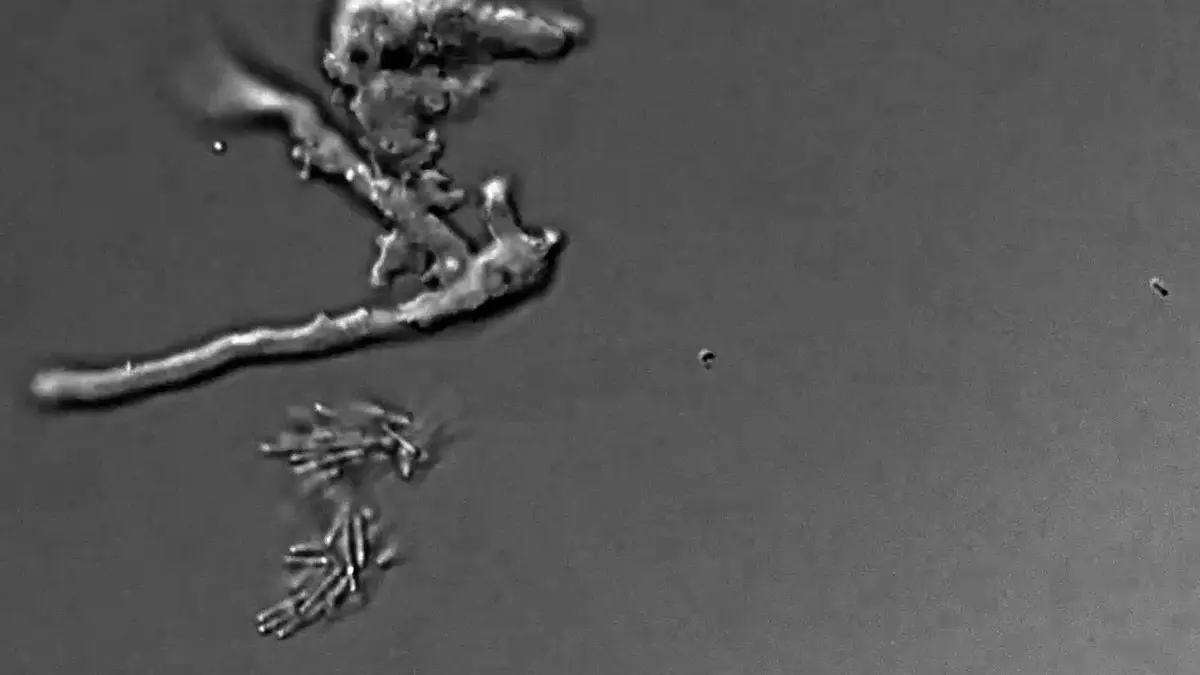
NASA-funded scientists have found an amoeba that can reproduce by division at 145°F (63°C) in the heated waters of Lassen Volcanic National Park in northern California. Nothing else with a nucleus is known to divide that hot.
The record, and the margin
The organism is Incendiamoeba cascadensis, already nicknamed the fire amoeba. It stops reproducing above 63°C but stays active, moving around in search of food at up to 147°F (64°C). Pushed in the laboratory it remains partially active at 150.8°F (66°C) and recovers after five minutes at 158°F (70°C); 176°F (80°C) is the point of no return. The previous upper limit for eukaryotes, 140°F (60°C), was held by a handful of fungi and red algae.
The name is a description as much as a label: Incendiamoeba cascadensis means fire amoeba coming from the cascades, and Lassen is the southernmost active volcanic region in the Cascade Range, home to Lassen Peak, the largest plug dome volcano on Earth. The results were published on Tuesday in the journal Cell, and the lead author is Beryl Rappaport.
Why a hot amoeba matters to astrobiology
Extremophile research has mostly concentrated on bacteria and archaea, cells with simple internal machinery. Eukaryotes, with a nucleus protecting delicate genetic material and a suite of moving parts, were assumed to fall apart at lower temperatures, which is the assumption the new study tests. NASA’s interest is planetary: the agency funds work on the edges of habitability on Earth to understand where life might survive elsewhere, including on Mars, and the proteins these organisms use have their own value in biotechnology and medicine.
Our opinion
Every few years the boundary of the habitable is pushed outwards by something small and stubborn, and the pattern in this case is more interesting than the headline number. The push came not from a bacterium but from a cell with a nucleus, organelles and a cytoskeleton doing a job that requires coordination, at a temperature that should have cooked its proteins. Mars’s surface and the subsurface oceans of the outer moons are usually judged against a limit calibrated on simple cells; if complex cells tolerate 63°C while dividing, then the honest answer about where life can hold on is wider than the last textbook said, and it is a volcanic national park in California that has moved the line this time.