Earth's centre of mass drifts less than we thought
A JPL-led team has used satellite tracking to measure the seasonal drift of Earth's centre of mass, and found the annual wobble is about half what scientists believed.
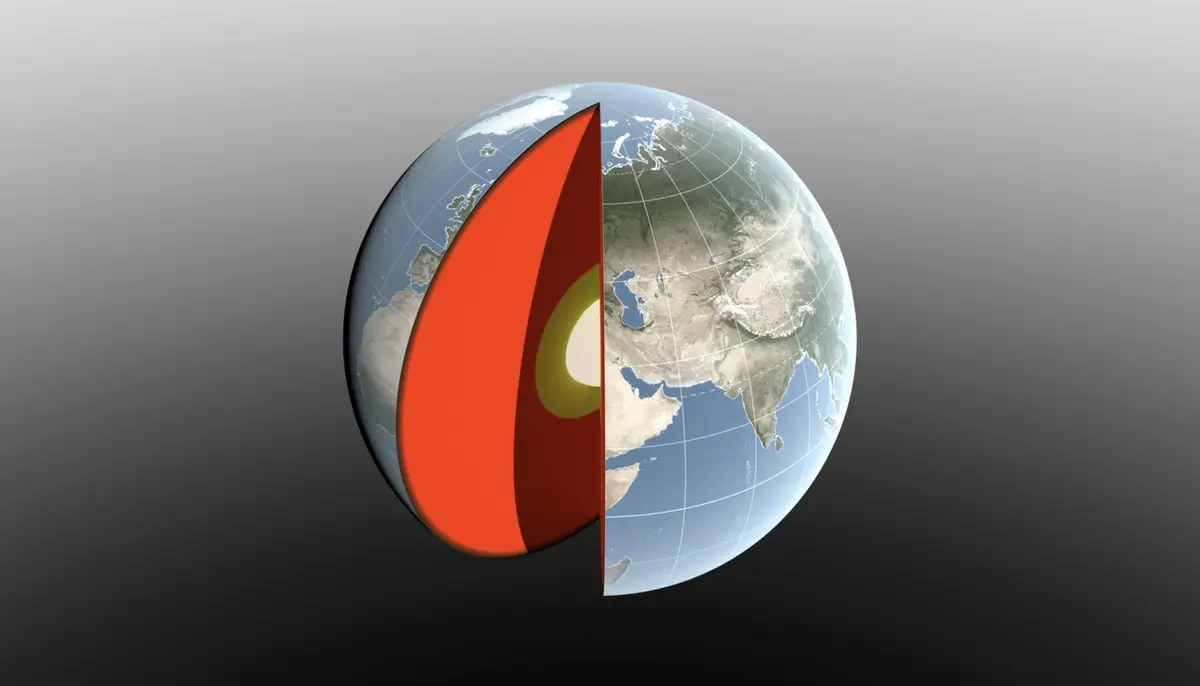
Earth is not a hard blue marble. Water and air slosh around the planet, and that movement drags its centre of mass — the point satellites naturally orbit — back and forth by millimetres every year. A team led by NASA's Jet Propulsion Laboratory has now measured that wobble more precisely than anyone before, and concluded the annual swing is roughly half the size scientists believed eight years ago.
How they pinned it down
Satellites are held by gravity to Earth's centre of mass, so tiny changes in the distance between a spacecraft and a ground station betray where that centre has moved. NASA has two satellites dedicated to exactly this: LAGEOS 1 and 2, dense metal spheres launched in 1976 and 1992, each studded with reflective prisms and still tracked by laser from stations spread across more than 20 countries.
That network has a flaw: the ground stations are not evenly spread around the globe. The new technique works around it by folding GPS tracking into the mix, adding orbital data from several satellites in low Earth orbit for a wider spread of targets, and modelling how the weight of water and ice deforms the planet's crust — taking the ground stations along for the ride.
The margin for error was not small. The last two international estimates, made in 2017 and 2023, differ by 0.27 inches, or 7 millimetres — about the height of three stacked coins, and nearly as large as the movement being measured. “We're now estimating the size of the movement of Earth's mass center back and forth each year to be about half of what we believed it to be eight years ago,” said Donald Argus, the JPL geoscientist who led the work, published in Geophysical Journal International.
Where the wobble comes from
The study splits the annual oscillation into three drivers: oceans, atmosphere and continental water, the last of which covers land ice, snow, lakes, rivers, soil moisture and groundwater. Snow piling up across North America and Eurasia peaks in March and shifts the centre of mass about 3 millimetres towards the North Pole. A month later, rainwater in the Amazon basin peaks at 2,400 gigatons and swings it 2.2 millimetres towards South America. Monsoon rains in southeast Asia top out at 600 gigatons in November.
Between August and October the oceans swell with meltwater and rain, pushing the centre of mass towards the South Pacific. That ocean is so vast that its mass changes swamp those of the others, though the Mediterranean, Red, North, Baltic and Barents seas all nudge the planet in their own small way. The team used a model from the European Centre for Medium-Range Weather Forecasts to handle the atmosphere, finding that cold, dense winter air tips the scales over Arabia, Asia and northern Africa around 21 December each year, and over South America and southern Africa around 21 June.
The numbers line up with observations from GRACE-FO, the twin-satellite NASA and German Research Centre for Geosciences mission launched in 2018 that maps monthly changes in Earth's gravitational pull. Its successor, GRACE-C, is targeting a launch in late 2028, which would extend a data record now nearly 25 years long.
Our opinion
This looks like trivia and behaves like plumbing. The geocentre is a reference point that satellite navigation, elevation measurements, mapping and the survey work behind precision agriculture all quietly lean on. As JPL's Felix Landerer put it, movements of a few millimetres still matter to a world that depends on extremely accurate positioning. Get the reference frame subtly wrong and the error propagates outwards, from shipping routes to how high above sea level your house officially sits.
The other thing worth applauding is the correction. Eight years ago the accepted figure was double what it is now, and the researchers have said so plainly rather than defending the old number. That is how measurement science is supposed to work: the instrument improves, the error bar shrinks, and the answer changes.
Note also who did the work. The team included the University of Nevada, the University of Montana and the Helmholtz Centre for Geosciences in Germany, and the atmospheric modelling came from a European centre. Earth observation has quietly become one of the more genuinely international bits of science, even as the rockets that carry the hardware are sold as national trophies. The wobble is invisible. The infrastructure built on knowing about it is not.
- Seasonal water and air movement shifts Earth’s centre of mass by millimetres
- New satellite-tracking technique halves the estimated annual wobble
- Snow, Amazon rain and Pacific swell drive most of the annual swing