NASA's Moon orbiter spots a once-in-a-century crater
A routine scan of the Moon turned up a bright spot that was not there in 2011: McGetchin crater, 728 feet wide, carved by an impact scientists put at once a century.
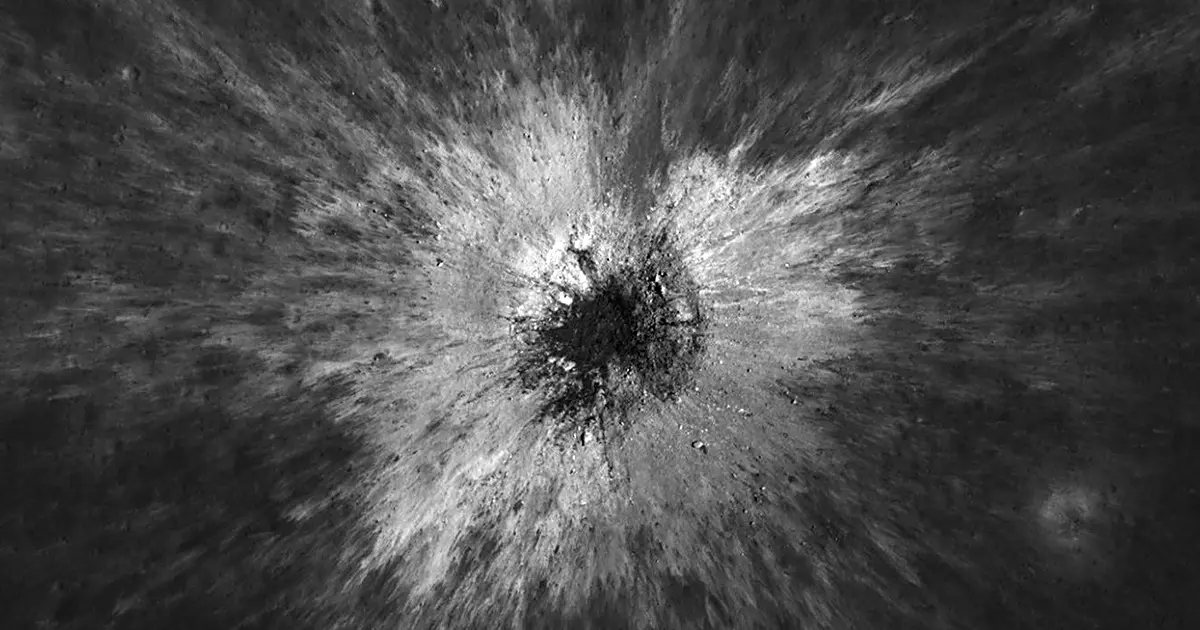
A routine data-quality check on a map of the Moon ended with the largest freshly formed crater anyone has found in the solar system. Robert Wagner, an image-processing specialist from Intuitive Machines who works with data from the Lunar Reconnaissance Orbiter Camera, was scanning a giant Moon map when an unusually large bright spot with a dark halo around it caught his eye. He pulled up older frames of the same ground and the spot was simply not there. “I just stopped, dropped everything, and started looking into what that spot was,” Wagner said.
How big is McGetchin crater?
The crater has been officially named McGetchin, after the pioneering lunar scientist Tom McGetchin, and it is a heavyweight. It is 728 feet (222 metres) across, roughly the length of two football pitches, and 141 feet deep — about three yellow school buses stacked on top of one another. It sits on the Moon's eastern edge and formed between 11 April and 22 May 2024, when a comet or asteroid the size of a three- to six-storey building slammed into the surface. The bright spot that started all this is not the crater itself but the material thrown out of it, scattered in long streaks across the surrounding grey terrain.
Why scientists call it a once-in-a-century impact
Strikes of this size are rare enough that scientists estimate one happens on the Moon about once a century, possibly less often. The smallest craters the orbiter's cameras can pick out are around 30 feet wide, punched out by rocks roughly 43 inches across — the size of a monster-truck tyre — and those smaller hits add up to about 140 new craters a year. NASA's Lunar Reconnaissance Orbiter has been circling the Moon for more than 17 years with seven instruments aboard, and over that time the mission team has identified at least 1,000 new impact craters and flagged another 100,000 surface changes. Nothing up there has an atmosphere to burn incoming rock away, so almost everything that arrives leaves a mark.
How was the crater confirmed?
The discovery came out of a comparison rather than a single picture. The “after” view was built from images taken by the orbiter's Wide-Angle Camera in summer 2025, and the “before” frame from the same wide view captured in spring 2011 across an area 38 miles wide. Temperature readings taken by Diviner between 15 November 2025 and 18 February 2026 confirmed what the visible-light images suggested, and the crater was then formally named and reported.
What the heat maps found around it
Once the crater had been spotted in visible-light images, scientists working with the orbiter's thermal instrument, Diviner, took a second look. They found a zone four miles wide around McGetchin that runs about 9°C (16°F) cooler at night than the terrain beside it. The explanation, set out in a second paper, is that the impact fluffed up the regolith around the crater, making it less dense and so less able to hold heat. That cold patch reaches far beyond the hole itself, which is the part researchers find most striking: an impact reworks the ground well past the crater rim, and loosened soil behaves differently under a rover's wheels.
Why the discovery matters beyond the crater
The finding lands as the Moon gets busier than it has ever been. NASA frames the crater as evidence of a landscape that is still being rewritten, and as a demonstration of why orbital data matters as the agency works towards a sustained human presence and expanded scientific and commercial activity on the surface. The work is written up in “A new 222-m diameter lunar crater” from the camera team and “New lunar crater reveals extensive distal regolith modification” from the Diviner team, both in Science Advances.
Our opinion
There is a lesson in how this one arrived. LRO has spent 17 years building an archive nobody would call dramatic — the same grey real estate, frame after frame — and that record is what made the discovery possible, because a bright spot only means something when you already hold the picture of how the place looked before. The flashy instruments get the headlines; the long, unglamorous survey is what turns a smudge on a map into a named crater with two papers attached to it. The second point is about the ground itself. A zone four miles wide that runs nine degrees colder at night because the surface has been loosened is exactly the sort of detail that decides how rovers, landers and eventually crews operate, and it argues for treating the Moon as a working site rather than a static backdrop. If one rock the size of a small building can rework that much terrain, the engineering assumptions behind anything parked nearby deserve a second look.
- McGetchin crater is the largest newly formed crater ever found in the solar system
- It formed on the Moon's eastern edge between 11 April and 22 May 2024, when a comet or asteroid the size of a three- to six-storey building hit the surface
- The crater is 728 feet (222 metres) wide and 141 feet deep
- Scientists estimate an impact of that magnitude happens on the Moon about once a century
- Follow-up readings from LRO's thermal instrument found a 4-mile-wide zone around the crater that runs about 16 degrees Fahrenheit cooler at night
- The discovery and the thermal analysis appear in two papers in Science Advances