Gemini opens its doors to Adobe, Airtable and Peloton
Google has started wiring 14 more third-party services into the Gemini app, from Airtable and Adobe to Peloton and SeatGeek, and it wants you to summon them with an @ mention in chat.
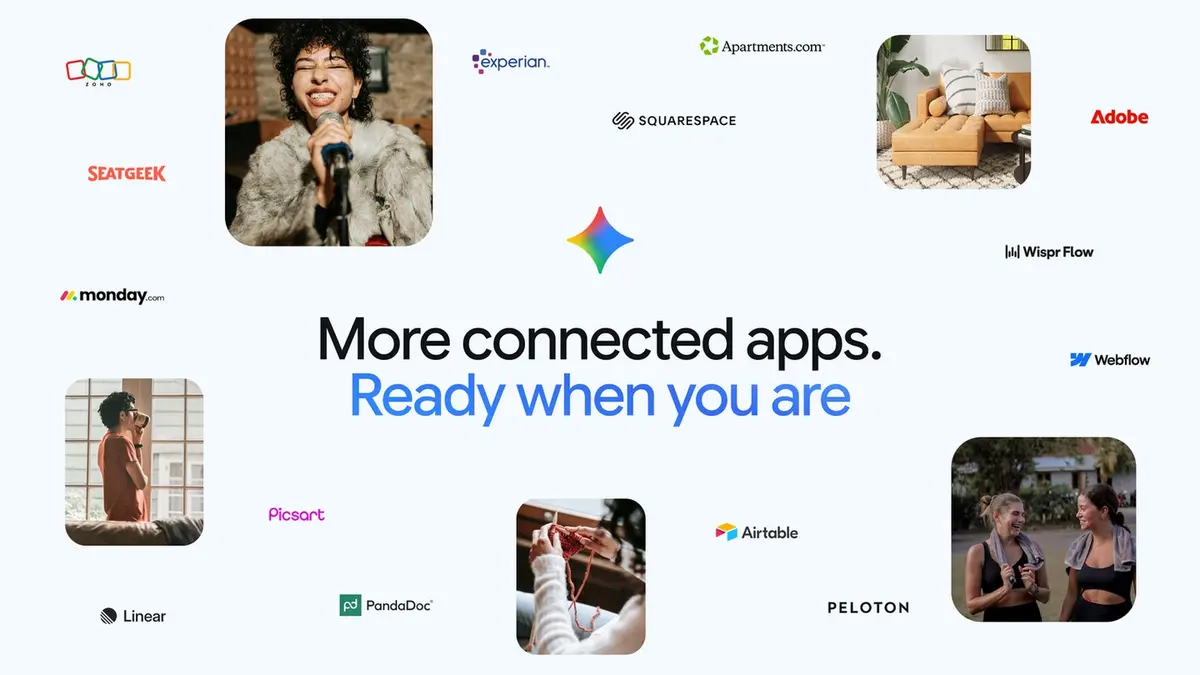
Google has begun plugging a fresh batch of outside services into the Gemini app. In a post published on 23 September 2026, Mai Lowe, group product manager for the Gemini app, said the new wave of Connected Apps is rolling out from that day, letting people link partner tools in Gemini settings or pull them into a conversation by typing an @ mention.
The pitch is familiar and blunt: stop hopping between tabs. Google's examples are managing a project, designing an asset and planning a workout without leaving the chat window.
Who is being connected
Fourteen services are named in the announcement, grouped into three categories. Productivity covers Airtable, Linear, monday.com, PandaDoc, Wispr AI and Zoho. Creativity adds Adobe, Picsart, Squarespace and Webflow. Lifestyle brings apartments.com, Experian, Peloton and SeatGeek.
That mix says a lot about who Google thinks will pay attention. Half of the list is work software, where an AI assistant that can read a database or draft a contract sits much closer to the money than one that can only talk about it.
What Google has not said
The post is a product note rather than a specification. There is no complete partner list beyond the named categories, no regional rollout schedule, and no detail on how long a Connected App keeps access to the data it reads once a chat is finished. As always with staged rollouts, availability will differ by account and country before it settles.
Google has been building Gemini into a hub rather than a standalone chatbot for most of 2026, and this is the same strategy in a new colourway: the assistant becomes the place where other companies' features are invoked.
Our opinion
Connected Apps is a smaller-sounding update than a new model, and it may end up mattering more, because it moves the fight from benchmark scores to distribution. A service that lives inside Gemini is a service a subscriber keeps, and an @ mention is a far cheaper user interface than teaching anyone a new dashboard. The awkward part is symmetry. Every partner here is handing Google the surface where its own customers will increasingly work, and the ones that hesitate will watch a competitor take the mention instead. Google wins wherever it becomes the front door, which is precisely why the interesting question is not how many apps shipped this week but who says no.