Arctic sea ice ends the 2026 melt season tenth-lowest
Arctic sea ice bottomed out on 12 September at 4.6 million square kilometres, tying 2008, 2010 and 2025 for the tenth-lowest minimum in the satellite record.
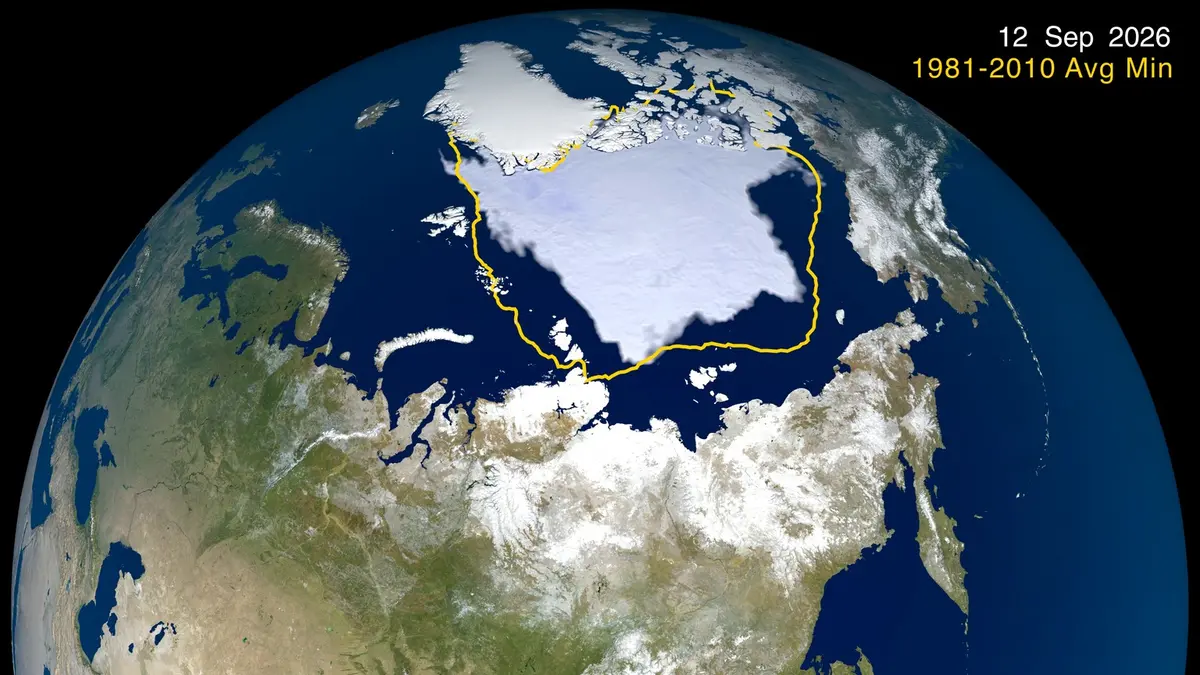
Arctic sea ice reached its annual minimum on 12 September, NASA and the National Snow and Ice Data Center said, with the ice covering an estimated 1.78 million square miles (4.6 million square kilometres) at its lowest point of the year. The figure ties 2008, 2010 and 2025 for the tenth-lowest minimum in a satellite record that began in late 1978.
What the numbers say
The tie is the detail worth sitting with. The 20 years from 2007 through 2026 have produced the 20 lowest annual Arctic minimums since continuous satellite measurements began, and the summer of 2026 fitted into that run rather than interrupting it. Arctic sea ice grows through the dark, cold autumn and winter and retreats as temperatures rise in spring and summer, normally reaching its lowest extent in September. Weather can swing the amount of ice that melts by a wide margin from one year to the next, which is why a single September figure is a snapshot rather than a verdict.
Cloud has flattened the September figure
NASA attributes the recent stability in large part to cloud. Linette Boisvert, a sea ice scientist at the agency's Goddard Space Flight Center in Maryland, said increased cloud cover over the past decade has kept solar radiation from accelerating the melt and has contributed to relatively stable September extents. Walt Meier, a senior research scientist at NSIDC, put the position plainly: "We’ve plateaued, but we’re still low relative to the earlier part of the record".
Antarctic ice heads for its maximum after an odd August
At the other end of the planet, Antarctic sea ice is approaching its annual maximum after an unusual fluctuation in August, when extent fell by roughly 116,000 square miles (300,000 square kilometres) over six days before resuming its seasonal growth. Meier said the drop appeared to be linked to weather that pushed and compacted the thin, mobile ice near the continent's outer edge. "Those types of things happen all the time," he said. "But the magnitude of it certainly is unusual." Antarctic sea ice varies more from year to year than the Arctic's because, unlike the Arctic, it is not surrounded by land and can respond more freely to wind and weather, and although maximum extents have generally been lower in recent years, both scientists are cautious about calling that a long-term trend.
Our opinion
The flattering version of this release is that the Arctic finished the melt season tenth on a list where tenth sounds respectable. The more useful version is that all 20 of the lowest minimums in a 48-year record have now arrived inside the past 20 years, so the ranking has quietly stopped being a scoreboard and become a description of where the ice sits. The tie with 2008, 2010 and 2025 is the detail that gives the game away: three separate years landing on the same extent looks less like luck and more like a floor that present conditions keep reproducing. That floor is being held up by cloud, which is weather doing the work rather than ice recovering, and it is a ceiling on further losses only for as long as the cloud keeps arriving. The Antarctic passage in the same release makes the point in miniature: 300,000 square kilometres vanished in six days and the seasonal growth simply resumed, a reminder that a large number and a large trend are different things. A tenth-lowest minimum is worth reporting precisely because it is unremarkable. It says the baseline has moved, and no single September is going to move it back.