Kinetica 1 lifts nine satellites on its 16th flight
CAS Space's workhorse rocket carried imaging, spectrum-monitoring and AI-computing payloads to orbit, closing a six-launch week for China.
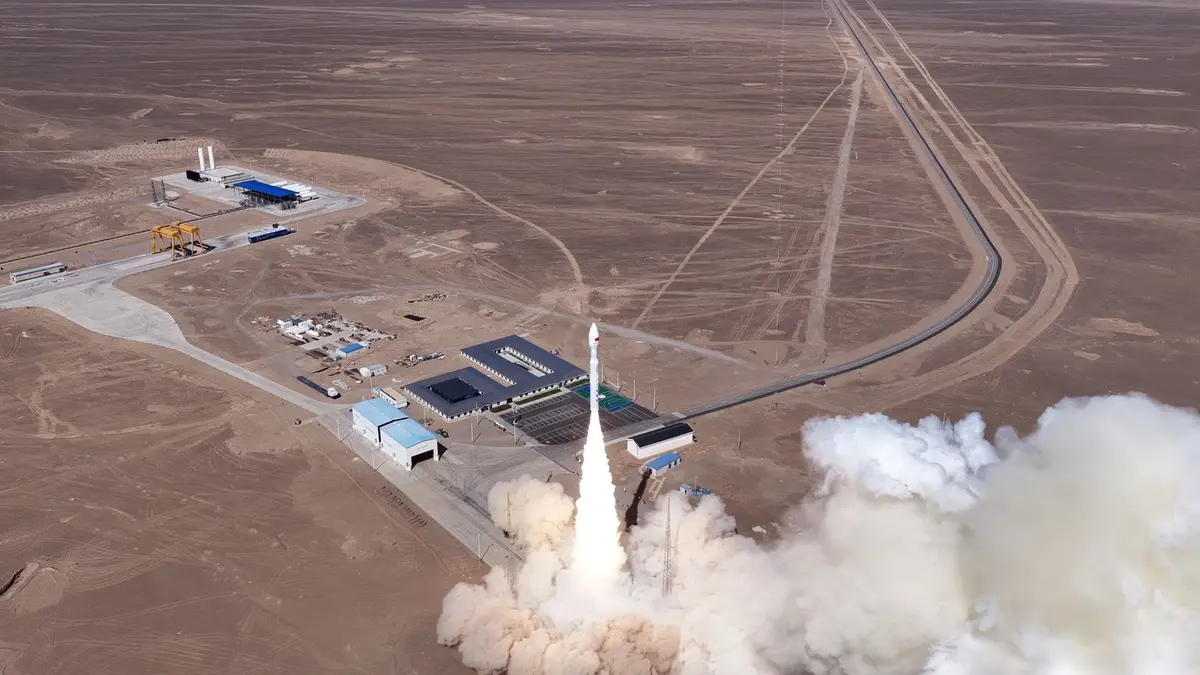
CAS Space's Kinetica 1 rocket lifted off at 12:03 pm local time on 20 September from the Dongfeng commercial space innovation pilot zone in north-west China and put nine satellites into their planned orbits. The flight, using the Y18 vehicle, was the 16th mission for Kinetica 1 and the 17th launch in the Kinetica family.
The operator flew the satellites as a single rideshare, a pattern it presents as a way to speed up the assembly of small constellations. Between them the payloads cover optical imaging, radio-spectrum monitoring, communications research and on-orbit computing.
What the nine payloads do
The mission's namesake is Chaozhisuan-1, a high-resolution remote-sensing satellite built around a four-metre visible-light camera and an onboard AI computer. CAS Space says the satellite can acquire imagery, process it in orbit and extract targets on its own, with applications pencilled in for smart cities, natural-resource surveys, precision agriculture, ecological monitoring and emergency response. It is also a testbed: the stated aim is to prove that real-time computing on a satellite is stable enough to be routine.
Three further spacecraft, Diting-01 A, B and C, form a radio-frequency monitoring constellation built by Tianjin Xingkan Jiuzhou. CAS Space describes it as China's first three-satellite formation dedicated to commercial space-based spectrum data collection, capable of sensing radio activity across a wide area and pinpointing transmitters quickly.
Pengcheng-1, also catalogued as PEGA-SUS1, was developed by GalaxySpace with Pengcheng Laboratory and the Southern University of Science and Technology. It carries a 5G non-terrestrial-network communications payload, a digital-retina computing device for in-orbit image analysis and a satellite-to-ground laser terminal designed for high-speed links. Its experiments are aimed squarely at the groundwork for 6G networks.
The remaining payloads are Qinling-1 and Qinling-2, two optical remote-sensing satellites approved by the Shaanxi provincial government and built by Northwestern Polytechnical University with panchromatic and multispectral cameras for environmental work across the Qinling mountains and the Yellow River basin; Yunxiao Tanluzhe, from the Chinese Academy of Sciences' Institute of Mechanics; and Pujiang-4, from the Shanghai Institute of Satellite Engineering.
A timetable booked into 2027
CAS Space now counts one spacecraft and 121 satellites delivered to orbit across the Kinetica family, carrying more than 21 tonnes of payload. The company says its order book is full and its launch schedule is mapped out into the second half of 2027, and it is preparing a first sea launch that will carry three satellites, adding a mobile pad to its land-based flights.
Sunday's mission also closed a busy stretch for Chinese launch providers: six orbital launches in under a week, all successful. The run began on 15 September and took in the Zhuque-2E, Gravity-1, Long March-12, Kuaizhou-11, Long March-2D and Kinetica-1 vehicles.
Our opinion
The interesting shift here is not the launch count but the payload list. Three of the nine satellites are essentially computers that happen to be in orbit, and one of them is explicitly selling itself on processing pictures in space rather than downlinking them first. That is the part of the commercial space market that is hardest to copy, because it needs cheap launch, cheap silicon and a customer who would rather buy an answer than a raw file.
CAS Space's real product is a schedule. Promising slots into the second half of 2027, and adding a sea pad to widen the launch windows, is an argument about reliability rather than about price per kilogram. A 16-flight record is still thin, and a perfect week of launches says more about a good month than about a mature vehicle, so the order book deserves the scrutiny that will come with the next dozen flights. But the direction of travel is plain: China's private launch sector is now competing on how soon it can fly, not on whether it can fly.