Astronomers spot a planet younger than a million years
Astronomers have confirmed Elias 2-24 b, a planet under a million years old that is still growing inside its birth disk, roughly 450 light-years from Earth.
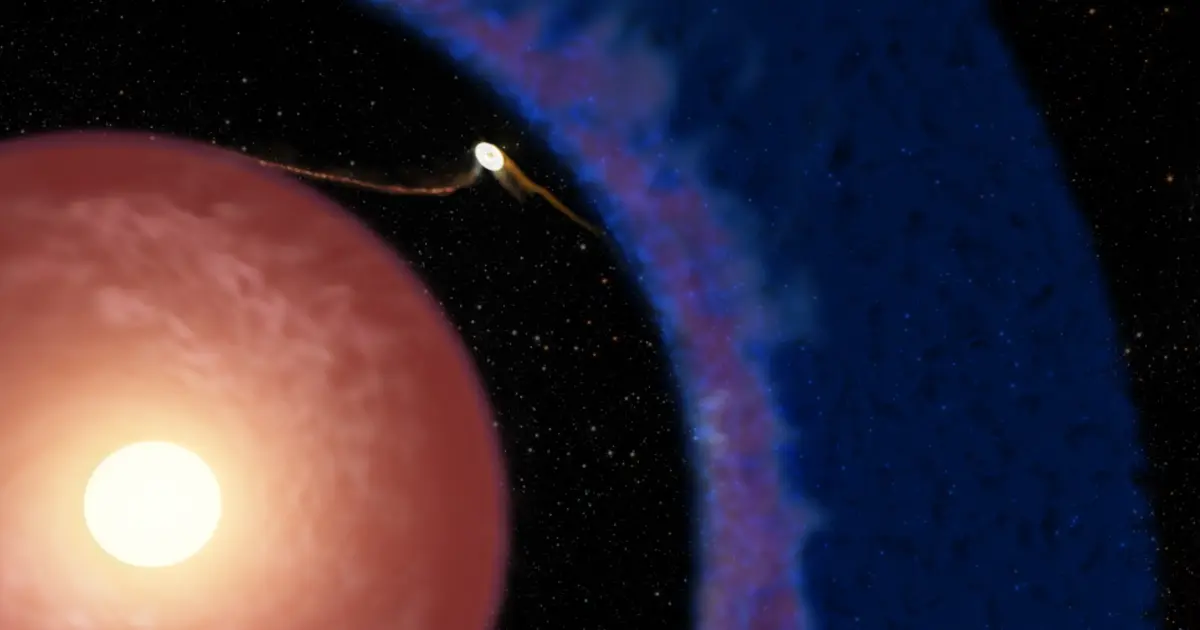
NASA has confirmed the youngest planet anyone has ever found, and it is barely out of the womb. Called Elias 2-24 b, the world is less than a million years old, still sitting inside the swirling disk of dust and gas it is being built from, about 450 light-years from Earth. For scale: our own planet has had 4,500 million years to get its act together, and this one has not yet managed a single one.
What astronomers actually found
The result, published by NASA Science on 16 September, comes from archival observations of seven young stars, each wrapped in a disk of dust, gas, ice and rock. The team used the coronagraph at the W. M. Keck Observatory in Hawaii, which partners with NASA under a cooperative agreement. A coronagraph does one blunt job very well: it blocks a star's glare so that anything faint sitting next to it becomes visible, rather like cupping your hand around a torch to see what is behind it. The astronomers then hunted inside the gaps in those disks, on the straightforward theory that planets are the things carving them. “The planets should be found within the gaps, since they are carving them,” said Andrea Bernardi, a doctoral candidate at Universidad Diego Portales in Chile, who led the study in The Astrophysical Journal Letters. “And that's exactly where we found Elias 2-24 b.”
The planet is roughly as massive as Jupiter. The star it orbits, Elias 2-24, is about 450 light-years away. That combination makes it a genuine record-breaker: the previous best was a four-way tie between two planets around the star PDS 70 and two around WISPIT 2, and all four of those are more than five million years old. Elias 2-24 b leaves them standing.
Why baby planets are so hard to catch
Newborn worlds are awkward to spot, and it is mostly a geometry problem. The vast majority of the roughly 6,000 confirmed exoplanets were found by watching a star dim as a planet crossed in front of it. That trick works beautifully for older planets hugging their stars, and badly for a planet still buried in dust or orbiting far out, which is why almost everything in the catalogue is billions of years old. “The galaxy churns out new stars and planets continuously, so there are many in every stage of evolution,” said Lucas Cieza, a professor at the Instituto de Estudios Astrofísicos in Chile and a co-author of the paper. “That means we can see the entire process in theory, but there is a large gap in what most telescopes can detect. We are mostly blind to these baby planets right now.”
What a newborn world tells us
A system this young is a time machine of sorts. Watching Elias 2-24 b accrete material from its disk is the closest thing astronomy has to a replay of what our own planetary system may have looked like billions of years ago, before everything settled down and stopped throwing rocks at each other. It is also an awkward result for the models. Cieza is blunt about that: the existing record holders already strained planet-formation theory, and this planet puts more distance between the simulations and the sky.
Our opinion
The headline is the record, but the interesting part is the admission underneath it. Planet-formation models are not slightly off; they are missing processes, and everyone involved says so in print. That is what the baby-planet hunt is really for. Every time astronomers get a clear look at a world that is still being assembled, the tidy textbook timeline of a disk settling, clumping and quietly producing planets takes another knock.
It also shows how much of the sky we are effectively ignoring. We have a catalogue of 6,000 exoplanets and almost none of them are young, not because young planets are rare but because our favourite detection method is blind to them. Fixing that is expensive and slow, and it is the sort of unglamorous groundwork that pays off later. In the meantime, a planet that has not yet had its first millionth birthday is doing more for planetary science than another rocky world in a familiar orbit ever will.
- NASA Science published the result on 16 September 2026
- Elias 2-24 b is less than a million years old and is the youngest confirmed planet so far
- The planet is about as massive as Jupiter and orbits a star roughly 450 light-years from Earth
- The team studied archival observations of seven stars taken with the coronagraph at the W. M. Keck Observatory in Hawaii, which partners with NASA
- The study was published in The Astrophysical Journal Letters and led by Andrea Bernardi, a doctoral candidate at Universidad Diego Portales in Chile
- The previous record was a four-way tie: two planets around PDS 70 and two around WISPIT 2, all more than 5 million years old
- The planet sits inside a gap in the dust disk, which is where planet-formation theory says it should be
- Most of the roughly 6,000 confirmed exoplanets are billions of years old and orbit close to their stars, because that is what the transit method can detect