Hubble passes 200,000 orbits still chasing a supernova
NASA's Hubble Space Telescope completed its 200,000th orbit on 19 September, more than 5 billion miles and 1.7 million observations into a 36-year career, and the anniversary image is a supernova stakeout.
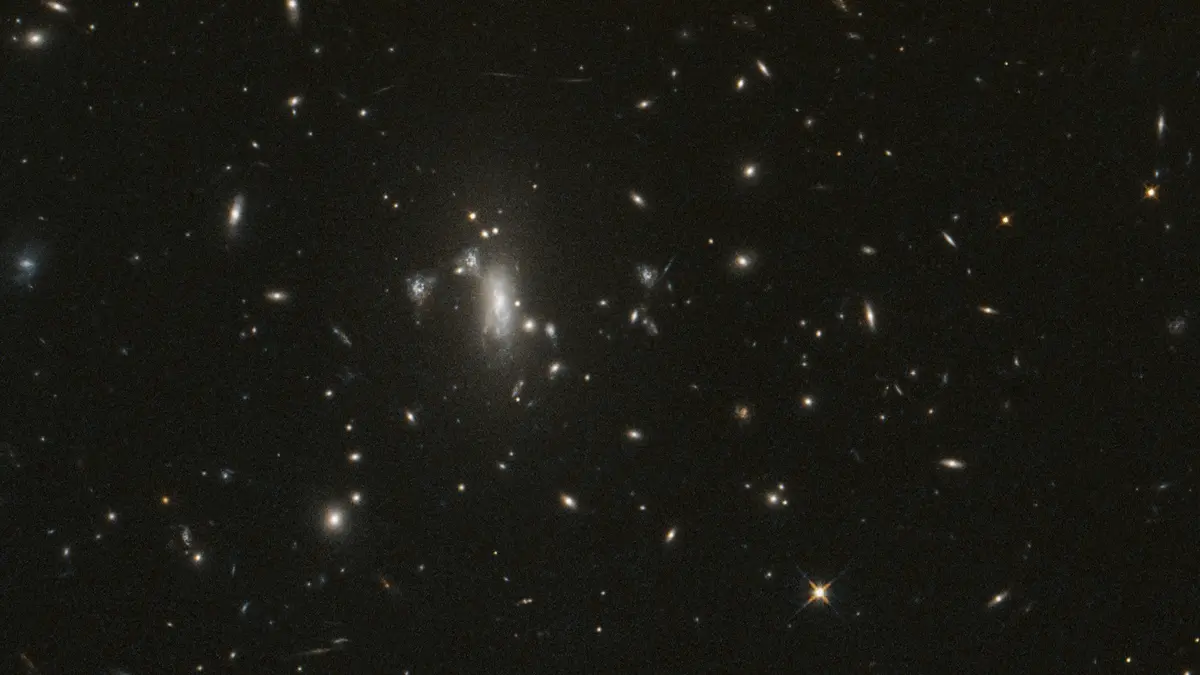
The Hubble Space Telescope has now circled Earth two hundred thousand times. NASA confirmed that the observatory reached the milestone on 19 September, and marked it with an image that shows what the telescope was doing on the day rather than where it has been.
What 200,000 orbits adds up to
Hubble has travelled more than 5 billion miles around the planet since it launched in 1990, and it has now logged over 1.7 million observations across a 36-year lifetime. The telescope works around the clock, and NASA publishes a live track of what it is looking at.
The milestone image is a waiting game
The observation completed on the day of the 200,000th orbit belongs to one of Hubble's defining scientific legacies: pinning down the expansion rate of the universe, the Hubble Constant. The picture centres on the massive galaxy cluster MACS J0417, which acts as a gravitational lens, bending and magnifying the light of objects far behind it.
That bending is the point. Light from a single exploding star can reach Earth along more than one path, so the same supernova can appear two or three times, separated by months or even years depending on the route the light took. The supernova in question is Athena, found by the James Webb Space Telescope in 2025 and predicted to reappear between now and early March 2027. Hubble is watching for repeat performances, and the timing of those appearances can be used to weigh the cluster that is doing the magnifying.
Why astronomers keep queueing for it
Thirty-six years after launch, demand for Hubble time still runs at around seven times the observing time available. Its strength is wavelength: the telescope sees in ultraviolet and visible light, which complements the infrared view from the James Webb Space Telescope and the wide-field survey work planned for the Nancy Grace Roman Space Telescope. The image credits go to NASA, ESA and STScI, with M. Pascale of UCLA and image processing by J. DePasquale at STScI.
Our opinion
Space telescope milestones usually arrive as engineering trophies, and 200,000 orbits is a fine one: a machine designed for fifteen years that has now spent 36 circling the planet and still gets seven applications for every hour it can offer. The better story is the picture NASA chose to mark it with. Not a greatest-hits collage, but a working frame from a delayed appointment.
That is the part worth taking seriously. Hubble's most valuable contribution to cosmology has been patience, observing the same patches of sky often enough to catch events that happen on nature's schedule rather than an observation committee's. Athena may return before March 2027 or it may not, and either way the watch continues, which is exactly the kind of unglamorous, long-horizon science that budgets find easiest to cut and astronomers find hardest to replace.