Whiskers let tiny drones fly by touch in the dark
TU Delft's tactile sensor uses two artificial whiskers and 34 kilobytes of memory to steer a drone weighing under 100 grams through smoke, dust and darkness.
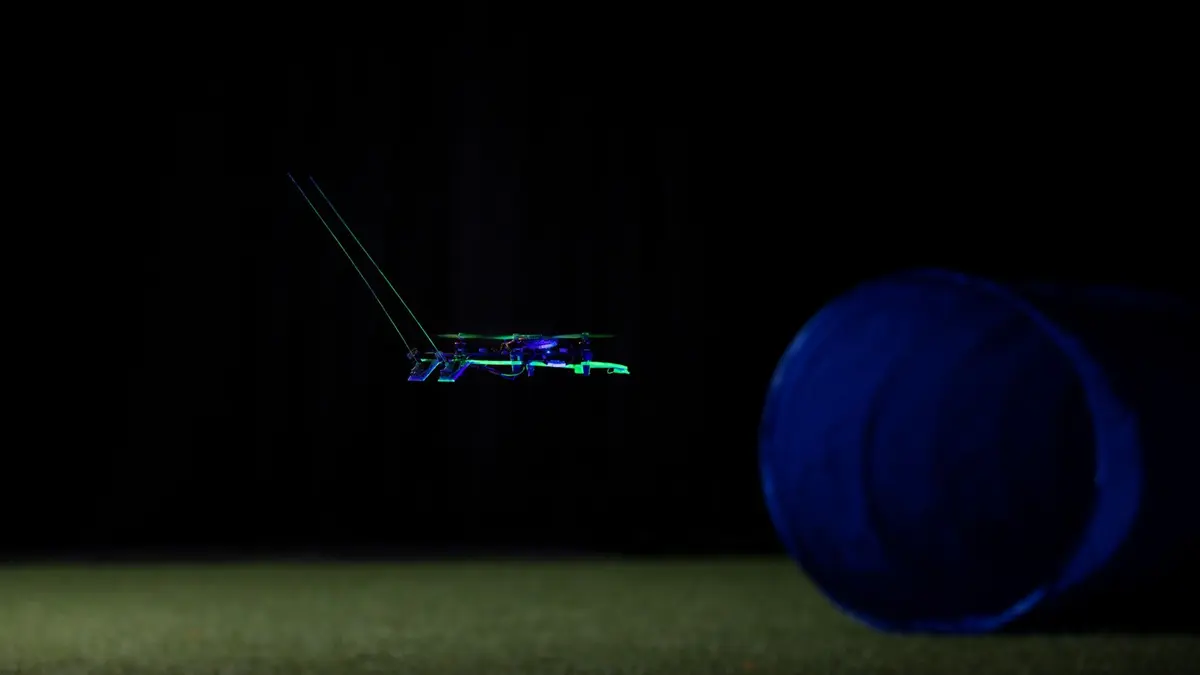
Drones have spent a decade buying awareness with more pixels, bigger sensors and battery capacity they do not have. Researchers at TU Delft have gone the other way and taught a palm-sized quadcopter to fly by touch, using two artificial whiskers that give it a working sense of what is in front of it without a single camera. The work is published in Nature Communications.
Whiskers instead of eyes
Flying robots under 100 grams are squeezed on sensing, computing and power at the same time. Cameras, LiDAR and rangefinders add weight, and they degrade badly in exactly the places a small drone is most useful: smoke-filled buildings, dusty spaces and caves. The Delft team, led by Dr Salua Hamaza, mounted a pair of artificial whiskers inspired by rodent vibrissae at the front of the aircraft. Each whisker carries three miniature pressure sensors at its base, so a contact can be located in three dimensions, and bending against a surface is converted into a depth estimate accurate to millimetres.
Ignoring the drone's own racket
The awkward problem was telling a genuine touch apart from the aircraft's own noise. Propeller wash pushes and vibrates the whiskers, producing drift and false readings. The team wrote a real-time pipeline that corrects for that interference, separates contact from turbulence and runs entirely on an onboard microcontroller in 34 kilobytes of memory. “We wanted to show that touch does not have to come at the cost of size or computational power,” said Chaoxiang Ye, a PhD candidate on the project. “Our entire tactile perception pipeline runs onboard using just 34 kilobytes of memory, allowing a tiny drone to sense and respond to its environment in real time.”
What it managed in the dark
In tests the drone followed both rigid and soft surface contours in complete darkness, hugged walls to explore enclosed spaces, assembled tactile maps of unfamiliar rooms and found its way out without any vision-based sensing or external positioning. The whole sensing apparatus weighs 3.2 grams, and the behaviours it enables, obstacle avoidance, surface following and tactile mapping, are the groundwork for flying into places where sight is not an option.
The researchers frame the obvious applications as search and rescue, safety inspections and environmental monitoring, which is where a drone that can feel its way along a wall matters more than one that can photograph the room. Aerial robotics has been chasing the sensory toolkit of a rat for years; this is one of the first attempts to fly with it rather than just build it.
Our opinion
The number to remember is not 3.2 grams but 34 kilobytes. Everyone can add a sensor; the hard part is making its output cheap enough to act on in the air, and a perception stack that fits in a microcontroller changes what a disposable drone can do. Whiskers are also a pleasingly unfashionable answer to a problem the industry usually attacks with more silicon, and the physics does the work that a neural network would otherwise have to.
There are honest limits. Contact sensing means the aircraft still has to get close enough to touch something, which caps how fast it can move through clutter and makes surface condition part of the design problem, and a pair of whiskers is a narrow field of view compared with a camera. But as a demonstration that touch can be a primary sense rather than a bumper of last resort, it is a much more interesting result than another incremental flight-time record.