Raspberry Pi 5 gains a 25 TOPS AI HAT for on-device AI
Raspberry Pi has shown off a 25 TOPS accelerator HAT that lets a Raspberry Pi 5 run vision, vision-language and small language models locally at about 3 W of sustained NPU power.
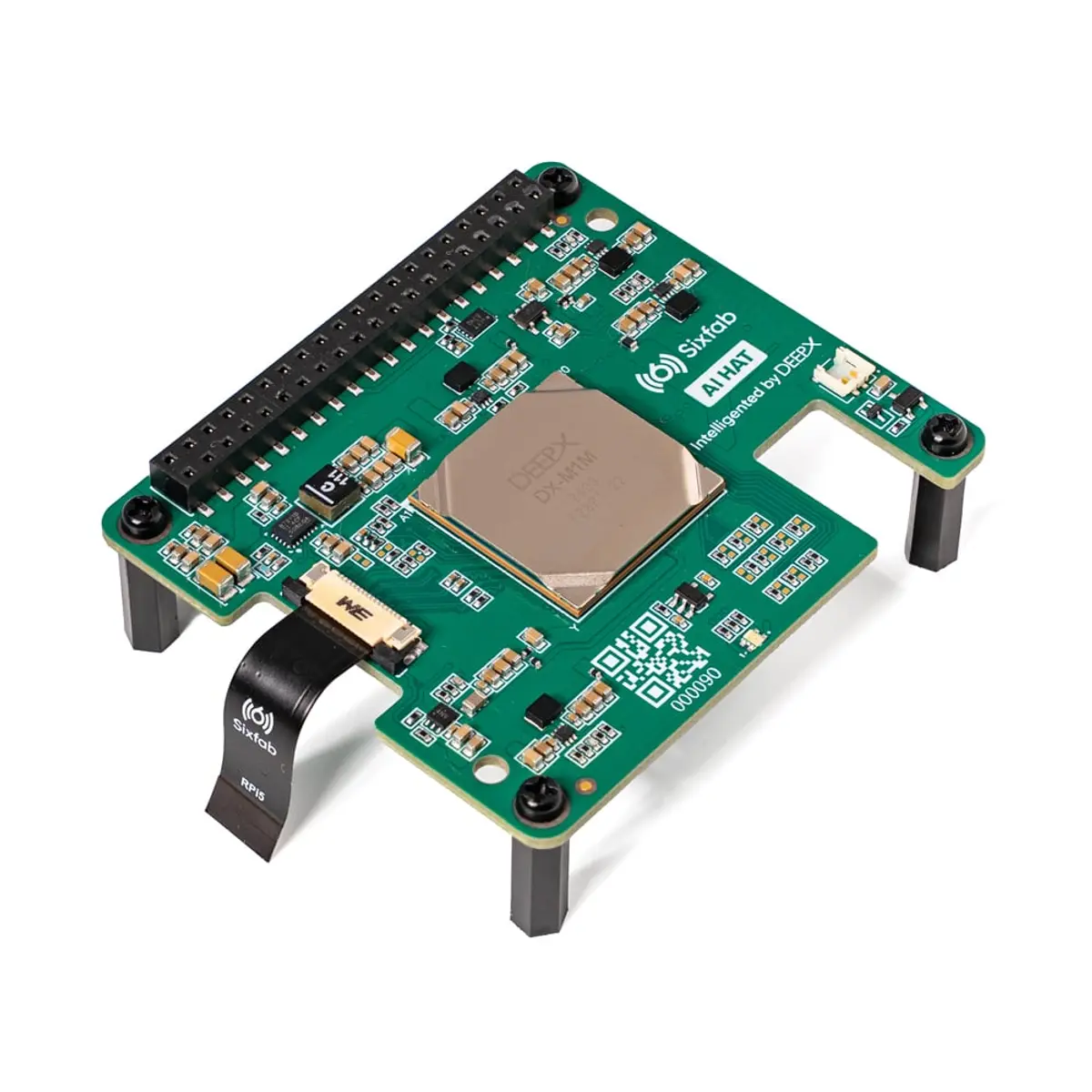
Raspberry Pi says the next step for its boards is not a model that runs once in a demo, but an intelligent system that keeps watching, understanding and responding without leaning on a cloud connection for every decision.
The hardware behind that pitch is the Sixfab AI HAT+ for Raspberry Pi 5, an add-on board built around the DEEPX DX-M1M neural processing unit. It adds 25 TOPS of dedicated AI acceleration at roughly 3 W of typical sustained NPU power, which leaves the Raspberry Pi's own processor free for camera handling, application logic, connectivity and whatever the device actually controls.
That wattage figure is the interesting one. Peak TOPS numbers make good marketing, but most edge products live or die by their power and thermal budget, because the complete system still has to power a camera, storage, networking and the board itself. An accelerator that holds near 3 W under sustained load means smaller enclosures, simpler passive cooling and models that can run continuously instead of in short bursts.
Memory is the other practical limit, and the DX-M1M carries 2 GB of dedicated LPDDR4x on the module. Raspberry Pi says that comfortably supports vision-language and small language models alongside traditional vision workloads.
Perception comes first. Object detection, classification, segmentation, pose estimation, depth and image enhancement turn camera pixels into structured events, and DEEPX's ModelZoo ships pre-optimised examples including YOLO-family detectors, with DX-Stream assembling them into GStreamer-based camera pipelines.
On top of that, a compact vision-language model can describe a scene or answer a focused question about an image, and a small language model can take a command, summarise local events or explain what the camera just saw. The work happens on the device, so nothing has to leave it.
DEEPX stresses that its INT8 optimisation is an accuracy-aware engineering process rather than a straight conversion, a claim that matters most in the conditions edge cameras actually meet: low light, glare, motion blur, occlusion and awkward angles.
Our opinion
The number to watch here is not 25 TOPS, it is 3 W. Raspberry Pi has spent years building an ecosystem where the useful ceiling is a power supply you can hide behind a skirting board, and an accelerator that genuinely holds near 3 W is what turns a vision-language model from a party trick into something a camera can run from dawn until dusk.
The harder question is cost. A Raspberry Pi 5 plus a 25 TOPS HAT is now competing with the cheapest purpose-built edge boxes and with the cloud subscriptions people were paying to avoid. If the combination lands anywhere near the price of the boards it is trying to replace, makers get a genuinely credible local AI stack. If it drifts much above that, the 3 W figure stops mattering, because the project never gets built in the first place.