NASA's Mars carbon-capture tech is cleaning up breweries
Carbon-capture hardware built for Mars life support now recovers CO2 from brewing, wineries and power plants, and NASA's Spinoff series traces the line back to the Red Planet.
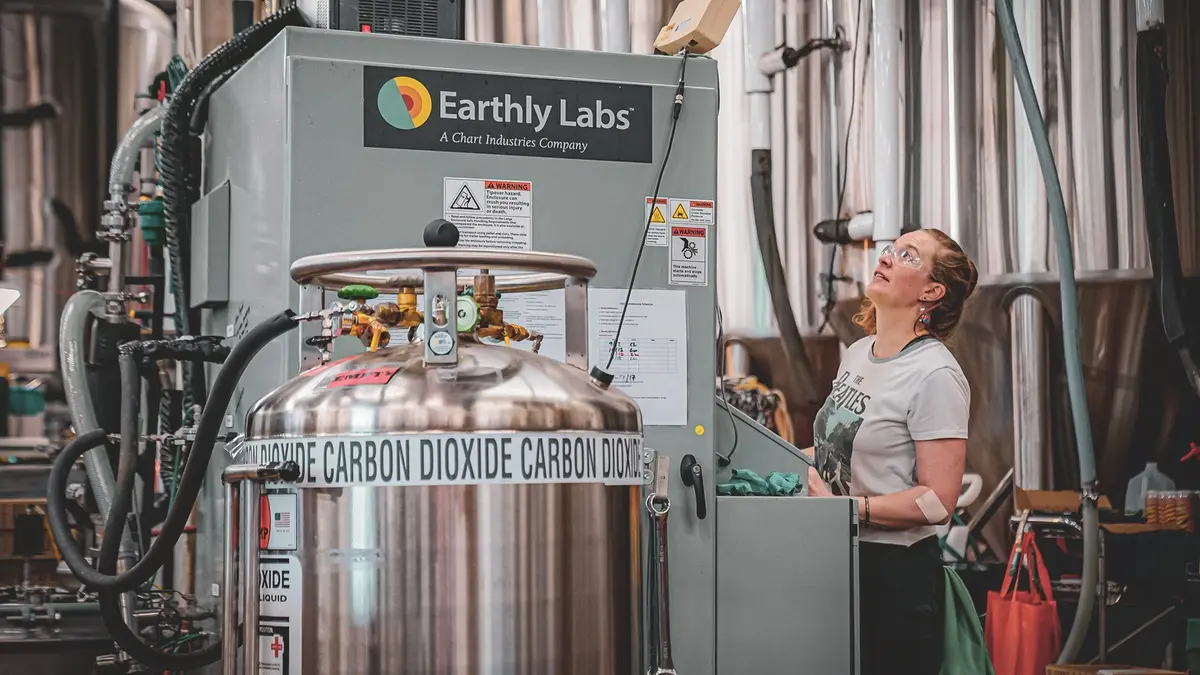
In 2021, Maine Beer Company's supplier ran short of carbon dioxide, the gas the brewery needs for carbonation and for moving beer between tanks. The fix the company settled on came from hardware designed to keep people alive on Mars, and the same equipment is now working in wineries, distilleries, power plants and helium production.
Where the technology came from
The line starts in the 1990s, when a company called Pioneer Astronautics won a series of Small Business Innovation Research contracts from NASA's Johnson Space Center in Houston. The brief was to build systems that could generate resources on Mars: capturing carbon dioxide from the Martian atmosphere and combining it with hydrogen to produce water for life support and methane for rocket fuel. Those capabilities were not new in principle, but Pioneer's hardware was compact, efficient and automated, which is what made it portable into industry.
Pioneer Astronautics founder Robert Zubrin later set up Pioneer Energy to rearrange those subsystems for the oil and gas business, and he spotted a second use for the carbon-dioxide side of the work: a brewery capturing the CO2 given off by fermentation and putting it back into its own beer. By 2015 the Craft Brewery Recovery System was in production, and the company put it up for licensing.
Who runs it now
Amy George founded Earthly Labs of Austin, Texas, in 2016 to build small-scale carbon capture, took an exclusive licence to the brewery system, and started selling it. Carbon-dioxide shortages and price swings since the pandemic have done the marketing for her. From breweries the technology spread to wineries and distilleries, then to energy companies that generate carbon dioxide as a by-product and can sell it once it is captured, and to helium production, where helium used in microchips and fibre-optic cables has to be separated from the methane and carbon dioxide it sits with underground.
Chart Industries, a cryogenic equipment engineering firm, acquired Earthly Labs in 2021 and has since scaled the equipment for larger applications, power plants among them.
Dave Love, the brewery's sustainability manager, described what was at stake at Maine Beer Company. “There was potential for our beer to go stale in the tanks,” he said. “We wouldn't be able to use CO2 for any of our bottling, kegging, or centrifuge operations.”
Why you should care
Carbon capture is usually discussed as a megaproject: pipelines, saline aquifers and public money. This is the same chemistry at the scale of a building, sold to businesses that need the gas for their own production and will pay for a machine that keeps them supplied. Food and drink manufacturers sit at the easy end of that market because their CO2 stream is concentrated and food-grade already. The helium link matters more than it looks: helium is critical to semiconductor and fibre-optic manufacturing, it is scarce, and anything that improves recovery from mixed underground gas is a supply-chain story dressed as equipment.
Our opinion
NASA is fond of the spinoff headline, and it is easy to be cynical about a space agency taking credit for a brewery's gas bill. The Zubrin detail is what makes this one worth reading: the hardware was built to work on Mars precisely because the mission could not afford waste, mass or babysitting. Those constraints are almost identical to the ones a small brewery faces, which is why the technology jumped markets instead of dying in a lab report. The honest caveat is that capturing CO2 from a fermentation tank is the simplest version of the problem, and nothing here proves the same kit scales to a cement kiln. But distributed capture has one advantage that the megaprojects keep struggling to answer: somebody on site wants the gas, today, and will sign the cheque themselves.