Lab testing magnet-powered brakes for high-speed spacecraft re-entry
Tokyo Metropolitan University researchers have built a stronger test platform for magnetohydrodynamic aerobraking, reaching magnetic fields above 1.5 tesla in hypersonic experiments.
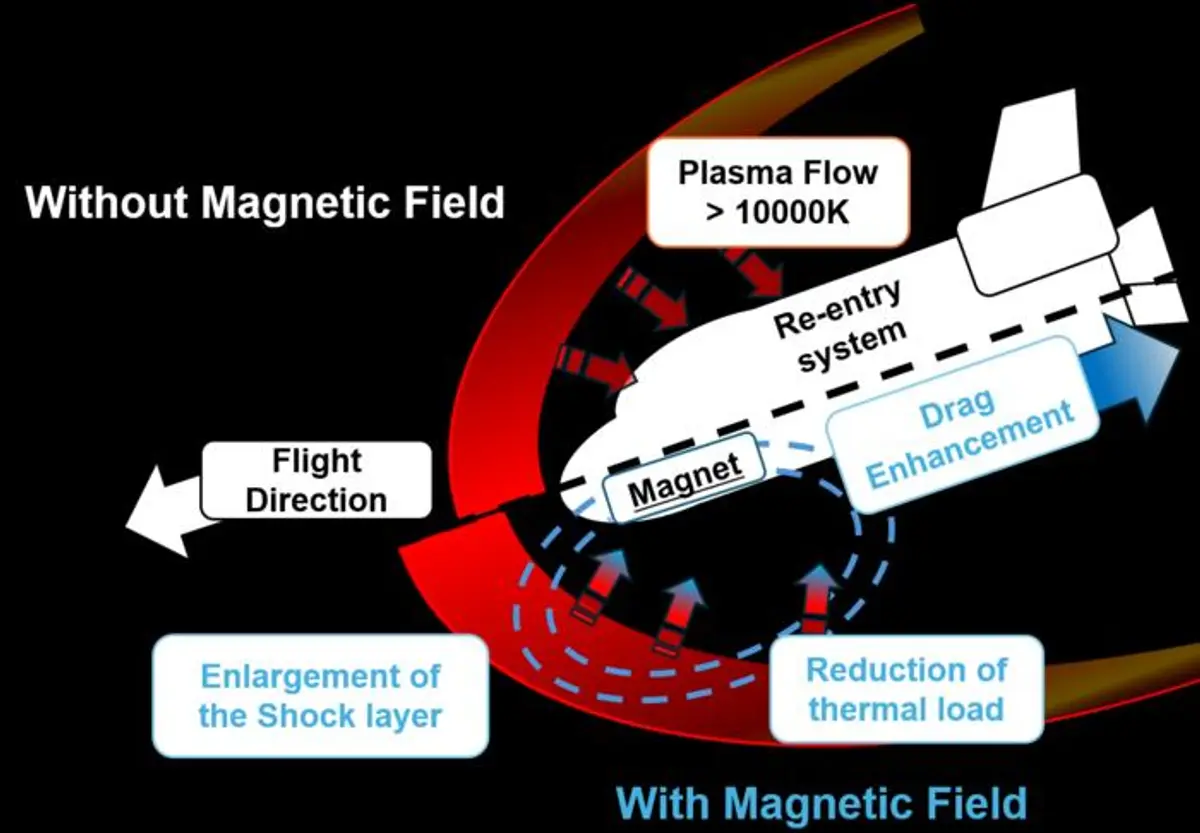
Spacecraft re-entry is one of engineering’s least forgiving moments: a vehicle slams into the atmosphere at hypersonic speed, producing a shock layer hot enough to push conventional heat shields to their limits. Researchers at Tokyo Metropolitan University have now built a stronger test platform for a proposed alternative — using magnets to move that plasma away from the spacecraft and help slow it down.
What’s actually going on: the team has created a magnetohydrodynamic, or MHD, aerobraking test system. A miniature model is placed inside a hypersonic expansion tube, where it is struck by a shockwave travelling at more than seven kilometres per second for tens of microseconds. An electromagnet inside the model is powered by a pulse-forming network, producing a strong magnetic field for a precisely timed burst.
The researchers tested two model shapes with customised coil arrangements. They measured magnetic fields of 1.24 and 1.58 tesla, with the stronger result more than twice the field strength of conventional neodymium magnets. A high-speed camera recorded the light emitted by the heated shock layer, and the team observed that the self-emission layer was more than 15% thicker when the magnetic field was switched on.
The work was published in the peer-reviewed Journal of Spacecraft and Rockets under the title “Quasi-Steady Magnetic Field Generated by Pulse Forming Network for Magnetohydrodynamic Aerobraking”. The paper’s publication date is 23 July 2026, and its DOI is 10.2514/1.A36635.
Why you should care: today’s re-entry systems rely on heat-resistant tiles and sacrificial materials to absorb or shed energy. Those approaches work, but they add mass, wear out during use and make reusable spacecraft more expensive and time-consuming to maintain. MHD aerobraking aims to use electromagnetism to reshape the superheated plasma around a vehicle, potentially reducing heat transfer while increasing aerodynamic drag.
The important word is “potentially”. This experiment did not demonstrate a complete spacecraft re-entry system, nor did it show a real vehicle safely returning through an atmosphere. It established a more flexible way to vary magnetic-field strength and coil geometry in a ground-based test, and it observed a change in the shock-layer emission. Planned experiments with real re-entry vehicles remain a future step.
Our opinion
Magnetic braking sounds like science fiction, but this is the sort of careful laboratory work that could make it less fictional. The 1.58-tesla field is the headline result, while the better news is the adjustable electromagnet platform itself. Re-entry is still brutally difficult, and no one should mistake a microsecond-scale test for a ready-made heat shield. But if reusable spacecraft are going to become routine, clever ways to reduce heat, mass and maintenance deserve serious attention.