Boston Dynamics starts training Atlas in a Hyundai plant
Boston Dynamics has opened a robotics training centre inside Hyundai's Metaplant America, where Atlas humanoids are being taught to sequence parts for assembly.
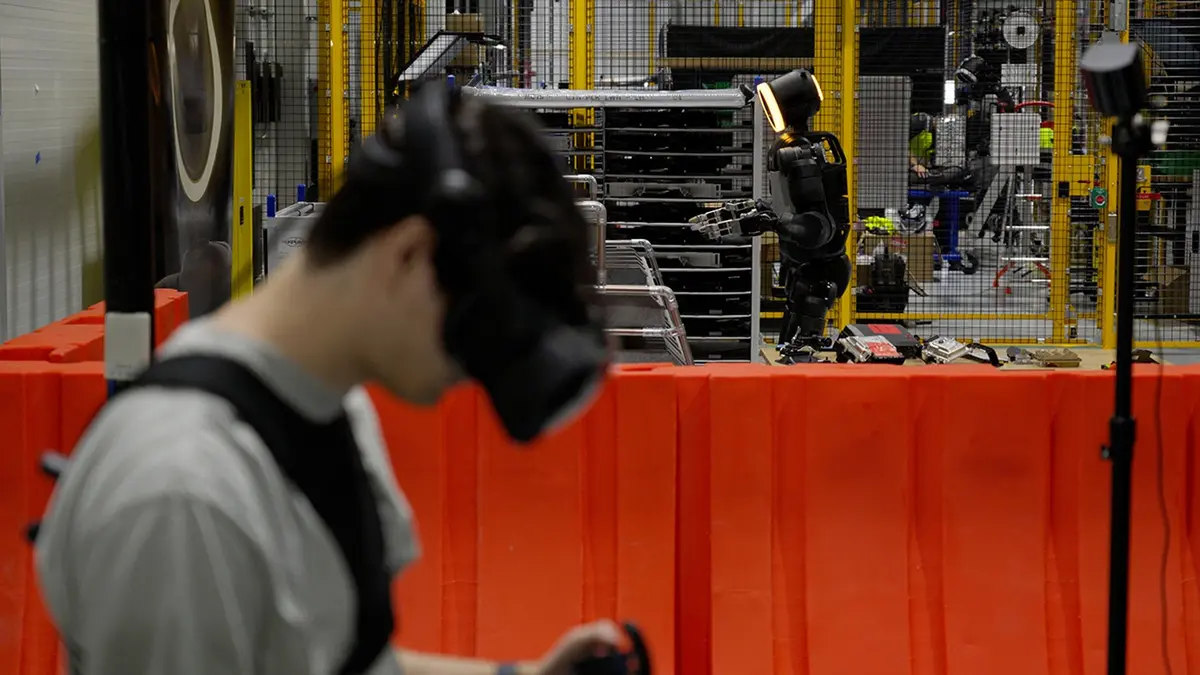
Atlas clocks on at a Georgia car plant
Boston Dynamics announced on 21 September that it has opened a Robotics Metaplant Application Center (RMAC) inside Hyundai Motor Group Metaplant America, the carmaker's campus outside Savannah, Georgia. The first phase of the centre is already running, and the company's electric humanoid, Atlas, is in training there rather than on a demonstration stage.
RMAC is described as a testbed and a training centre: a place to put Atlas directly into the Group's manufacturing operations and find out what it can actually do. The first jobs are logistics, preparing and sequencing automotive parts so they arrive at the assembly line in the right order. Boston Dynamics expects component assembly to follow by 2030, and says that over time Atlas will take on work involving repetitive motion and heavy lifting. The robot's public career to this point has been built on set-piece videos; this is the unglamorous version, in which the interesting question is not whether a humanoid can lift a crate but whether it can be relied on to do it every shift.
25,000 robots, and a factory to build them
The deployment plan is larger than the pilot suggests. Hyundai Motor Group intends to spread Atlas across its global network, beginning with 25,000 units at Hyundai and Kia plants over the next few years, and to establish a new United States production facility capable of producing 30,000 robots a year. Those are the companies' own targets rather than anything independently verified, but they are the clearest numbers yet attached to a humanoid programme at a mass-market carmaker.
The centre is about to grow tenfold
"Together with Hyundai Motor Group, we are pioneering physical AI at enterprise scale," said Zack Jackowski, Boston Dynamics' chief product and technology officer. "We have established a clear strategy to optimize our supply chain, production, testing, and deployment capabilities for Atlas."
Expansion is already planned. Next year operations move into a new building at the same site that will make RMAC roughly ten times its current size, and Boston Dynamics says it will begin exploring uses in other industries as well. The company is talking to existing customers of its Spot quadruped and Stretch box-mover in manufacturing, aerospace, semiconductors, logistics, food and beverage, and life sciences about scaling up data collection so that Atlas training can continue through 2027 - a reminder that the humanoid is being taught on the back of a business built on less ambitious machines.
What the announcement does not settle
Boston Dynamics gave no production volume for Atlas itself, no cost per robot and no reliability figures, and the CES unveiling it points back to was a stage presentation rather than a shift report. A car plant is the hardest possible showcase - cycle times, tolerances and safety rules are unforgiving - which is exactly why the industry has converged on it, and exactly why the first serious numbers will matter more than the first serious video.
Our opinion
The telling detail here is the task list. Nobody is promising that Atlas will build a car; the promise is that it will carry and sequence the parts, which is the same work that has defeated every previous generation of factory automation precisely because it is fiddly, variable and thankless. Teaching a humanoid to do the least celebrated job in the building is a more honest indicator of progress than another parkour clip, and it is also the more revealing test: a robot that can hand the right bracket to the right line at the right second is doing something genuinely useful, while one that can only perform for a camera is expensive theatre. The 25,000-unit figure deserves scepticism until a plant manager, not a press release, is counting them - but the direction of travel is no longer in doubt. The interesting question has moved from whether humanoids can work in factories to who ends up responsible when one of them drops something.