Quadruped robots earn where they work, not where they play
IDC's first-half figures show quadruped robots shipping in volume to schools and homes while industry buyers take more than two-thirds of the money.
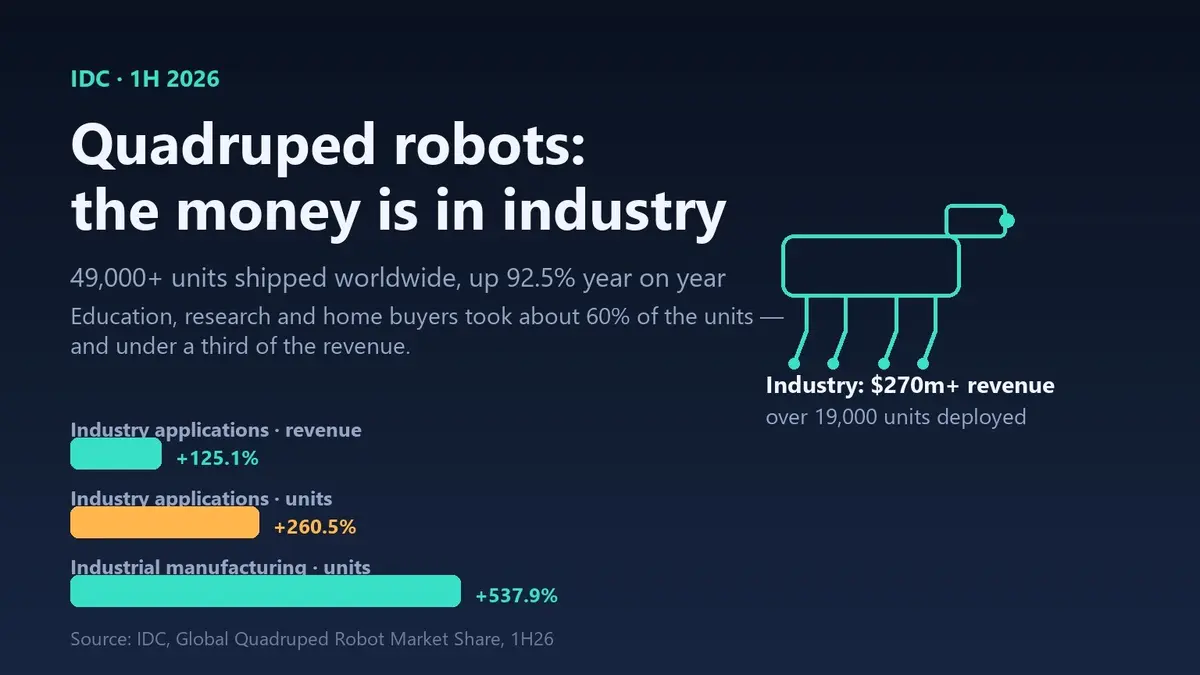
At a glance
IDC published its first-half 2026 quadruped robot figures on 21 September. More than 49,000 machines shipped worldwide, up 92.5% year on year, in a market worth more than $400m, up 95.4%. Education, research and home buyers accounted for roughly 60% of those units but under a third of the revenue, while government, manufacturing and utility customers took over two-thirds of the money from fewer than 40% of the units.
Industry buys the expensive machines
Industry applications were worth more than $270m in the first half, up 125.1% year on year, on more than 19,000 deployed units — a 260.5% increase. Industrial manufacturing moved fastest: about $76.75m, up 194.2%, across more than 4,100 units, up 537.9%.
The gap between units and money follows the work rather than the hardware. A quadruped patrolling a substation is sold with integration, service and spares attached; a quadruped in a classroom has to stay cheap. Divide IDC's own figures and the industry average works out at roughly $14,200 a deployed machine against about $8,200 across the market as a whole. For scale, IDC puts the whole of 2025 above $490m on about 58,000 units, both more than double 2024.
Who is selling them
Chinese suppliers hold the widest position. Unitree, DEEP Robotics, AGIBOT and Micbot lead across consumer, research and industry work, leaning on supply chain, cost and manufacturing scale. DEEP Robotics tops IDC's industry-application table on power-grid and industrial inspection plus emergency response, and Micbot targets high-risk industrial sites with wheeled-legged machines and explosion-proof models sold alongside its industrial embodied-AI platform. ANYbotics and Boston Dynamics stay in specialist sectors such as government, oil and gas, and hazardous operations.
From patrol duty to real work
IDC expects the machines to be pushed from inspection towards doing the job. Fused multi-modal sensing, AI models and arms are moving them into maintenance, handling and emergency response; real-world data and model training are becoming the differentiator rather than gait quality; and the consumer tier is expected to compete on cost and interaction instead of capability. China's vendors are expected to keep expanding into Europe, Asia-Pacific and the Middle East and Africa, which shifts the contest towards localisation, delivery and service.
Our opinion
The 92.5% headline is the least interesting number in IDC's release. Industry applications grew 260.5% in unit terms from a base of about 19,000 deployed machines, which says the serious revenue still comes from dozens of framework contracts rather than thousands of orders — a single utility rollout can move a vendor's position more than any consumer price cut. That is also why the brutal price war in robot dogs barely registers in the revenue table, and why the winners over the next two years will be the vendors that can put engineers in countries where they have no factory. Field service is harder to copy than a gait controller.