SES breaks ground on Luxembourg satellite factory
SES has begun work on a 16,000 m2 satellite manufacturing facility in Kockelscheuer, Luxembourg, a site due to open in 2028 that will build payloads for its meoSphere network and Europe's IRIS2 programme.
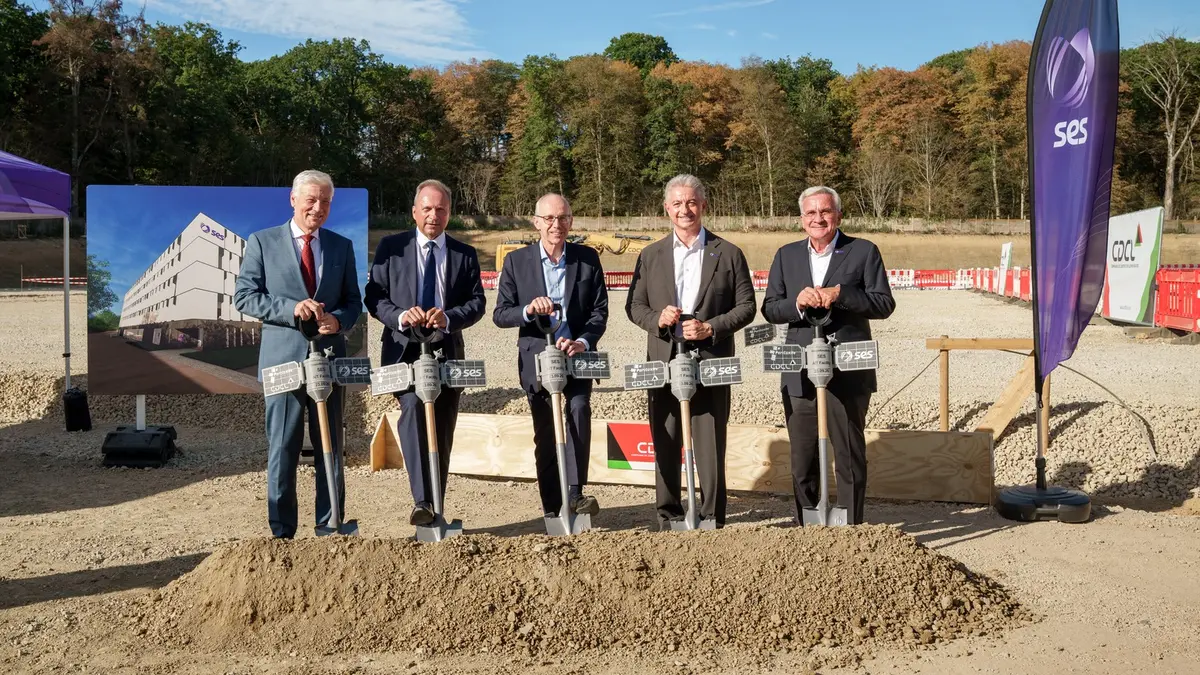
SES, the Luxembourg-based satellite operator, has started building a satellite manufacturing plant in Kockelscheuer, in the south of the country. The 16,000 square metre facility is being raised on land earmarked for a national Space Campus, and it marks a shift for a company that has spent its history buying finished spacecraft: from here on, it intends to design, build and test much more of them itself.
What the factory is for
According to SES, the site will hold engineering, manufacturing and testing halls along with office space and supporting infrastructure, and the company expects it to open in 2028. The plant is meant to support meoSphere, SES's next-generation medium Earth orbit network, and to contribute to Europe's IRIS2 programme through payload development and satellite assembly, integration and testing. Capital spending on the project sits inside the guidance SES has already given investors.
“This state-of-the-art facility is a landmark moment for SES and for Luxembourg’s space sector,” said Adel Al-Saleh, chief executive of SES. “Our ambition is to create a world-class centre for advanced space systems development, manufacturing and engineering excellence that enables faster development cycles, greater innovation and more efficient delivery of next-generation multi-orbit solutions to our customers.” He said the project builds on the pilot line and research and development site SES already runs.
A national project, not just a company one
The plant is part of Luxembourg's effort to create and scale a dedicated Space Campus, which the government wants to use to attract New Space companies and industrial collaboration. SES is developing the site with two project partners, CDCL Group and POURDERIE de LUXEMBOURG, working under the name ParcLuxite. The Grand Duchy's prime minister, Luc Frieden, framed the investment as a matter of industrial sovereignty: “SES’ new manufacturing facility is not just an investment in the future, but a bold affirmation of Luxembourg’s leadership in the rapidly evolving space sector,” he said. “Together with our upcoming Space Campus, this site will serve as a catalyst for innovation, developing industrial capabilities that strengthen Luxembourg’s and Europe’s strategic autonomy, hand in hand with trusted partners.”
SES traces its origins to Luxembourg's state satellite programme and today sits in the middle of European space policy: it operates multi-orbit fleets across geostationary and medium Earth orbit, and it is one of the industrial names attached to IRIS2, the European Union's planned secure communications constellation.
Our opinion
An operator buying itself a factory is a stranger move than it sounds, because SES got good at buying. The pitch here is speed: shorter development loops, less time queuing for somebody else's production line, more control over the smaller pieces that decide whether a constellation flies on schedule. Give the company that it already runs a pilot line and 2028 is a long enough runway to absorb a slip or two.
The fixed cost is the catch. A plant has to be fed, and the addressable market for European satellite manufacturing is short, with governments already the largest buyers. If IRIS2 payload work is the anchor tenant, then part of the business case lives in a budget line that European capitals have already spent two years arguing about.
The better argument for Kockelscheuer is not financial. Europe has spent the decade learning what it costs to depend on other people for launch, for chips and for constellation capacity, and Luxembourg has decided the answer is to own more of the chain. That is a defensible bet, and it will be judged by the first satellite that rolls out of the building rather than by the shovels in the photographs.