Samsung and SK Telecom build Korea's first 5G smart office
Sixteen floors of Hana Financial Group's new Incheon headquarters run on private 5G, because the banking industry's security rules had already ruled out Wi-Fi.
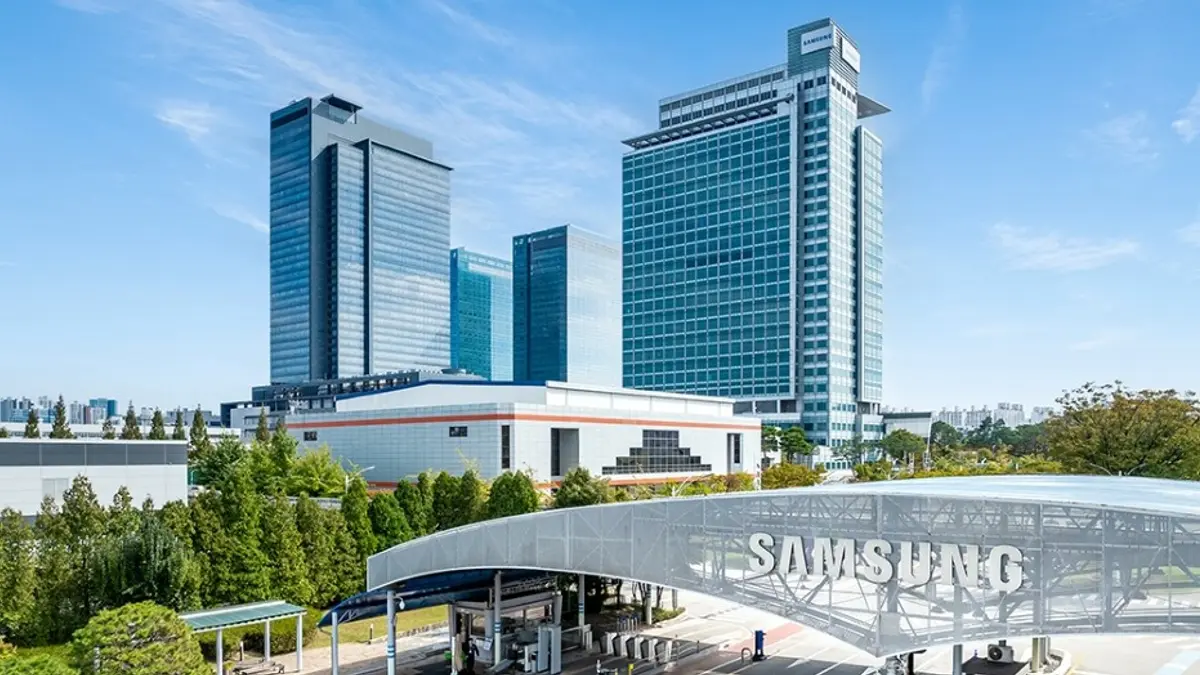
Hana Financial Group's new headquarters in Incheon is running on private 5G, in what Samsung Electronics describes as the first deployment of its kind in the Korean financial sector. Samsung supplied the network as sole vendor, working with SK Telecom, and the result covers 16 floors of the building, several group affiliates and thousands of employees.
Staff work from 5G-connected laptops, tablets and phones rather than fixed desks, which the companies say makes better use of office space, cuts the time needed to reconfigure a floor, and lays the groundwork for running AI across day-to-day operations.
Why a bank picked 5G over Wi-Fi
Financial institutions hold customer credit and banking data and work under strict network-separation rules, which had left Wi-Fi largely off the table on security and cyber-risk grounds. The Incheon deployment answers that with a multi-layered security stack: enhanced encryption, a firewall, distributed denial-of-service protection and USIM-based authentication that only admits authorised devices and registered users. Samsung's pitch is that a private 5G network gives a bank the isolation of a wired network with the flexibility of wireless access.
On the technical side Samsung supplied the full stack — radios, baseband and a cloud-native core — running in the 4.7GHz mid-band spectrum that Korea reserves for private 5G. Its 5G Standalone Core adds network slicing, dividing one physical network into separate virtual slices. Each of Hana Financial Group's subsidiaries gets its own slice with an independent operating environment, so individual security policies and business requirements stay apart.
What the two vendors say
“For AI and data to be used widely in day-to-day work, employees need a network that gives them secure, reliable access to internal systems and data from anywhere,” said Kim Goo-Young, head of SK Telecom's Enterprise Business Office. “Built on Samsung's core and radio solutions, that secure foundation is now in place.”
Angelo Jeongho Park, executive vice president and head of strategic sales in Samsung Electronics' Networks Business, called the project a milestone that shows private 5G standing up to the security standards that regulated industries demand, and pointed to the company's commercial experience in manufacturing, finance, construction and IT.
Our opinion
Banks have spent a decade telling anyone who would listen that wireless is a risk they cannot take, so seeing a financial group wire 16 floors to a 5G core is a real change of posture rather than a press-release flourish. The detail that matters is the network slicing. One dedicated slice per subsidiary is the part that makes this look like an operating model instead of a fit-out, because it lets each business carry its own security policy on shared infrastructure.
It is also worth being precise about what has been proven. This is one headquarters, with a vendor supplying the whole stack and a carrier running it, and private 5G only becomes a genuine alternative to office Wi-Fi when a bank can change networking suppliers without rebuilding its security model. Korea's reserved mid-band spectrum made this deployment straightforward in a way that most markets will not match.