Samsung puts AI RAN to work in Korea's shipyards
Samsung Electronics is the only vendor picked for both of Korea's Hyper AI Network projects, putting 5G standalone private networks into a shipyard and a petrochemical complex from October.
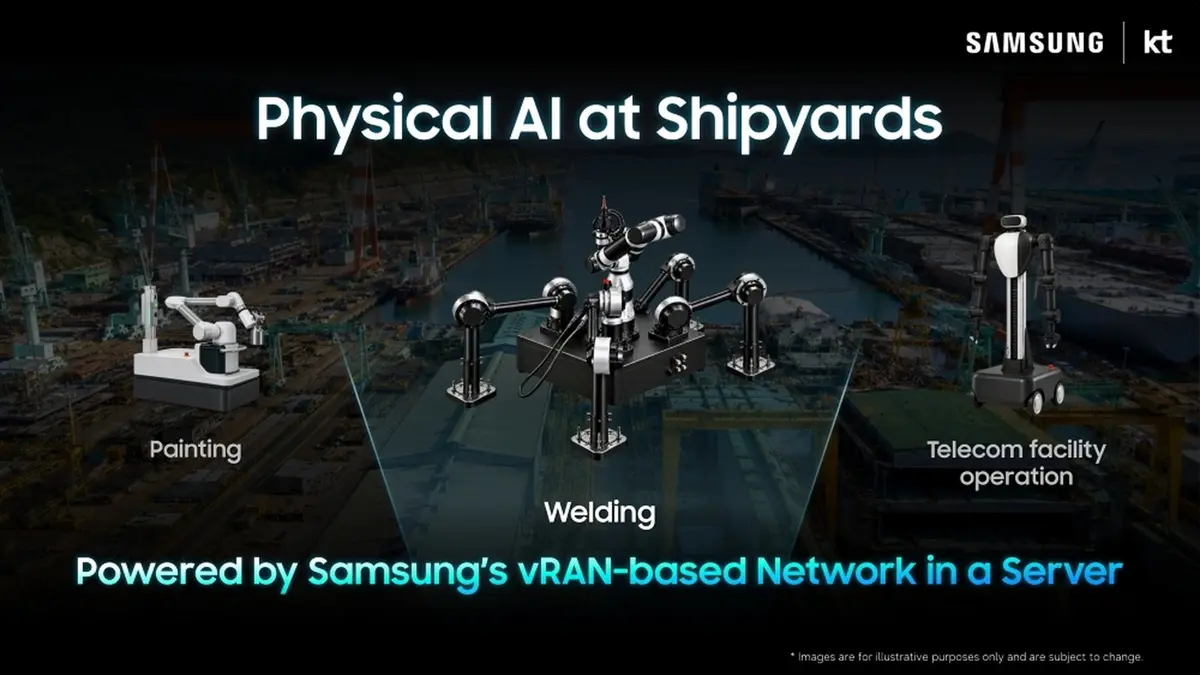
Samsung Electronics has signed contracts with KT and SK Telecom for their AI RAN projects under the Korean Ministry of Science and ICT's "Hyper AI Network" initiative, the company said on 23 September 2026. It is taking the role of sole global vendor on the KT project and main vendor on SK Telecom's, making it the only partner selected for both.
The work starts in October and is deliberately industrial. Rather than lab tests, the operators will run 5G standalone private networks in shipyards, petrochemical facilities and other heavy sites, using them to prove out AI RAN and the robotics and automation services that depend on it.
A welding robot on a private 5G network
At HD Hyundai Samho's Yeongam shipyard, KT will trial a set of physical AI services, from welding and painting robots to autonomous machines that handle telecom facilities. For the quadruped welding robot, Samsung is supplying its software-driven Network in a Server platform, an edge stack that bundles virtualised RAN, an AI core and AI applications in one box, together with its CognitiV network operations suite.
Samsung says the package runs on a Supermicro compact edge server powered by an AMD EPYC 8004 processor with Wind River's cloud platform, and is built for on-premise deployment so that network and AI capacity sit near the machines being controlled. That is the pitch for factory floor AI in general: ultra-low latency, consistent throughput and a local processing path, rather than a round trip to a distant data centre.
Patrols on a petrochemical site
SK Telecom's half of the work is at SK Incheon Petrochem, where the companies will test an autonomous robot patrolling hazardous areas while streaming high-definition video for AI analysis, alongside camera-based monitoring. Samsung is providing the same Network in a Server platform for that project.
What the partners say
"As AI evolves toward embodied intelligence, networks are becoming platforms that connect a new generation of intelligent machines, including humanoids and autonomous vehicles," said June Moon, executive vice president and head of research and development in Samsung's networks business.
Jongsik Lee, an executive vice president at KT, described the project as a starting point for validating a next-generation communications model where AI and networks converge, while SK Telecom's Takki Yu said AI creates more value when it is paired with the right foundation. Contract values, site scale and the number of machines involved have not been disclosed, and the ministry initiative runs across several operators and vendors, so Samsung's win is a piece of a larger programme.
Our opinion
The interesting word in Samsung's release is "validate". These are trials in working shipyards and chemical plants, not a commercial rollout, and that is the right way to read the announcement: Korea is buying evidence, and Samsung is buying the right to be the vendor in the room when the evidence is written up. Shipyards are also a smarter test bed than a smart factory demo, because welding steel hulls is dirty, high-stakes work with an ageing workforce in exactly the economies pushing hardest on industrial AI. If a quadruped welder on a private 5G slice survives a Korean winter, that result travels further than any lab benchmark.