Sakana AI hires Jürgen Schmidhuber to advise its RSI lab
The Tokyo lab has brought in the researcher it calls the father of modern AI to help steer a new lab aimed at recursive self-improvement.
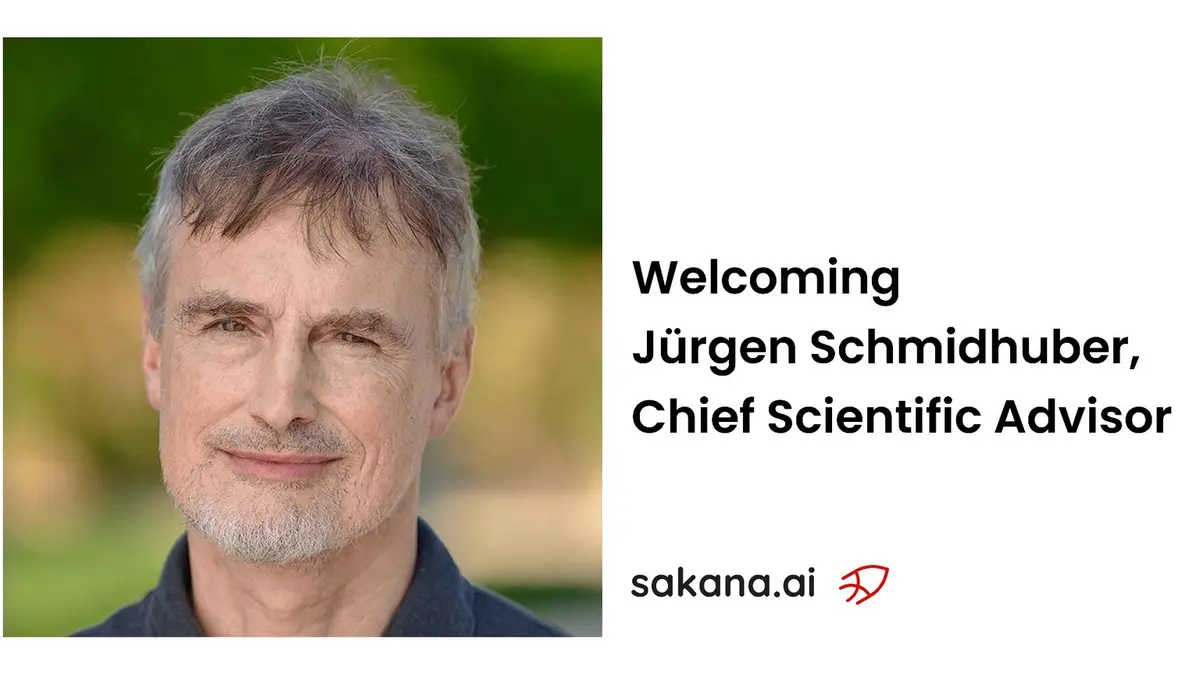
Sakana AI has a new name on its masthead. The Tokyo lab announced on 24 September that Jürgen Schmidhuber is joining as Chief Scientific Advisor, a role he will hold alongside his current positions, and that he will help guide its Recursive Self-Improvement Lab. He is not moving to Japan, but the company says he will travel to Tokyo regularly to work with its researchers and support the wider Japanese AI ecosystem.
What is actually going on
The appointment is aimed at a specific argument rather than general credibility. Sakana says the next era of artificial intelligence moves beyond digital interfaces into the physical world, and that the route there runs through world models: systems that internalise how objects and logistics behave so an agent can simulate the consequences of an action before taking it. It calls what it is building agent-native world models, and the stated industrial target is unglamorous and concrete, namely planning for manufacturing and supply chains without paying for every mistake in the real world.
Sakana credits Schmidhuber with foundational work on world models, meta-learning and the Gödel machine, along with the 1991 deep learning techniques that much of today's machine learning builds on, and it traces his 1987 thesis on recursive self-improvement and meta-learning straight to its own Darwin Gödel Machine and AI Scientist projects. He is also the company's chosen historian for the moment: the announcement spends real space on Kunihiko Fukushima's 1979 Neocognitron and Shun-Ichi Amari's work on self-organising recurrent networks, arguing that Japan did not simply join the AI revolution but started it.
The RSI Lab he will help steer has been public since March, and its stated objective is a compounding loop in which discoveries feed discoveries aimed at improving machine intelligence. That is the most ambitious claim in the whole announcement and the one with the least attached to it so far, beyond two research projects and an open invitation to apply for jobs in Tokyo.
The quote worth keeping
Schmidhuber's own line is the clearest statement of why a company known for evolutionary model merging is talking about robots. He says Japan is a birthplace of foundational neural network architectures and advanced robotics, that it is a privilege to join a lab bridging those two worlds, and that the future of intelligence is not just language but physical AI powered by world models.
Our opinion
Advisory appointments are the cheapest announcement in AI and this one should be read as a statement of direction rather than a change of output: Schmidhuber keeps his existing posts, travels in rather than relocates, and the lab he advises has published more manifesto than result. What makes it interesting anyway is the pairing. Sakana has spent three years arguing that frontier capability does not require an American-scale data centre, and Schmidhuber has spent thirty years arguing that the field forgot his version of the answer came first, so both parties benefit from the story being told together. Treat the father-of-modern-AI billing as the company's framing rather than a fact settled by history, and treat recursive self-improvement as a research programme with a long record of confident projections and short record of demonstrations. If the physical-world models do reach a factory floor, this will look like the day Tokyo bought a credible bridge back into robotics. Until then it is a hiring announcement with unusually good company history attached.