Microsoft Research's Quine models biology before the lab
Microsoft says Quine pairs a world model of biology with a harness for reasoning models, scientific tools and the wet lab, and it has already ranked compounds in pancreatic cancer research.
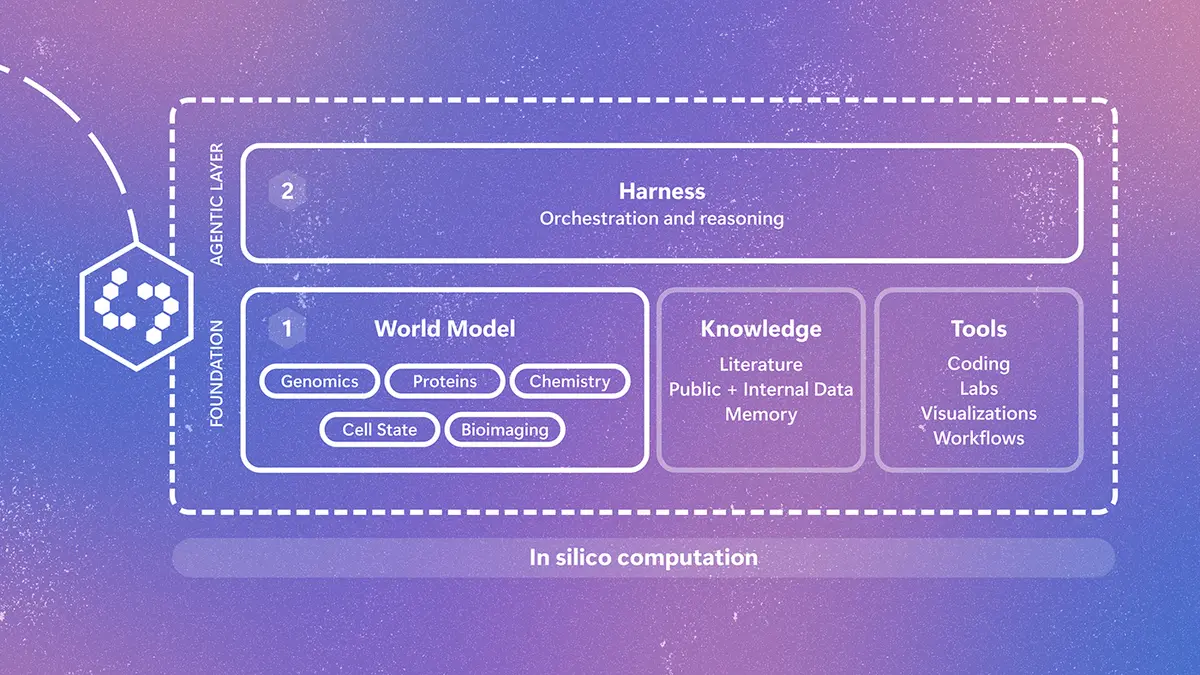
Microsoft Research introduced Quine on 29 September 2026, a research system built around a world model of biology rather than a single narrow prediction task. The company describes it as two halves: a model that learns shared representations across biological data, and a harness that connects that model to reasoning models, scientific tools, the literature, the wet lab and the researchers using it.
The world model trains jointly across sequence, structure, function, cellular state and imaging data, so evidence from one modality can inform predictions in another. Microsoft's ambition is a system that can represent the state of a biological system, predict how that state responds to an intervention and reason several steps ahead — not as a replacement for experiments, but as a way of choosing better ones.
Pancreatic cancer is the first test case
The worked example is pancreatic ductal adenocarcinoma, the most common form of pancreatic cancer and one of the hardest to treat. Working with researchers at the Broad Institute of MIT and Harvard, Microsoft used Quine to predict and rank thousands of compounds by their potential to shift tumour cells between therapeutically relevant states, exploring whether non-genetic features of cancer — cellular state in particular — can act as therapeutic targets.
Wet-lab assays focused on the classical-to-basal transition validated several of the top-ranked candidates. The reverse transition proved harder, and Quine had predicted the available compounds would have a weaker effect there. The unexpected result was a third cellular phenotype: Quine predicted several compounds would consistently push cells towards it, and the lab work bore that out.
Access is limited, and the caveats are explicit
Quine is experimental research technology. Microsoft states plainly that it is intended for research only and not for clinical or medical use, that outputs may be incomplete or inaccurate and need review by qualified researchers plus proper experimental validation, and that initial access is limited to the Quine Fellows programme and selected research collaborations. The company says it expects to widen access later through products such as Microsoft Discovery, and that an internal review process and built-in safeguards are part of the phased rollout.
Our opinion
The most interesting thing about Quine is what Microsoft does not claim for it. There is no enormous benchmark table and no suggestion that the wet lab is optional; the system is presented as a hypothesis-ranking tool that got a third cellular phenotype right when the researchers had not fully expected it. That is a modest claim, and it is the right one. Where this becomes genuinely valuable is iteration: the loop is designed so that each round of experiments sharpens the model, and Microsoft's own admission that the world model will never perfectly model biology is more reassuring than a promise that it will. The gating matters too. Restricted access through a fellows programme keeps the technology inside institutions equipped to interpret it, and stating the clinical limitations up front is the responsible default for anything aimed at cancer. The real test is not the first validated compound screen; it is whether the system stays useful when the evidence is thin and the question has never been asked before.