Ear-clip earbuds are carrying the open-ear boom
IDC's second-quarter wearable data shows open-ear shipments up 35% while the fight inside the category breaks along clip, hook and neckband lines.
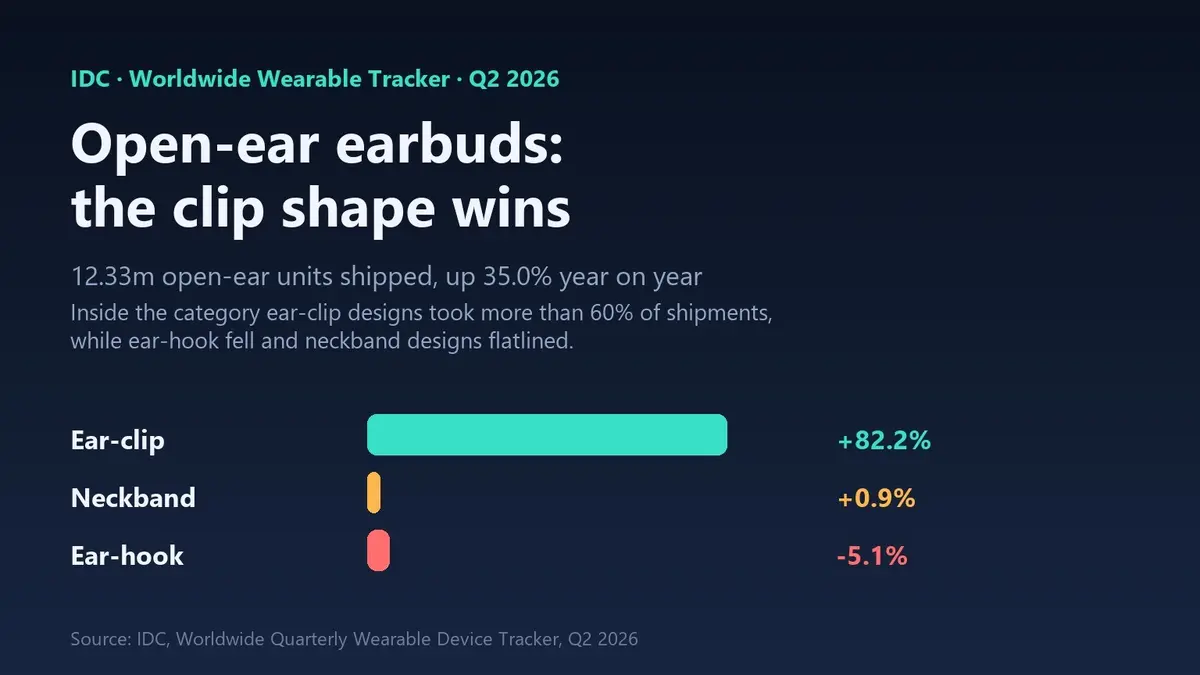
At a glance
IDC's quarterly wearable tracker puts global ear-worn shipments at 96.13m units in the second quarter of 2026, up 5.4% year on year. Open-ear designs, which sit outside the ear canal, shipped 12.33m units, up 35.0%. Inside that category the shapes have pulled apart: ear-clip devices grew 82.2%, ear-hook designs fell 5.1% and neckband models managed 0.9%. China remains the largest single market, taking more than 60% of global open-ear shipments.
The clip shape took the category
Ear-clip models now account for more than 60% of open-ear shipments, and the reasons are more about wearing than listening. A clip sits around the ear rather than inside it, which suits the growing number of buyers who wear glasses all day, and the light shell makes long sessions comfortable in a way that in-ear buds are not. IDC also credits the fashion angle: colours, finishes and accessories that turn a headphone into something closer to jewellery, which is what allows phone brands to charge a premium for a clip while budget audio brands iterate cases and spec sheets further down the range.
Hooks are squeezed at the bottom
Ear-hook designs were the open-ear category's early volume sellers, and they are now the ones being cleared out. Shipments fell 5.1% and the sub-$25 tier is shrinking as buyers who tried cheap hooks move up or away. The shape is not finished, though: the larger shell leaves room for bigger batteries, better sport stability, noise processing and, increasingly, an AI chip that a clip cannot easily carry.
Neckbands are not done yet
Neckband models grew just 0.9% and relatively few brands still build them, largely because they are the least convenient shape for everyday use. Their niche is stubborn for exactly that reason: a band stays put when a clip or hook would not, and pair it with bone-conduction drivers and onboard storage and you have a headphone that works in a pool with no phone nearby.
The next fight is the assistant, not the driver
IDC separates two routes to AI in open-ear hardware. Mass-market brands lean on cloud models for face-to-face translation and basic office features, which keeps costs down and has already produced near-identical feature lists across the category. Phone-ecosystem brands and established audio makers are instead pairing on-device neural processing with the cloud for low-latency call translation, which needs better microphone arrays, noise handling and system integration. IDC's own verdict is blunt: most of today's AI features are still marketing points, and the vendor that turns them into something dependable will separate from the field.
Our opinion
Open-ear audio has spent three years being sold on a single idea — hear your music and the traffic — and the shape split is what happens when that idea stops differentiating anything. An 82.2% jump for clips is not really an acoustic story: it is fit, fashion and a lower engineering bar, which is precisely why phone brands can enter a category they never designed a driver for. That is also the trap. Once any accessory maker can mould a clip, the only ground left to hold is the one IDC is pointing at, an assistant that translates a call reliably instead of a spec sheet that advertises one. Expect plenty of the second and very little proof of the first.