NVIDIA's Isaac ROS 5.0 hands your robot a helper agent
NVIDIA's robot toolkit now lets AI agents take on the tedious parts of development, and tracks object poses up to 5.5 times faster.
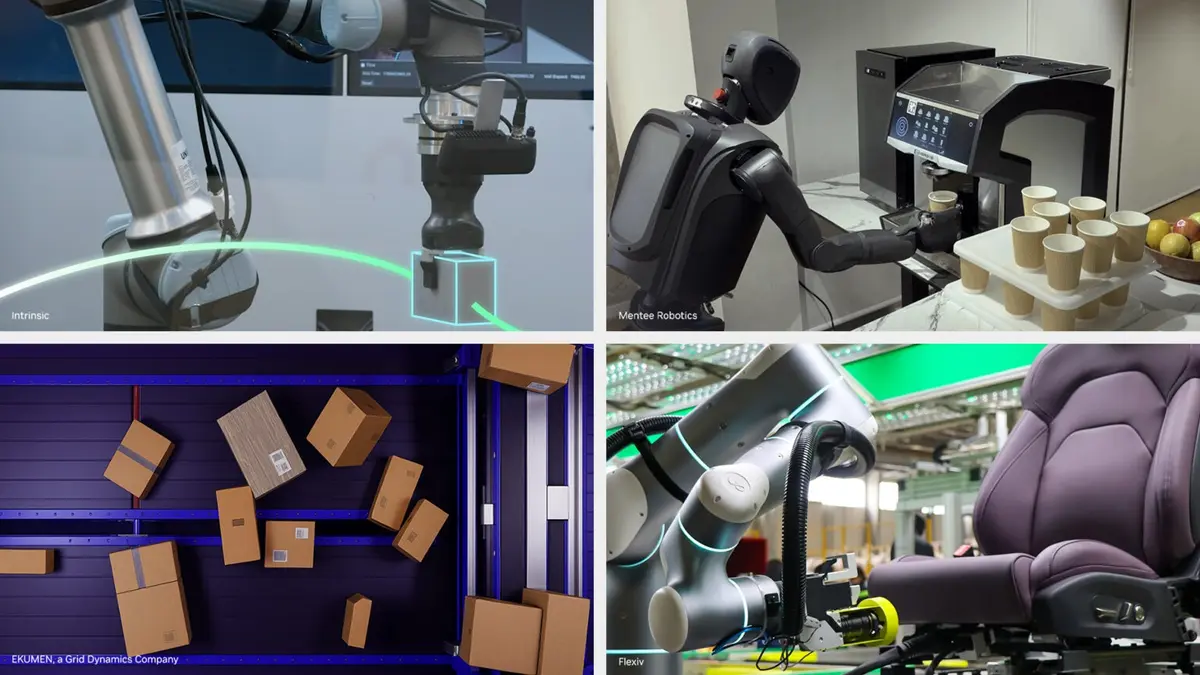
Robot building has a new assistant. NVIDIA released Isaac ROS 5.0 on 22 September at ROSCon in Toronto, and the headline change is that AI agents can now share the work of getting a machine to see, plan and move. The update adds agent-ready skills, support for ROS Lyrical on Ubuntu 24.04, and an inference library for tracking the position and orientation of objects that NVIDIA measures at up to 5.5 times the previous speed.
What Isaac ROS is, and what version 5.0 adds
Isaac ROS is a collection of GPU-accelerated packages built on ROS, the open source framework that a great deal of modern robotics is assembled from: navigation, perception, manipulation and the plumbing between them. NVIDIA puts the ROS population at about 1.3 million users. The pitch for 5.0 is that agents can now take a run at the parts developers least enjoy, which is environment setup, package wiring and the documentation reading that comes before either.
Skills rather than another library
The new Isaac skills for setup and manipulation are reusable workflows written to be driven by a person or an agent, and the documentation has been rewritten so agents can follow it. One skill goes noticeably further: a FoundationStereo fine-tuning routine that lets an agent adapt a stereo depth model to a specific camera rig and working environment. Pick and place, the chain of detection, depth estimation and pose output that every arm needs, is now a standalone skill that works outside the Isaac ROS stack.
An interface handed back to the ROS community
The more consequential item is easy to miss. Working with the Open Source Robotics Alliance, NVIDIA contributed a standard data-handling interface to ROS Lyrical that lets robotics software move data efficiently across different compute hardware, GPUs included, with CUDA serving as the worked example. It is available to the whole ROS community rather than only to owners of NVIDIA hardware.
Where it runs, and who has signed up
Isaac ROS 5.0 runs across NVIDIA's Jetson line, from the entry-level Orin Nano to Jetson Thor, so the stack used on a workstation can also sit on the machine itself. Partners named in the release include RealSense, whose AgenticROS project connects Isaac ROS to NVIDIA's Nemotron models and NemoClaw blueprints; Intrinsic, whose Open Machine Tending Solution uses FoundationPose to register and track parts; Seeed Studio with its reBot Arm; Magna, pairing the stack with hardware-in-the-loop testing in Isaac Sim; Flexiv with the Rizon 4 arm; Ouster with ZED stereo cameras; Foxglove and Prefix.dev as tooling partners; and Ekumen, which maps a collision-free path for a warehouse arm on a GPU in roughly two to five milliseconds.
Our opinion
The number worth attention here is not 5.5 times. Robotics has never been short of models; it has been short of the weeks of setup that sit between reading a paper and watching an arm move, and that is the work agents are now being pointed at. Writing documentation an agent can follow is a sensible target that happens to help human readers as well. What lifts 5.0 above a version bump is the interface NVIDIA gave away through the Open Source Robotics Alliance: a shared standard decides whether acceleration becomes something every ROS package can use or something one vendor's packages use better than yours. Treat the speed figures as vendor measurements until independent testers reproduce them on their own benches, and read the partner list as intent rather than adoption.