NVIDIA launches DSX Ready to qualify AI factory power
NVIDIA has opened DSX Ready, a qualification programme that checks power and cooling products against its DSX AI factory reference design, starting with battery storage and cooling distribution units.
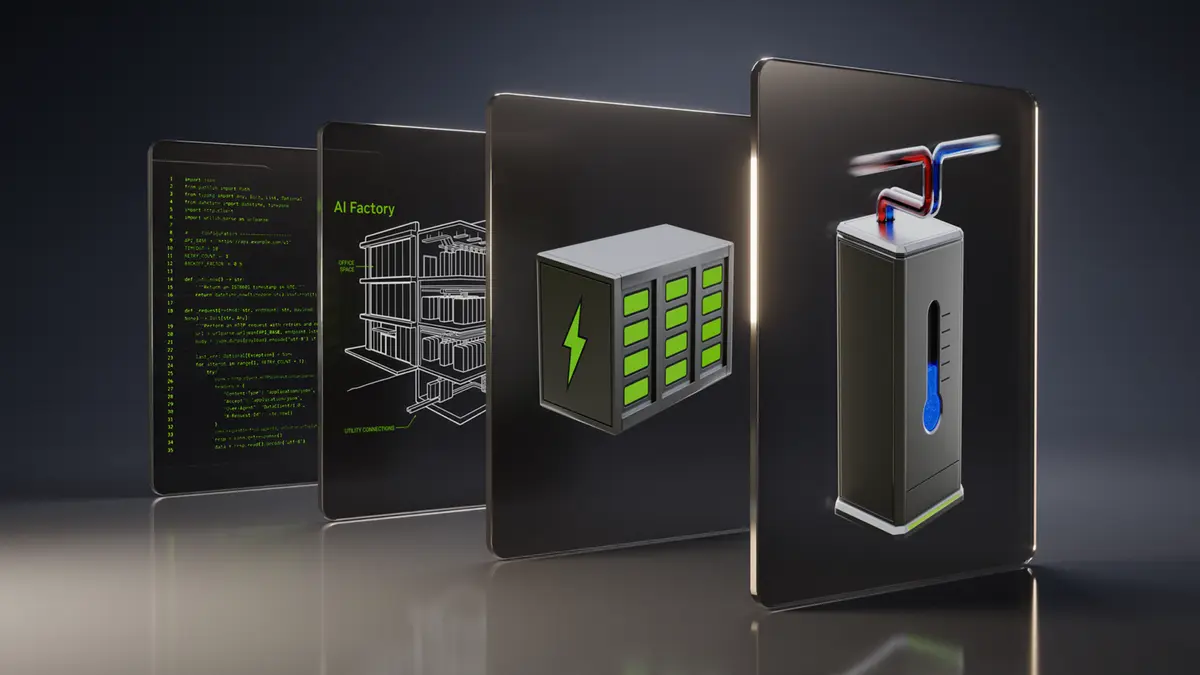
NVIDIA has opened DSX Ready, a qualification programme that tests partner power and cooling products against the requirements of its DSX AI factory reference design. The programme starts with two categories, battery energy storage systems and cooling distribution units, and NVIDIA says more will follow across infrastructure and software.
What the qualification covers
DSX Ready is aimed at the gap between a reference design and a purchase order. NVIDIA describes it as a way for builders to discover and evaluate offerings with more confidence, and for suppliers to demonstrate that a specific product meets the requirements for its own category rather than the programme as a whole. Requirements are tailored per technology, so a storage system and a liquid-cooling unit are judged on different terms.
Six partners are qualified at launch. Under battery energy storage, the list names Hitachi Energy, LG Energy Solution and Tesla. Under cooling distribution units, it names LG Electronics, LiquidStack and Vertiv. That mix puts electrical storage and liquid cooling inside the same programme rather than treating them as separate supply chains.
How a product qualifies
The two categories take different routes. Battery storage providers run the required qualification tests themselves and submit the supporting data for NVIDIA to review and approve within a defined qualification boundary. NVIDIA is direct about the limits of that approval: passing qualification does not replace site-level engineering, and it does not imply that a facility will be stable.
Cooling suppliers use a CDU self-qualification suite to establish whether a given unit meets the applicable NVIDIA functional requirements. NVIDIA notes that a qualified cooling unit may meet the relevant criteria while a builder still has to work out how that unit fits a planned site, its configuration and its operating conditions.
Why power and cooling get a programme of their own
The DSX platform is NVIDIA's attempt to treat an AI factory as a single system spanning compute, networking, power, cooling, facilities and software. Its pitch is that optimising one part of that system simply moves the bottleneck somewhere else, which is why power, cooling, water, site and grid limits now shape what builders can actually deploy.
A qualification list is the practical step that follows from that argument: it gives buyers a common label to specify and suppliers a defined route to appearing on it. NVIDIA has not published the individual test criteria for either category, and the launch names describe qualified offerings rather than site-wide approval.
Our opinion
A qualification badge is a supply-chain instrument rather than a technical one, and this one is designed to make DSX the specification that procurement teams quote. That is a smaller concession from NVIDIA than it looks, because the requirements are the company's own reference design, and a partner's alternative architecture has to clear a hurdle NVIDIA set to be sold next to it.
The line worth crediting is the disclaimer attached to battery storage. Telling customers that a qualification neither replaces site engineering nor promises stability is an unusual thing for a vendor to put in its own launch post, and it is the honest position: a certified battery cabinet and a certified cooling unit can still make a fragile building. Builders should treat DSX Ready as a shortlist, not a guarantee.