Google and Constellation add 890MW of nuclear uprates to the grid
The power purchase agreement covers uprates at six operating plants across Illinois, Pennsylvania and New Jersey, pushing the nuclear capacity Google has enabled past 1.5 gigawatts.
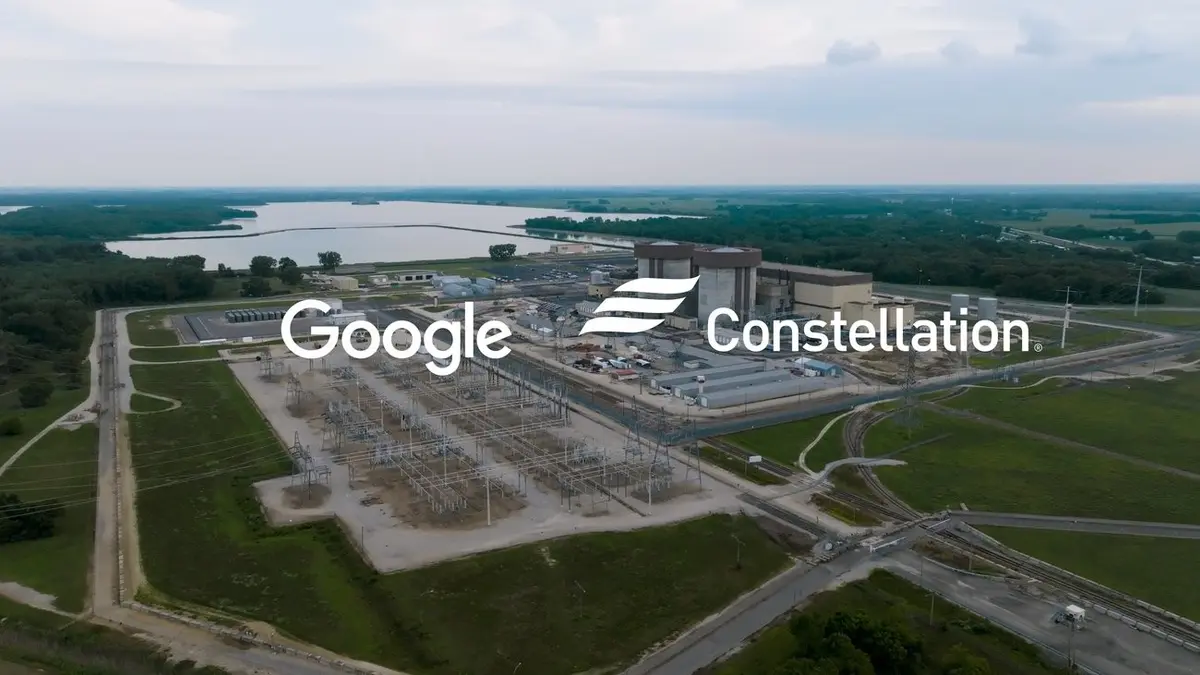
Google has signed a power purchase agreement with Constellation Energy to add 890 megawatts of nuclear capacity to the PJM grid, financing physical and digital upgrades at six operating plants across Illinois, Pennsylvania and New Jersey. In the same collaboration, Constellation is deploying Google Cloud's Gemini Enterprise agentic workflows across its core operations to speed up uprate planning, streamline construction and optimise plant output.
What an uprate actually is
A nuclear uprate modernises a reactor's turbines, steam generators and digital control systems to raise output without building anything new. Google is acting as the anchor customer for the work, giving Constellation the long-term revenue certainty it needs to invest in upgrades across 11 of its reactors, and Google says other grid customers bear none of the associated costs. Nuclear generates nearly 20% of US electricity and there are 94 reactors operating in the country, so the fastest new megawatt is often one squeezed out of hardware that is already connected.
The projects are due to add 890MW of firm, round-the-clock clean power to PJM before the end of 2032. PJM spans 13 states across the industrial Mid-Atlantic and Midwest and serves 67 million people. Google frames the total as roughly equivalent to adding an entirely new large reactor to the system, arriving years sooner than building one from the ground up.
Six plants, and a wider portfolio
The financing covers upgrades at six operating nuclear plants, with Google counting roughly 4,400 existing jobs sustained and about 7,200 new construction jobs supported. Google says the Constellation deal takes the new nuclear capacity it has enabled for the US system — through uprates and restarts — past 1.5 gigawatts in total.
It sits inside a broader set of deals. In Georgia, Google has an agreement with Georgia Power covering uprates at four reactor units, which it expects to enable around $900 million in ratepayer benefits. In Iowa it is working with NextEra Energy to restart the Duane Arnold Energy Center, bringing more than 600MW back online. In Tennessee it is partnered with Kairos Power and the Tennessee Valley Authority on advanced reactors and a reinvestment in Oak Ridge.
The US Department of Energy wants 5GW of domestic nuclear expansion enabled by 2030 through uprates and restarts. Google expects its agreements to cover close to a quarter of that national goal, and argues that long-term offtake is what lets projects line up supply chains, train a workforce and attract cheaper capital.
Our opinion
Google's nuclear strategy is better read as procurement than as climate advocacy. Data centre growth is the stated driver, and buying uprates from reactors that already hold licences, grid connections and staffed control rooms is the quickest way to add firm capacity without waiting a decade for new-build approvals. Paying to be the anchor customer is also the cheapest vertical integration on offer: it buys certainty for Constellation and, in return, Google gets a say in when and where the megawatts appear.
The part worth watching is the software. Putting Gemini Enterprise into plant operations to plan uprates and optimise output is a far bigger claim than signing a cheque, because it places an AI system next to critical infrastructure. If it delivers the compressed schedules and fewer construction surprises Google implies, other operators will copy it quickly. If it does not, the consequence is not a bad demo but a delay at a plant supplying millions of homes — and 'optimise plant output' is doing a lot of work for a sentence with no numbers attached.