Volkswagen's Mission Efficiency sets three EV records
The Mission Efficiency concept covered 1,278km from Wolfsburg to Vienna on a single charge, and Volkswagen says it is the most efficient near-production electric car yet.
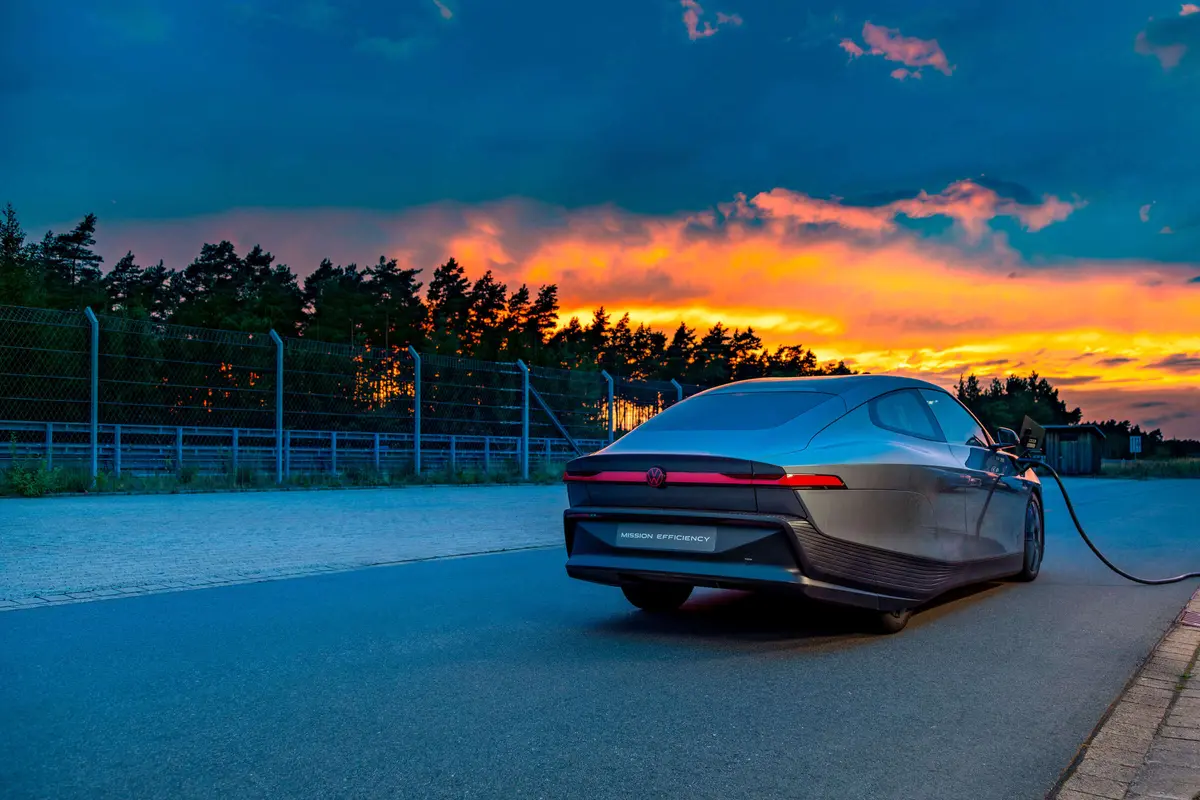
Volkswagen has shown off Mission Efficiency, a near-production four-seat electric concept, and it has collected three world records for efficiency along the way.
What's actually going on
The records sit in the Record Institute Germany's category for near-production four-seater electric vehicles suitable for everyday use. The first is aerodynamic: a drag coefficient of 0.158, which Volkswagen says breaks the record for all road-approved cars. The second is a consumption figure of 6.48kWh per 100km, measured on a controlled “ideal trip” at a constant 68km/h with no gradients and the climate control switched off.
The third matters more. On a documented run of 1,278.36km, roughly 794 miles, from Volkswagen's development centre in Wolfsburg through Poznań in Poland and Olmütz in the Czech Republic to Vienna, the car returned real consumption of 7.51kWh per 100km including charging losses, or 6.89kWh without them. The route was driven at an average of 67.72km/h with a 138km/h top speed. It charged once, taking the 54.9kWh net battery through a single stop, and arrived in the Austrian capital with 164km of range left.
Volkswagen also says a 370W solar system built into the glass roof and boot lid can add up to 30km of real range a day depending on season and weather. The concept sits on MEB+ underpinnings with front-wheel drive, sharing its underlying technology with the upcoming ID. Polo and ID. Cross. It is a concept vehicle and not for sale.
Why you should care
Most of the electric car conversation has been about battery size, and these numbers point somewhere else. A drag coefficient of 0.158 buys more range than a few extra kilowatt-hours in the floor, and it costs nothing per car once it is in production. If the figures hold up when the technology reaches a showroom model, the interesting question stops being how big the battery is and becomes how little of it you actually need.
Our opinion
The obvious caveat is that this is a concept, and concepts are allowed to be lighter, stranger and more slippery than anything carrying a price list. A 1,278km run at a steady pace in September is also the kindest possible test for an electric car, and nobody at Volkswagen is pretending otherwise. Still, the company has form: the XL1 of the mid-2010s was a genuine efficiency exercise rather than a styling buck, and this car wears that lineage openly. The genuinely encouraging detail is not the 0.158 figure. It is the mention of MEB+, front-wheel drive and shared parts with the ID. Polo, because efficiency records are only worth celebrating when the engineering behind them is already heading for the conveyor belt.