TII's Falcon-Emirati keeps an Arabic LLM in the Emirati dialect
The UAE's Technology Innovation Institute has released a 7B-parameter model built on Falcon-H1-Arabic that holds a conversation in Emirati Arabic instead of drifting back into Modern Standard Arabic.
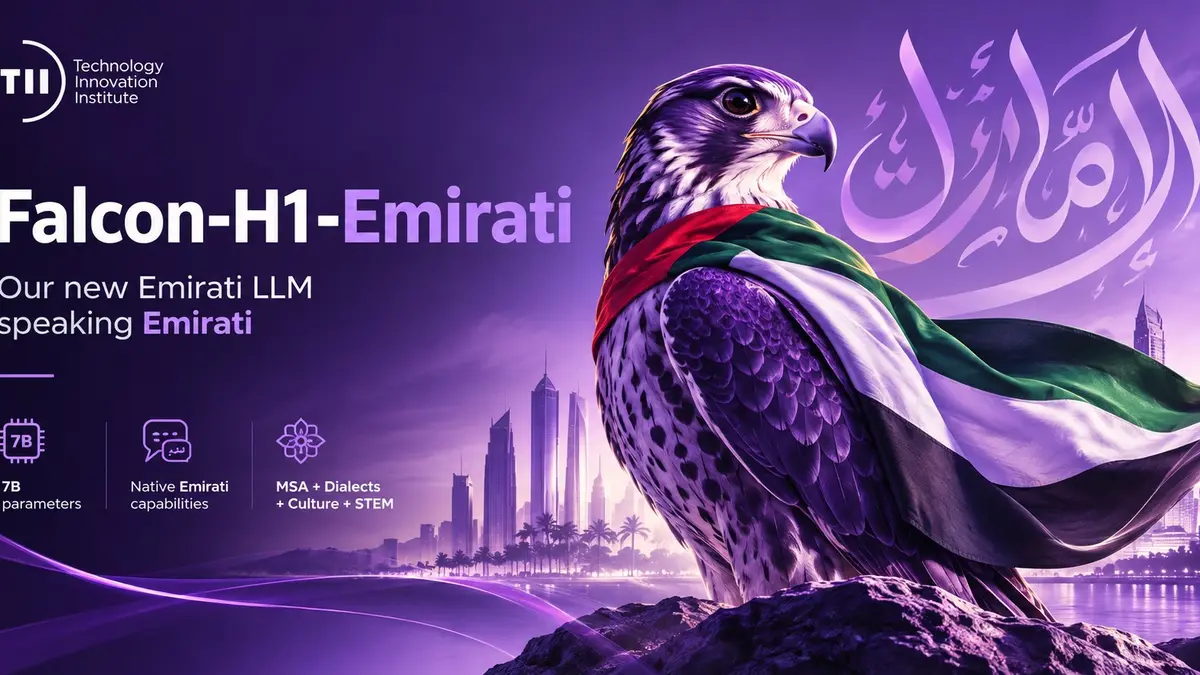
The Technology Innovation Institute (TII) has published Falcon-Emirati-7B, an Arabic language model tuned to answer in Emirati Arabic rather than sliding back into the formal register of Modern Standard Arabic. The Abu Dhabi research centre says the 7B model scores 84.83% on Alyah, an Emirati dialect benchmark, ahead of every other Arabic and multilingual model it compared against, including several far larger ones.
A dialect specialist built on Falcon-H1-Arabic
Falcon-Emirati-7B is not a new base model. It is built on Falcon-H1-Arabic, which TII released earlier this year and which uses the Falcon-H1 hybrid architecture: state space models running in parallel with Transformer attention inside every block, with the two fused before each block's projection. That gives the linear-time efficiency of Mamba on long sequences while keeping attention's precision for long-range dependencies. The Falcon-H1 family spans 3B, 7B and 34B parameters with context windows up to 128K and 256K tokens, and was already trained on a mix of Modern Standard Arabic and dialectal Arabic from the Gulf, the Levant, Egypt and the Maghreb. TII picked the 7B variant as the balance point between quality and the cost of training and serving a dialect-specific chat model.
Three kinds of training data
The team built a dedicated Emirati data pipeline on top of that base, drawing on three sources. The first is authentic dialect text crawled from Emirati websites and forums written natively rather than translated, which supplies ground truth for everyday phrasing and the natural drift between Emirati and Modern Standard Arabic. The second is Modern Standard Arabic material about Emirati culture, heritage and social norms, which does not teach the dialect but does teach the model what Emirati topics mean. The third is a large set of synthetic dialect data generated under glossaries and style rules, added because authentic written Emirati text is scarce online.
TII is candid that there is no established recipe for this. There is no settled answer on how much dialect data is enough, how to mix it with Modern Standard Arabic, or which training stage matters most, so much of the work was trial and error across data mixes, training stages and supervision strategies.
Dialect fidelity is where the gap opens
Multiple-choice benchmarks only show that a model can recognise the right answer, so TII ran a second evaluation: open-ended generation on the same 1,173 Alyah questions, scored by an LLM judge against four competitors, ALLaM-7B-Instruct-preview, gemma-3-27b-it, Jais-2-8B-Chat and Fanar-2-27B-Instruct. The judge scored correctness and dialect separately. Falcon-Emirati-7B led on correctness, but the wider gap came on dialect fidelity, where it scored 0.52 on partial credit against 0.05 for ALLaM, 0.03 for gemma-3-27b-it, 0.02 for Jais-2-8B-Chat and effectively zero for Fanar-2-27B-Instruct. In other words, the rival models often knew the right answer and said it in Modern Standard Arabic anyway. TII also flags that Fanar-2-27B-Instruct abstained on 26.2% of questions, against under 5% for every other model in the comparison.
Our opinion
The interesting number here is not the 84.83% benchmark score but the 0.52. Arabic is a family of languages wearing one name, and the failure mode TII is describing, a model that understands the question and then answers in a register nobody in the room uses, is exactly what makes regional language models feel foreign in daily use. A 7B model is also a deliberately unglamorous choice: TII could have made a bigger splash with the 34B variant and chose the size people can actually run and serve.
The caveats are worth stating plainly. TII built the data mix and the evaluation, and one of the strongest claims rests on an LLM judge rather than a large panel of native speakers, so independent replication on Alyah would be the real test. Falcon-Emirati-7B is also a dialect specialist, not a general-purpose upgrade, and its value depends entirely on how well it holds up outside the benchmark categories TII chose to highlight.