Surface Pro 12 and Laptop 13 move to Snapdragon X2 Plus
Microsoft’s second-generation Surface Pro 12 and Laptop 13 bring Snapdragon X2 Plus, more battery life and a $79.99 haptic mouse on 13 October.
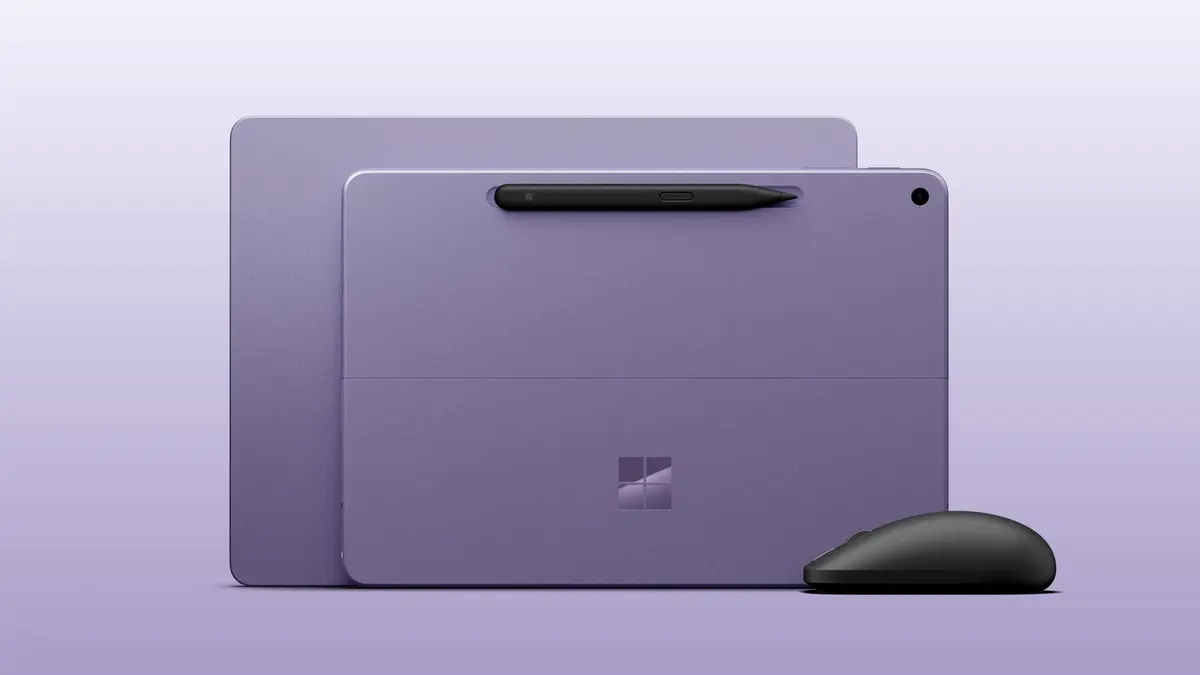
Microsoft has refreshed the two Surface machines it wants people to carry every day. Announced at Snapdragon Summit on 23 September, the Surface Pro 12-inch and Surface Laptop 13-inch move to Qualcomm’s Snapdragon X2 Plus, and both arrive on 13 October in select markets: the Pro 12-inch from $1,149.99 and the Laptop 13-inch from $1,199, with a new Surface Mouse at $79.99 alongside them.
What the X2 Plus is claimed to change
Microsoft’s own comparison against the previous generation puts up to 18% more efficient battery performance, more than 60% faster graphics, up to 95% faster local AI inferencing on the NPU and up to 17% faster Office productivity. Both machines stay fanless, which is the point of the exercise: the gains are meant to show up on hour six of a working day rather than in a benchmark chart, with supported AI experiences able to run on the device, in the cloud, or across both.
Surface Pro 12-inch
The tablet that becomes a laptop keeps the magnetic Slim Pen and its keyboard cover, and picks up an hour of extra active web browsing, a 25% brighter 500-nit PixelSense touchscreen, a new Black finish and an enclosure made with 86% recycled content. The bigger software addition is Microsoft Ink Canvas, a pen-first canvas for sketching, annotating, generating images and summarising text in place, which ships pre-installed on the Pro 12-inch and can be downloaded on other supported Surface and Windows devices from the same day. Commercial buyers can also order it with 5G.
Surface Laptop 13-inch
The Laptop 13-inch is the more conventional machine: a full-size backlit keyboard, a precision touchpad, an aluminium body and a taller 3:2 PixelSense screen, now 25% brighter at 500 nits with 22.5 hours of battery life claimed and the same new Black option. It starts at $1,199, a hundred dollars above the tablet, which is roughly the going rate for a keyboard you do not have to buy separately.
A mouse that answers back
The Surface Mouse is the small, likeable part of the announcement. Haptic feedback gives a physical tick when a click registers or a window snaps into place, the shape is ambidextrous, there is a customisable action button for Copilot, Bluetooth 6.0 handles pairing across devices, and Microsoft says 30% of it is recycled content. It lands in Black and Platinum on 13 October at $79.99, alongside Surface for Business availability for all three devices.
Our opinion
The interesting part of this refresh is not the chip, it is that Microsoft has stopped pretending the entry price is the story. A $1,149.99 tablet and a $1,199 laptop are premium money for machines whose selling point is efficiency, and the people who most need 22.5 hours of battery are the ones least able to spend four figures on it. The claimed NPU uplift will also only matter to buyers who actually use the local AI features, which is a smaller group than the marketing suggests.
Haptics on a mouse, though, is the sort of unglamorous improvement that turns out to be genuinely hard to give up, and shipping Ink Canvas pre-installed on the new tablet rather than as an add-on shows Microsoft has learned something about how features actually get adopted. The pricing is the weak spot: without UK figures, and with a trade-in offer doing a lot of the persuading in the small print, this reads as a solid if cautious generation — worth buying if you are replacing a four-year-old Surface, hard to justify if you are not.