STMicroelectronics' new 6-axis IMUs rebuild events, not just motion
Two new inertial sensors — LSM6DSK320X for consumer gear and ISM6HGK256X for industry — pair mirrored gyroscopes with twin accelerometers and an on-chip machine-learning core.
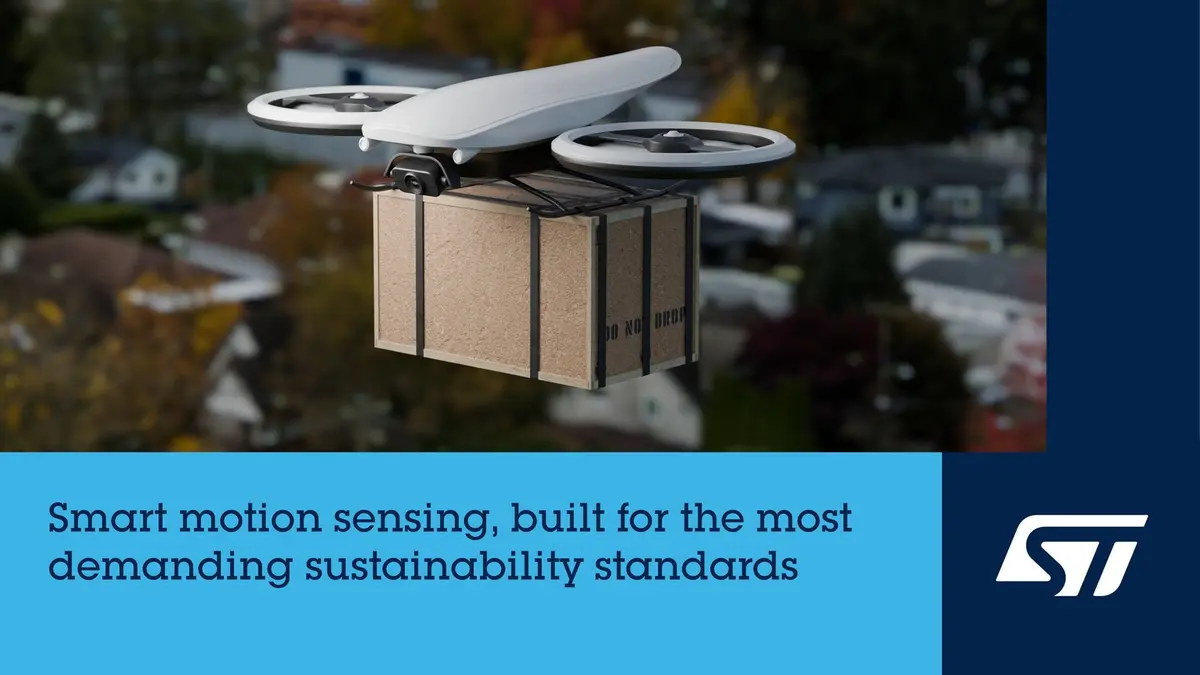
STMicroelectronics has announced a pair of six-axis motion sensors built around a mirrored gyroscope design and twin accelerometers, aimed at devices that need to reconstruct what happened to them rather than simply record that they moved. The consumer part is the LSM6DSK320X and the industrial version is the ISM6HGK256X.
Mirrored sensing, two accelerometers
The sensors use two mirrored MEMS gyroscope structures whose phases face one another, a layout the company says cancels the effect of vibration and impact while still resolving very small phase differences. Each package also carries two independent accelerometers instead of the usual one, so a single device can measure low-acceleration movement up to ±16g and high-acceleration events up to ±320g at the same time. A conventional single-accelerometer IMU has to switch between ranges, and the company's argument is that this is precisely when brief events get missed.
Event reconstruction on the sensor itself
ST frames the headline capability as event reconstruction: identifying and classifying distinct events — an impact, the use of a power tool, a drone manoeuvre — from motion data alone. Both parts include the company's machine-learning core so that classification runs inside the sensor, which reduces power draw and offloads the host processor. The chips are supported by the Motion XLF, sensor-fusion and context-recognition libraries and by the ST MEMS Studio development environment.
Price, size and availability
Both sensors occupy a 2.5 x 3 x 0.83mm package. The consumer LSM6DSK320X is rated from -40°C to +85°C and priced at about $4.60 per unit in thousand-unit quantities; the industrial ISM6HGK256X covers -40°C to +105°C, is covered by the company's ten-year longevity commitment and lists at about $5.10. Adapter boards for both, the STEVAL-MKI257A and STEVAL-MKI258KA, are due through the manufacturer's own store and distributors by November 2026. Target applications run from fitness trackers, smart tags and game controllers to industrial asset monitoring, robotics and delivery drones.
Our opinion
The genuinely interesting claim here is not the resolution, it is where the intelligence sits. Putting a machine-learning core inside a $4.60 sensor means a fitness band or a drone flight controller can decide that a tumble was a fall, or that a vibration was a crash, without waking a power-hungry applications processor to do the maths. That is the same shift that has quietly reshaped image sensors, and it is worth watching precisely because ST is selling it at volume prices to component buyers rather than as a premium flagship part. The two-accelerometer design deserves the scrutiny it will get from drone builders, who have spent years working around the saturation and range-switching limits that this approach claims to remove. If the mirrored-gyro architecture performs as described under real vibration, the £4 sensor could end up mattering more than most of the hardware it is fitted into.