Claude finds a CRISPR-like system hiding in viral DNA
Anthropic's new life sciences lab says Claude spotted a previously uncharacterised enzyme system built around CRISPR-like DNA repeats, after roughly 950 agents spent 21 hours combing a database of viral proteins.
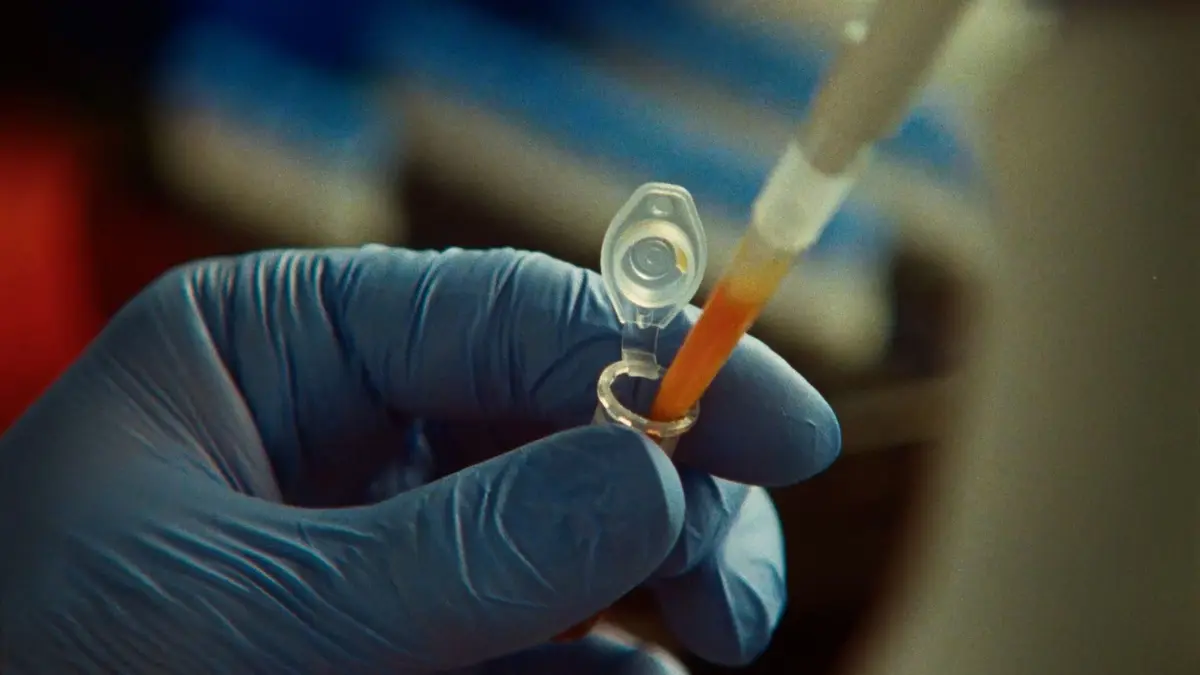
Anthropic has published early results from its own molecular biology lab in which Claude, its AI model, found a previously uncharacterised enzyme system defined by an array of repeating DNA sequences that closely resembles the repeat structure at the heart of CRISPR. The company posted the findings on 23 September 2026 alongside a pre-print and a technical report, and it is careful to label them early: nobody yet knows what the system does.
The work came out of a research group formed in spring 2026 and a wet lab built next to it in the Bay Area, an unusual move for an AI company. The brief given to Claude was deliberately thin. Anthropic says it supplied one prompt and the lab work, while the agents did the reading, the searching and the filtering themselves.
One prompt, 950 agents and 210 million tokens
Over about 21 hours, roughly 950 Claude agents working in parallel gathered more than 200,000 reverse transcriptases, the enzymes that copy RNA back into DNA, and pulled out 3,500 systems that no published work described. They narrowed those to the 20 most interesting candidates and wrote a short, human-readable report for each one, a screening job Anthropic says would take a specialist weeks or months by hand. The agents were also told to check their own methods, reproducing known results from public data before drawing conclusions.
One agent then noticed something odd sitting next to the gene for a particularly strange reverse transcriptase: an evenly spaced set of repeats, visible in the raw sequence. The model's logged reaction reads like a researcher talking to themselves. It counted the repeats, measured their spacing, compared the layout against known systems, went looking for any earlier report of the pattern and, finding none, filed the candidate for human review.
What Claude actually found
The system is called ART, for array-associated reverse transcriptases, and it turns up mainly in bacteriophages, the viruses that infect bacteria. It has three parts: the reverse transcriptase itself, a partner gene beside it, and a long run of evenly spaced DNA repeats. That layout mirrors a CRISPR array, which stores a bank of RNA sequences and is what makes CRISPR-Cas systems programmable. Anthropic's first experiments show the ART array is expressed as a set of distinct short RNAs, which is the signal that something comparable may be happening here.
Feng Zhang, a CRISPR pioneer at MIT and the Broad Institute, reviewed the pre-print and said the identification of RNA-repeat arrays associated with reverse transcriptases is genuinely intriguing and merits further investigation, calling it an exciting example of how AI agents can contribute to biological discovery.
What happens next
Anthropic is explicit that the primary function of ARTs is still unknown and that experiments are continuing. The lab works only at biosafety levels 1 and 2 and does not handle pathogens that infect humans, and all of the bench work is done by people. Scientists can read the full detail in the technical report.
Our opinion
The interesting number here is not 200,000, and it is not 210 million tokens either. It is the gap between 3,500 candidate systems and the 20 that made it through, because that is where scientific taste is doing the work. Anthropic says most candidates are eliminated at review and that surviving ones go to a bench, which means the constraint on discovery has moved: hypotheses are now cheap and plentiful, and the scarce resources are the chemists, the equipment and the patience to prove a hunch wrong. An uncharacterised repeat array with no known function is a lead rather than a tool, and the counterpart to that excitement is the question every lab will eventually ask of an agent-written result: if someone else runs the same prompt on the same database, do they get the same answer? Reproducibility, not novelty, will decide whether this becomes a method or a headline.