Micron stacks 512GB onto a single stick of server memory
Micron has built the first 512GB DDR5 module, a stacked server RDIMM that lets one 24-slot dual-socket machine hold 12TB of memory while cutting DRAM power use by more than 60 per cent.
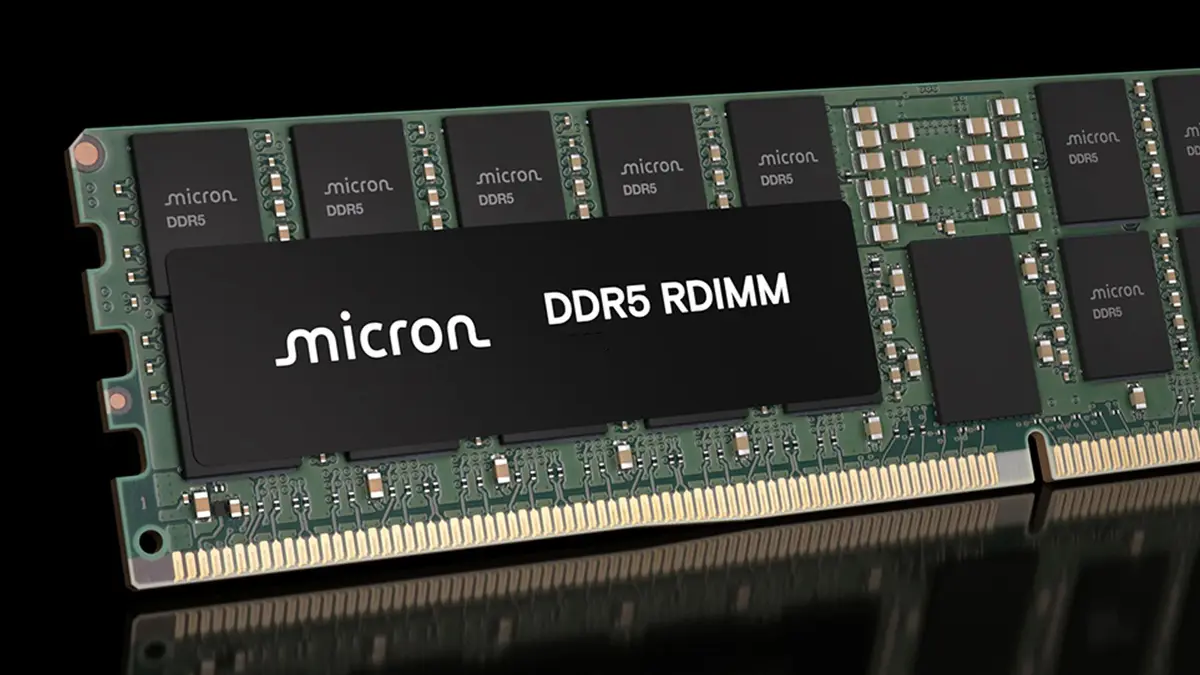
Micron has built the first 512GB DDR5 memory module, a single stick of server RAM holding half a terabyte that lets a standard two-socket machine carry 12TB of memory. The company announced the part on 15 September, and AMD and Intel are reported to be validating it for future server platforms.
That much capacity on one module means abandoning the flat layout ordinary DIMMs use. Micron stacks the DRAM dies vertically and links them with through-silicon vias, the same class of packaging work that made high-bandwidth memory possible. The result is a 512GB RDIMM running at up to 9,200 MT/s, the fastest speed Micron has put into a module this dense, in the same slot as any other DDR5 DIMM.
What half a terabyte per stick buys you
The arithmetic is the story. A dual-socket server with 24 memory slots filled with these modules reaches 12TB of DDR5 without extra boards, risers or a second chassis. That matters because the datasets AI models and analytical databases work on have outgrown the tiers beneath them: keeping more of the working set in memory means fewer trips to storage an order of magnitude slower. Micron is aiming the module at AI, analytics and database workloads, and at buyers who want more virtual machines in the rack space they already rent.
Density usually costs power, and Micron is claiming the opposite. One 512GB module is rated at 16W against 44.2W for the four 128GB RDIMMs it replaces at the same total capacity, a reduction of more than 60 per cent on Micron's own test conditions. The company also claims up to 1.4 times the performance of 256GB DDR5 configurations in analytical workloads.
Raj Narasimhan, senior vice president and general manager of Micron's Cloud Memory Business Unit, framed the part as a way of holding larger datasets closer to compute: “A 512GB RDIMM enables multi-terabyte servers, supporting larger AI and database workloads, greater virtualisation density and improved power efficiency, all within existing server footprints.” AMD's Amit Goel said the engineering collaboration with Micron was aimed at helping customers “realise the full value of AMD-powered platforms”.
The memory squeeze behind the density race
Micron's timing is not a coincidence. DRAM supply has been tight all year as AI infrastructure soaks up capacity, which pushes every maker towards more bits per slot rather than more slots per server. Micron's 256GB DDR5 RDIMMs, in production since early 2026, already ran at up to 9,200 MT/s using its 1-gamma DRAM with a 3D stack; the 512GB part doubles that capacity in the same footprint. The company has not said what the module will cost, and it expects production in 2027 rather than now.
Our opinion
Twelve terabytes in a server chassis you can already buy is a neat trick, but the wattage is the part worth reading twice. Data-centre operators are being squeezed by power and cooling limits long before they run out of rack space, so a 60 per cent cut in DRAM power per unit of capacity attacks the constraint that actually bites. The caveat is that the comparison is one 512GB module against four 128GB modules under Micron's own test conditions, and laboratory ratings rarely survive an untidy production workload untouched. The sharper question is price. Micron's 256GB RDIMMs are already shipping and will cost less per gigabyte; the 512GB module has to win on slots and watts, not on paper capacity. Watch whether AMD and Intel validation turns into shipping platforms in 2027, and whether anyone outside a hyperscaler can justify the premium.
- Micron announced the first 512GB DDR5 RDIMM server module on 15 September 2026
- The module stacks DRAM dies vertically and links them with through-silicon vias to reach 512GB in one slot
- A 24-slot dual-socket server can hold up to 12TB of DDR5 with these modules
- Rated speed is up to 9,200 MT/s, the fastest Micron has shipped at this density
- Micron rates one 512GB module at 16W against 44.2W for four 128GB RDIMMs of the same total capacity
- Micron claims up to 1.4 times the analytical performance of 256GB DDR5 configurations
- AMD and Intel are reported to be validating the module for future server platforms
- Production is expected in 2027 and no price has been announced