Meta’s VR Glasses cost $1,299.99 and arrive in spring 2027
Meta has priced its 100-gram VR glasses at $1,299.99 for spring 2027, with a $349 audio pair and a $249 frame landing within weeks.
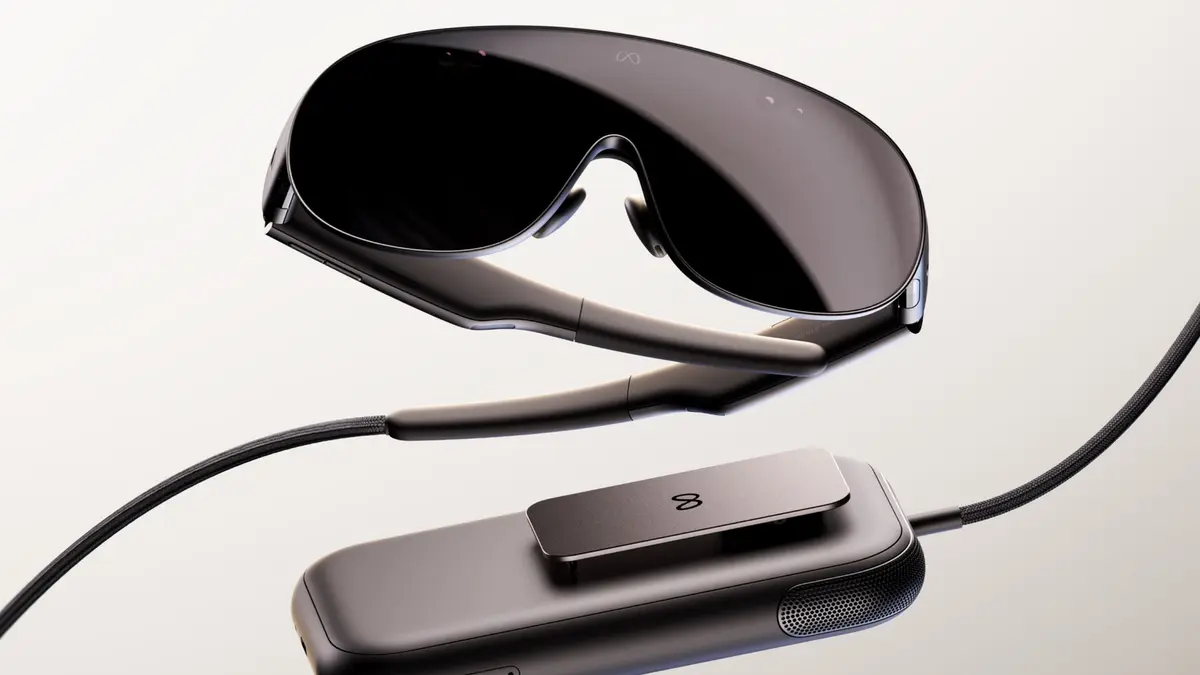
Meta has finally put a price and a date on the headset it has spent years describing as a pair of glasses. Meta VR Glasses go on sale in spring 2027 for $1,299.99, the company said at Connect on 23 September, and the pitch is not more power but less weight: about 100 grams, or roughly what a deck of cards weighs, against a device Meta says they are five times lighter than.
A cinema that weighs what a deck of cards does
The frames carry what Meta calls a 5K Infinite Display built on micro-OLED panels at 37 pixels per degree, with Dolby Vision and Dolby Atmos spatial audio built into the frames. Meta says they are the first IMAX Enhanced certified VR device and one of the only ways to watch select films in IMAX’s exclusive expanded aspect ratio at home. From November, Disney+ subscribers can stream 3D versions of films including The Avengers and Black Panther in select countries, with themed viewing environments such as Tatooine and Avengers Tower, and a Disney Immersive Cinema by ILM app for VR Enhanced takes on Avengers: Infinity War and Star Wars: A New Hope.
Meta has lined up Prime Video, YouTube, DIRECTV, AMC+, Crunchyroll, Plex, ESPN and Tubi, with Peacock, HBO Max and Paramount+ offering their 3D catalogues for the first time, and says owners will get more than 100 immersive live sports events a year through MLB, NBC Sports, TNT Sports and UFC once the glasses launch.
The puck does the work
None of that fits in a frame, so Meta split the device in two. The glasses hold the sensors and the display, while a puck that clips to a pocket or bag holds compute, battery and storage, joined to the frames by an optical tether. Inside is Qualcomm’s Snapdragon Reality Elite, which Meta credits for the load times and the efficiency, and the puck is rated for up to three hours of continuous high-resolution playback with 45W fast charging.
Meta is also selling it as a computer rather than a console. You get a private multi-screen workspace, and any flat surface can become a keyboard and touchpad, with full-colour passthrough so you can still see your desk and your phone. Meta says more than 75 games will play at launch using hand gestures alone, with Xbox Cloud Gaming streaming hundreds more, and hologram calling will drop a photorealistic version of you, expressions included, into calls made from WhatsApp to Zoom.
The glasses you can actually buy are much cheaper
The rest of the Connect line-up arrives far sooner and costs far less. Ray-Ban Meta Audio, Meta’s first audio-only glasses, start at $349 and ship on 13 October: 43 grams, up to 12 hours of listening with 48 more from the included case, and 23 colour and lens combinations across the Clubmaster and Burbank styles. Ray-Ban Meta (Gen 3) is available now from $449 with nine hours of battery, an hour more than Gen 2, a six-microphone array Meta says removes more than 90% of background noise, a 12MP camera and 3K video.
Meta’s cheapest glasses yet are the new Meta Adventurer at $249, on pre-order now and on sale 23 October in every country that sells Meta Glasses, alongside Kylie Jenner’s Ivory colourway and a collection designed with LISA at $399 each. Add the Mix & Match frame, lens and case programme, and Meta reckons it will offer more than 100 glasses options across Ray-Ban, Oakley and Meta Glasses by the end of the year. Singapore, South Korea, Mexico and the United Arab Emirates join today, with Brazil next.
Muse, the personal AI agent Meta announced for its AI glasses at the same event, is the software half of the story: the glasses are the body, and Meta is betting that an assistant which answers, summarises and books things in the frame is worth more than any one specification. Existing Meta Ray-Ban Display owners get hands-free cycling and transit directions, a hologram for calls and an Explore app, and the Display model is expanding to the UK, Canada, France, Italy and Germany, on sale today in the UK and Canada with the continental markets following on 13 October.
Our opinion
$1,299.99 for glasses that need a puck in your pocket is a lot to spend on a first generation, and the tether is the giveaway that this is an engineering compromise dressed as a design choice. It is still the most interesting thing Meta has shown in VR for years, because it attacks the reason headsets sit in cupboards: they are uncomfortable, isolating and faintly ridiculous to wear. If these really feel like glasses, the price stops looking absurd. If they do not, Meta has built a very expensive novelty.
The $349 audio pair is the one to watch. Meta has spent a decade trying to make smart glasses normal, and the version without a camera is the first that reads as a product rather than a demonstration — cheaper than flagship earbuds plus a pair of prescription frames, and it does not leave everyone around you wondering whether they are being recorded. The frustration is that Meta still will not say what any of it costs outside the United States, which is the only number its British customers can actually use.