Lenovo says its AI adoption playbook lifted daily Copilot use by 36%
Lenovo reports that a measured internal trial of its AI adoption model lifted daily Copilot use to 91% against 67% for a licence-only group, an increase of 36%.
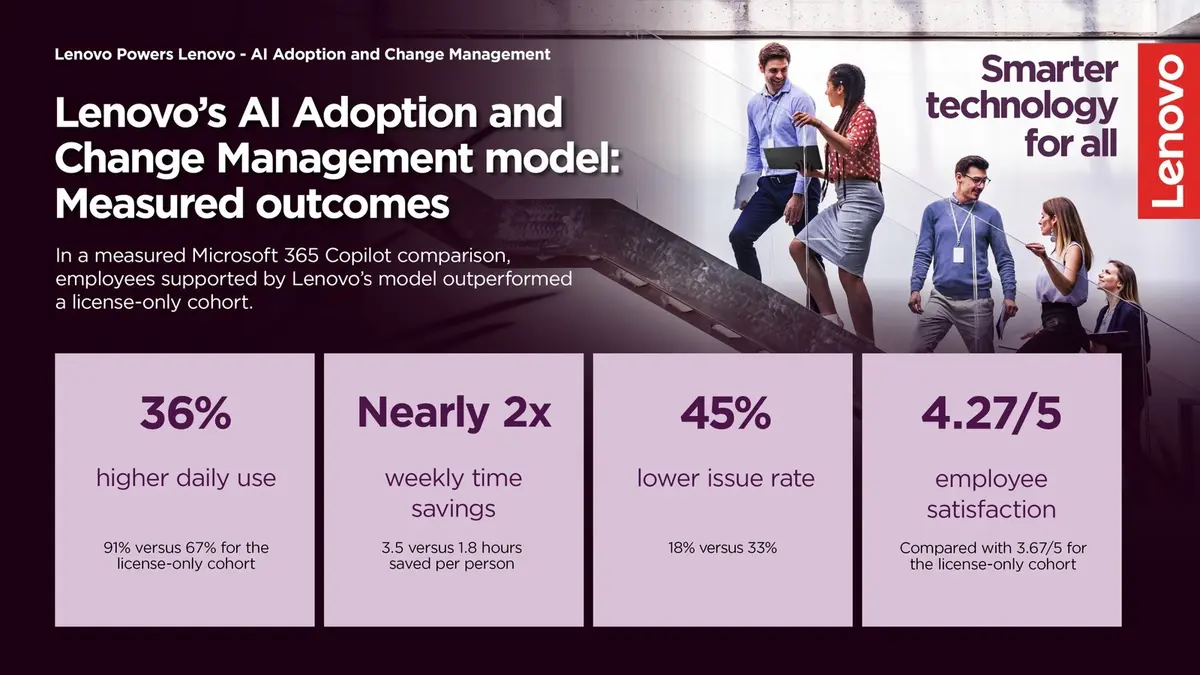
Lenovo has published the AI adoption model it built for its own workforce, and the figures it reports are unusually specific: a measured internal comparison put daily Microsoft 365 Copilot use at 91% in the group given structured support, against 67% in a group handed licences alone.
Managers first, licences second
Lenovo's own account of the rollout is blunt about what did not work. Early deployments went from executive communications straight to training and launch, leaving managers little time or guidance to prepare their teams, even though employees looked to those managers to explain why the change mattered. The answer it settled on, developed through a programme it calls Lenovo Powers Lenovo, brings together change practitioners, learning specialists and AI engineers, and builds on the Prosci ADKAR framework.
Three phases
The model runs through three connected stages. It prepares for change by fixing objectives, assessing readiness and bringing managers in early; it enables change through role-specific communication, training, hands-on learning and a champion network; and it reinforces adoption by tracking usage and business value, collecting feedback and clearing barriers as they appear.
What the comparison found
Lenovo tested the full method internally by running two groups side by side. One received Copilot licences with no tailored adoption support; the other received the same technology alongside role and use-case guidance, tailored training, manager involvement and continuing feedback. Daily Copilot use reached 91% in the supported group against 67% in the licence-only group, an increase of 36%. Staff in the supported group reported saving 3.5 hours each per week against 1.8 hours, satisfaction rose from 3.67 to 4.27 out of five, and the issue rate fell from 33% to 18%.
An internal tool becomes a service
The knowledge-agent deployment behind part of the testing reached roughly 3,000 employees, and the wider programme included prompt-a-thons that had staff apply Copilot to their own work rather than sit through generic demonstrations. Lenovo has since packaged the approach as Lenovo AI Adoption and Change Management Services, part of its Hybrid AI Advantage offering. “Managers are uniquely positioned to inspire employees, reinforce culture, surface potential barriers and help us capture AI value,” said Linda Yao, vice president of SSG hybrid cloud and AI solutions at Lenovo.
Our opinion
Vendor AI stories usually arrive as anecdotes, so a published control group is worth noticing even when it is also a sales pitch. Lenovo sells adoption services, and this case study exists to sell them; the comparison is nonetheless the honest kind, with the same technology handed to both groups and only the support differing. The 36% headline is less interesting than what sits beneath it. The licence-only group still reached 67% daily use, a reminder that access alone carries a workforce two-thirds of the way and that the last third is the expensive part. Lenovo's three phases are really a description of that last third: managers prepared before launch, training mapped to a specific job, and measurement that continues after the novelty wears off. None of it is novel. All of it is the work most rollouts skip.