Juice comes home for one more slingshot before Jupiter
ESA's Jupiter-bound spacecraft returns to Earth on 28 September for a flyby that bends its path and sets up the final Earth pass before Jupiter in 2031.
A slingshot that costs nothing but patience
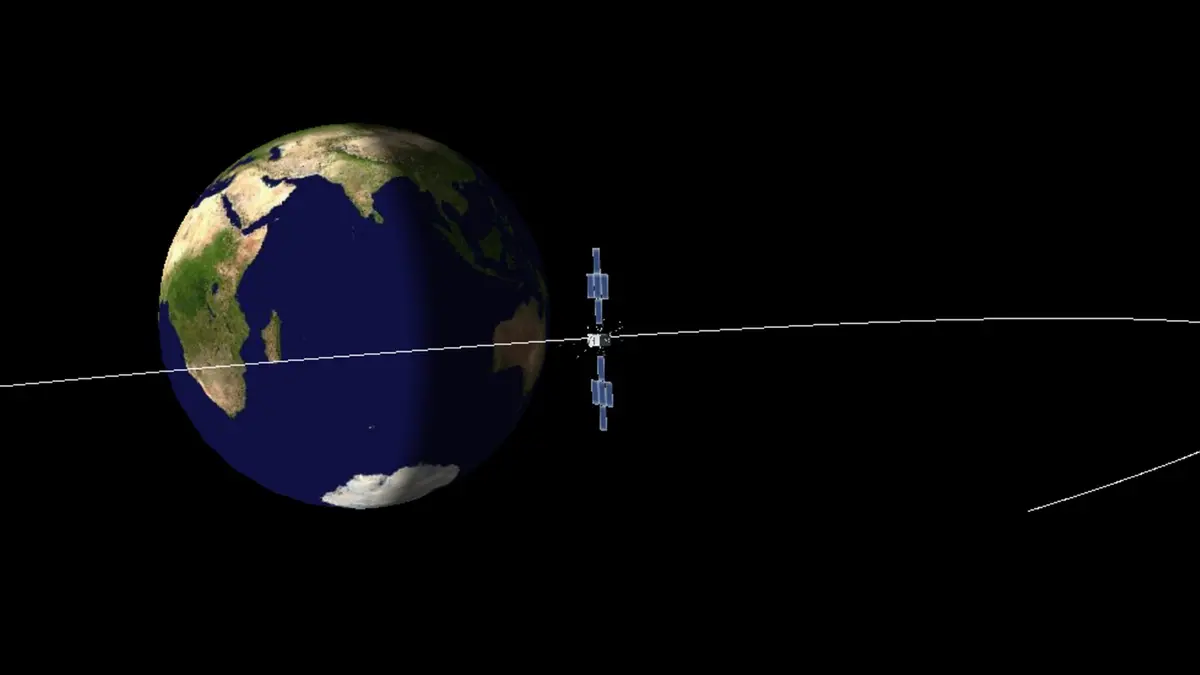
ESA's Jupiter Icy Moons Explorer, known as Juice, will return to Earth on 28 September, with flight controllers steering the spacecraft within 8,640 km of the planet to change its speed and direction on the way to Jupiter. The closest approach happens over the Indian Ocean at 13:45 CEST (11:45 UTC).
The flyby will bend Juice's trajectory by about 20 degrees and add roughly 3.5 km/s to its velocity - a turn and a push that would otherwise have to come out of the fuel tanks. It sets the spacecraft up for one final Earth flyby in January 2029 and, after that, an intercept with Jupiter in July 2031.
What happens on the day
Between 15 and 30 minutes before closest approach, Juice crosses over Australia from the north-east to the north-west, and ESA says amateur astronomers with binoculars or a suitable telescope may be able to track it. The agency has published trajectory data for anyone planning a look.
The pass is not entirely straightforward. From 21:24 CEST on 27 September to 06:03 CEST on 28 September the spacecraft sits in Earth's shadow, running on battery power alone, so the team is prioritising the most important instrument observations to avoid draining it. At 08:00 CEST on the day, controllers will be ready to make a final emergency manoeuvre to correct critical navigation errors or avoid a collision with another satellite. ESA expects it will not be needed.
All ten of Juice's science instruments are switched on between 23 September and 3 October, collecting data on Earth and the Moon. Several days of that time will be spent inside Earth's magnetotail, the long structure of charged particles stretched away from the Sun, which should produce magnetic field measurements that can later be compared with data from the European-Chinese Smile mission. The navigation camera, built to help the spacecraft steer around Jupiter's moons, will be pointed at the Moon's horizon to test a new optical navigation technique, and two monitoring cameras will photograph the flyby, with the last images taken on 29 September.
Why Juice takes the long way round
Gravity assists trade energy with planets, and Juice has been collecting them since its launch on an Ariane 5 from Europe's Spaceport in Kourou in April 2023. It made the first ever lunar-Earth flyby in 2024, a braking manoeuvre that sent it towards Venus, and then used Venus in 2025 to bend its orbit and pick up speed. Flying straight to Jupiter and braking hard on arrival would have needed an enormous rocket and an unthinkable amount of fuel, so the spacecraft spends its years being flung around the inner Solar System instead - almost entirely for free.
The result is a spacecraft that should still have fuel in its tanks for the parts gravity cannot do: entering orbit around Jupiter in 2031, making 35 flybys of Ganymede, Callisto and Europa, and finally settling into orbit around Ganymede in 2034.
The navigation campaign for this flyby began on 17 August, with six correction slots set aside at four weeks, two weeks, one week and three days before closest approach. Only the first was needed. "It was of relatively small size, but extremely effective. It put Juice in the right spot for the flyby," said Angela Dietz, Juice's Spacecraft Operations Manager. Claire Vallat, the mission's project scientist, added that this pass is simpler to run than the 2024 double flyby: "This is great news for science, because it means we will be able to turn Juice in all different directions to point its science instruments at different parts of Earth and the Moon."
Juice is an ESA-led mission with contributions from NASA, JAXA and the Israel Space Agency, and the first Large-class mission in the agency's Cosmic Vision programme. Its target is the question of whether the ocean-bearing moons of Jupiter could ever have supported life.
Our opinion
There is something faintly absurd about a spacecraft built to study alien oceans spending its seventh year circling back to the planet it left, but the arithmetic is unforgiving: rockets are expensive, gravity is free, and a mission that reaches Jupiter with full tanks is worth far more than one that arrives early and empty. The clever part is what ESA does with the detour. Rather than idling through cruise phase, Juice calibrates its ten instruments against a world it already knows, so that when it finally points them at Europa and Ganymede the team has already learned the quirks of every sensor. A pass at 8,640 km is also a genuine test of nerve, because there is one window, one emergency manoeuvre held in reserve and no second attempt if the geometry goes wrong. That is the bargain the outer Solar System demands, and doing real science on the way there beats counting down the years.