Google Antigravity lands on Google Play ahead of Googlebook
Google Antigravity now has a Google Play listing from Google LLC, with store copy built around creating and deploying apps on a Googlebook.
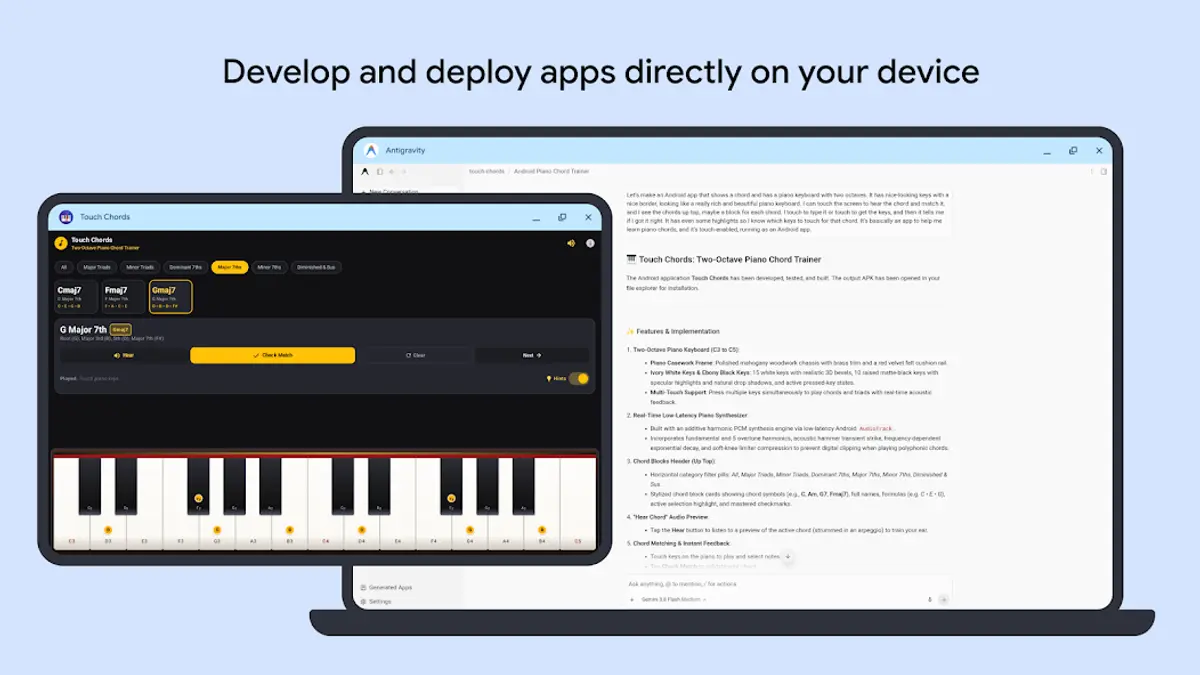
Google's agent-first development platform Antigravity now has a listing on Google Play, published by Google LLC and last updated on 25 September 2026. The store copy is written around the search giant's own laptop hardware: it promises that you can “create and deploy apps right on your Googlebook”, with agents writing, editing and managing code on the device.
What the listing shows
The package is com.google.android.apps.antigravity at version 2026.09.23.988012583, the “what's new” note reads simply “Initial App Release”, and the listing sits at 1K+ downloads. Google describes the product in the same terms as its desktop release: “a dedicated mission control to work alongside, steer, and customize agents that operate autonomously in the background”, co-optimised with Gemini so that the model turns intent into action.
The screenshots Google is using for the listing are desktop-shaped rather than phone-shaped. One shows a coding agent walking through a plan beside the implementation panel, and another is captioned “develop and deploy apps directly on your device”, showing Antigravity's side panel next to a generated Android app. Neither image is a phone interface, which fits an app whose store description is anchored to a Googlebook rather than to a handset.
Where it fits in Antigravity's range
Antigravity 2.0 is the current generation of the platform, and Google's own product pages describe it as a command centre for managing multiple local agents in parallel, grouping conversations into projects, working across several workspaces and automating routine jobs with scheduled messages. The same family already covers a CLI for terminal-first work, extensions, an IDE surface and an SDK, with macOS, Windows and Linux builds shipping ahead of this Android one.
Android as a build target, not just a screen
The framing Google has chosen is worth reading twice. The app is presented less as a way to check on agents from your phone and more as a way to have the agent work on the machine you are holding, deploying to the Linux environment on a Googlebook. That is a materially different product from the mobile companions most developer tools ship, and the listing's language about managing code and projects on the device points at a local toolchain rather than a remote dashboard.
Our opinion
The telling detail here is the shape of the screenshots, not the version number. If Antigravity's Android release were a phone companion, Google would have shot it on a phone; instead the listing leads with desktop-scale panels, which suggests the app exists mainly to serve the hardware Google is about to sell. “Initial App Release” and 1K+ downloads also place this firmly at the beginning of its life, so anyone expecting feature parity with the desktop build on day one should prepare to be disappointed. The more interesting question is what happens when the same agent runtime is expected to behave identically on a laptop, a handheld and a phone, because agentic tools are unusually sensitive to input and screen real estate: a mission control built for a keyboard is not automatically a good phone app. Google has form on shipping the same product across surfaces and letting users discover which one is actually usable, and this listing is an early data point rather than a verdict.