ESA and ISRO extend their space cooperation to 2032
The European Space Agency and India's ISRO have extended a cooperation framework first signed in 2002 by another five years, to 8 January 2032, adding space weather and human and robotic exploration to its scope.
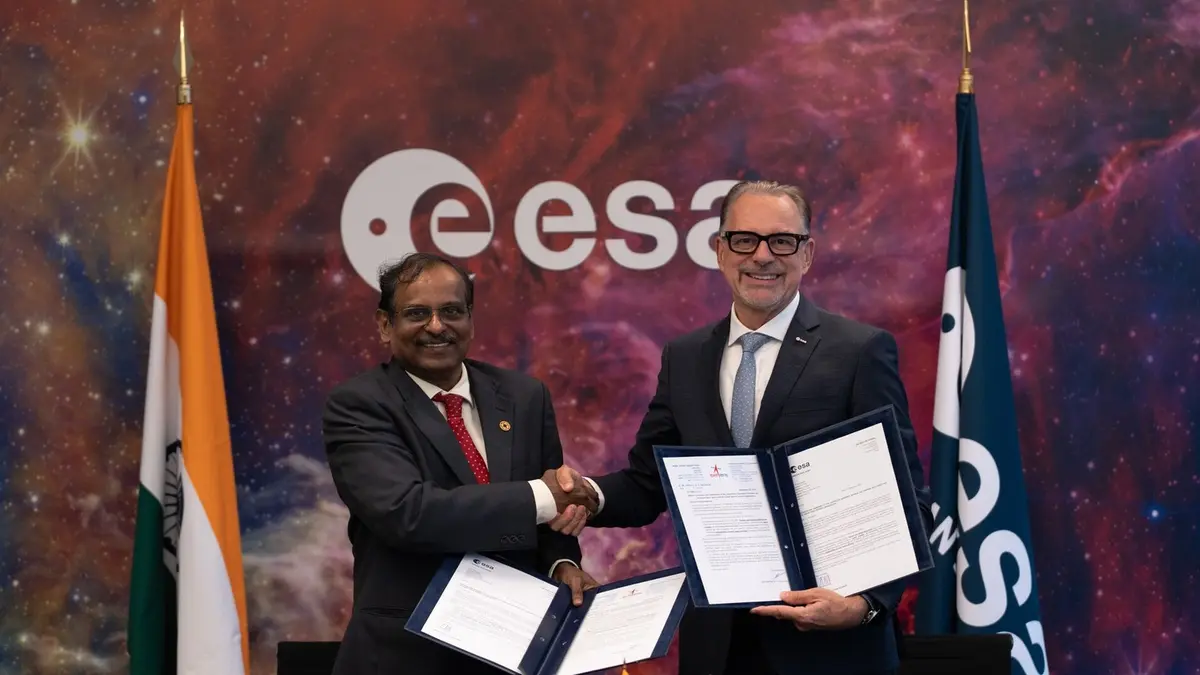
The European Space Agency and the Indian Space Research Organisation have extended their long-running cooperation agreement by another five years, taking it to 8 January 2032. ESA published the exchange of letters on 21 September, confirming that the two agencies had signed it in Paris on 10 September, on the margins of the International Space Summit.
What the extension actually changes
The Cooperative Agreement has been in force since January 2002 and works as a framework rather than a mission: it sets out where the two agencies will cooperate, leaving individual projects to be agreed later. Under it, ESA and ISRO have worked together on Earth observation, satellite navigation, space science and mission operations support, and the two agencies signed a Joint Statement of Intent on human exploration last year.
The rewritten scope adds two areas to that list. Space weather, the study of solar activity and its effects on satellites, power grids and radio links, now sits inside the agreement, as does human and robotic exploration. The text also recognises the growing importance of the sustainability of outer space activities, which covers both orbital debris and the traffic management questions that come with a busier sky.
What each side said
ESA Director General Josef Aschbacher framed the renewal around scale: "As space activities expand beyond Earth orbit and new opportunities emerge in exploration, sustainability and advanced technologies, international cooperation remains essential." He described a partnership "spanning more than two decades" and said the renewed agreement "positions us to pursue even greater ambitions together".
ISRO Chairman Dr V. Narayanan answered in the same register, saying the partnership "has delivered tangible benefits for India and Europe and has demonstrated the value of international cooperation", and that the renewal "reflects the shared ambition of ISRO and ESA to pursue innovation and scientific progress".
A framework, not a flight plan
Nothing in the announcement commits either agency to a particular mission, launch or astronaut flight, and no budget or contract value is attached to the extension. What has changed is the list of subjects the two agencies are now formally set up to work on together, with human exploration named for the first time in the agreement itself, a year after the joint statement of intent that pointed the same way.
Our opinion
The headline is the five-year rollover, but the revealing word in this release is "human". Space weather is a sensible addition, and a practical one: both agencies operate satellites that solar storms can degrade, so sharing forecasts and failure data is cheap insurance with an obvious return. Human and robotic exploration is a different kind of commitment. It is the area where Europe and India have the most to gain from each other, and it is also the most expensive, the most political and the slowest to produce anything visible. Writing it into a framework agreement costs nothing today and pays off only if a later government funds a later mission. That is not a criticism of the renewal so much as a warning about how to read it. Five more years of a 2002 agreement tells you the two agencies still find each other useful. It does not tell you what they will launch together, and the announcement deliberately leaves that question open.