Europe's own spy-satellite service starts with two rival blueprints
Two European consortia will now race to define how the EU's own Earth Observation Governmental Service watches the world from 2028 — and both are being paid to think in parallel.
The European Space Agency has signed two contracts for the same job. On 17 September, at the World Space Business Week in Paris, ESA awarded parallel architecture studies for the European Union's future Earth Observation Governmental Service — EOGS — to ICEYE and to Leonardo, each of which will lead its own European industrial consortium.
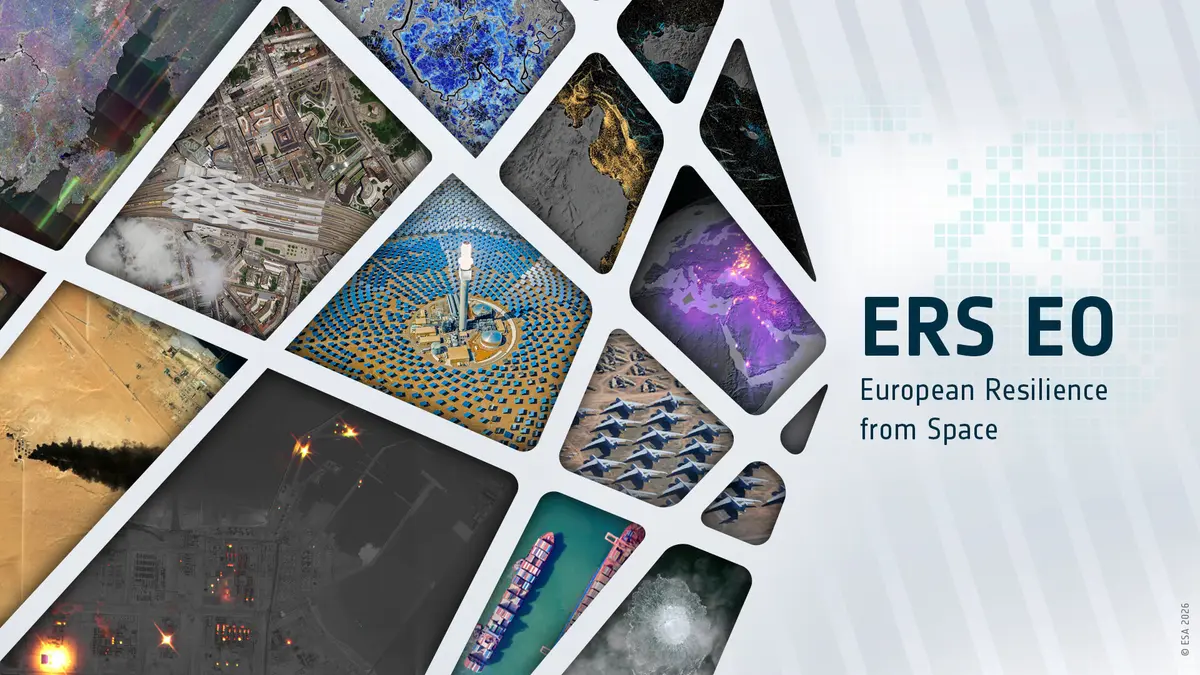
The work is funded by the European Commission and sits inside Element 1 of ESA's European Resilience from Space for Earth Observation programme, known as ERS-EO, which member states agreed at the Ministerial Council in November 2025. ERS-EO is a dual-use programme: it prepares the ground for EOGS, which is planned to begin in 2028 under the next Multiannual Financial Framework.
What EOGS is actually for
The stated purpose is secure, reliable, timely, persistent and targeted Earth observation data for the EU and its member states, aimed at situational awareness, preparedness, decision-making and action in security and defence. The service is envisaged as satellites, ground infrastructure, data and information, processing facilities and distribution infrastructure, drawing on commercial services, shared national capacities and core capabilities owned by the EU itself.
That breadth is why ESA is paying two primes to answer the same question. ICEYE and Leonardo will each define an end-to-end architecture across the whole value chain, from user needs and the space segment through ground infrastructure, data processing and distribution, and governance. Leonardo's study will draw on Telespazio, Thales Alenia Space, e-Geos and a wider network of European partners, and will run a gap analysis against security and defence user needs before weighing architectural options on performance, resilience, responsiveness and affordability. A central element is federation: getting national, institutional and commercial Earth observation assets to operate as one integrated system rather than a set of neighbours.
Why two blueprints instead of one
Parallel studies are an unusual way to spend public money and a familiar one in European space programmes. When the requirement is still being written, competing designs expose assumptions that a single contractor would never have to defend. ICEYE arrives from the commercial small-satellite radar business and Leonardo from the traditional prime-contractor world, which means the two studies are likely to disagree productively about how much capacity Europe should buy rather than build.
Simonetta Cheli, ESA's Director of Earth Observation Programmes, framed the contracts as the start of the real work: “These two contracts are an important early milestone to construct and define the space architecture and the technological foundations for the initiative, and accelerate the development of independent European capabilities for security, crisis response and strategic autonomy — and we look forward to the outcomes of these studies next year.”
The contracts carry no published value and ESA has not described the study deliverables beyond an architecture definition, so how much of EOGS is decided by these documents — and how much is decided later by budget — remains open.
Our opinion
Paying two teams to write rival blueprints is the right call precisely because nobody has defined what EOGS is for beyond the adjectives. “Persistent” and “targeted” are requirements that can mean six satellites or sixty, and the ICEYE study — written by a company that already sells commercial radar imagery — will inevitably argue that Europe should buy more of the capacity it can rent today. That is a genuinely useful counterweight to a prime-led answer, and it is why the honest measure of success here is not the elegance of the two architectures but whether Element 1 ends up as one funded programme in the next budget rather than another European capability study that everyone admired and nobody financed.