Bambu Lab’s R1 is a 55W CO₂ laser cutter for the workbench
Bambu Lab has opened pre-orders for the R1, a 55 W CO₂ laser cutter and engraver that slices 18 mm walnut plywood and 20 mm acrylic in one pass — the company’s first machine that is not a 3D printer.
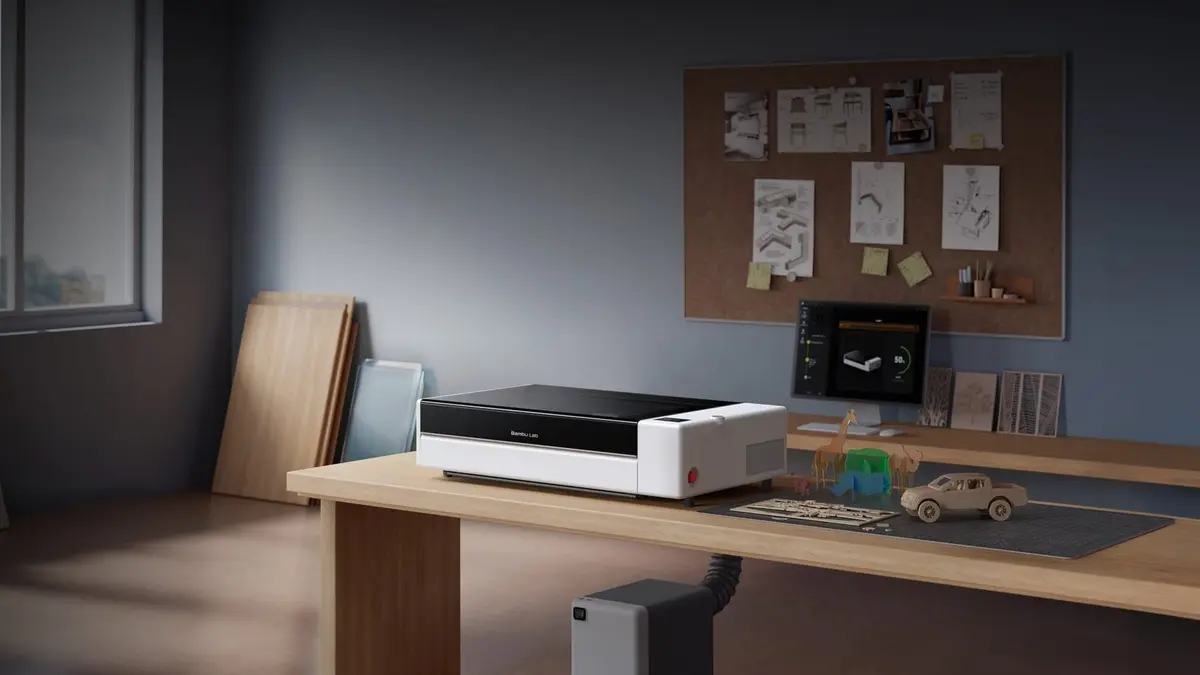
Bambu Lab has spent four years making 3D printing look easy. Its new machine does not print anything at all. The R1 is a 55 W CO₂ laser cutter and engraver — the first product in the company’s history that is not a 3D printer, and the start of a second product line aimed at makers who want to cut and etch as well as print.
Pre-orders opened on 22 September through Bambu Lab’s own store, with shipping starting in October. The R1 costs $2,499 in the United States before tax, with shipping included, and €2,499 in the European Union with tax included but shipping extra.
A CO₂ laser that cuts wood to glass
The R1’s 55 W CO₂ tube cuts and engraves wood, acrylic, leather, paper and fabric, and engraves glass, stone and coated metals. Bambu Lab makes the case for CO₂ over the cheaper diode lasers on the materials that matter: a diode beam passes straight through clear acrylic and glass, while CO₂ light is absorbed by them, and the CO₂ tube also gets through thicker timber with less charring at the edge. In practice that means up to 18 mm black walnut plywood and 20 mm acrylic in a single pass.
The bed measures 600 x 300 mm, and an optional conveyor takes material up to 3,000 mm long through the machine, which is how a desktop cutter starts producing furniture panels. A rotary attachment handles round objects, and long-focus lenses reach thicker stock.
It aligns its own beam
On most CO₂ lasers, keeping the mirrors lined up is a manual chore: thermal paper over the mount, a test pulse, a look at the burn mark, a turn of a screw, and then the same again mirror by mirror. It can eat an hour before a beginner cuts anything. The R1 uses a Laser Alignment Sensor on the toolhead that reads the beam and motorised actuators that correct the optical path automatically, in about a minute. Bambu Lab says the system is exclusive to the company.
Everything else the machine does before a cut is bundled under the name TriSense: a BirdsEye camera watching the whole bed, a toolhead camera for small parts, a Pinpoint laser marking the exact point on the material, a distance-measuring laser that sets focus on flat or curved surfaces, and XY encoders tracking the head as it moves. Bambu Lab says the combination lets the R1 follow an outline — a printed sticker, say — to within 0.2 mm, and engrave evenly across curved bowls.
Printer motion control, retuned for a laser
The R1 borrows the motion system and algorithms from Bambu Lab’s 3D printers. Vibration Compensation cancels the resonance that leaves ragged lines after a sharp direction change, and Speed-Synced Laser Power adjusts the beam in step with the head so that engraving keeps a consistent tone at speeds up to 1,000 mm/s instead of burning darker where the machine is slower.
A separately sold Vision Encoder measures and corrects the mechanical drift that any motion system develops with age, holding absolute accuracy to within 0.1 mm across the 600 mm working area. Bambu Lab says the same job now finishes nearly three times faster than on the machines the R1 is aimed at.
Class 1 at the bench, Class 4 with the conveyor
Fully enclosed, the R1 is certified as a Class 1 laser system under IEC 60825-1, the safest classification a consumer laser can hold: the beam stays inside the housing, so no goggles and no dedicated room are needed. Crossflow ventilation pushes air through the chamber to clear smoke, and a curtain of incoming air keeps fumes inside the machine while long stock passes through the opening. Five sensors watch for flames, an optional Auto Fire Extinguishing system puts a fire out, an emergency stop cuts the power, and opening the lid during a job stops the laser immediately.
That safety rating comes with a caveat worth reading twice: once the Riser Base or the Conveyor is installed the enclosure is no longer complete, the machine becomes a Class 4 device, and it then requires CO₂ safety goggles and is intended only for trained operators in a professional setting. A separately sold E1 Pro air purifier connects to the exhaust outlet for indoor use.
What is in the box
The R1 ships with a short-focus lens. The Riser Base, Conveyor, Rotary attachment, medium- and long-focus lenses, Vision Encoder, E1 Pro air purifier and Auto Fire Extinguishing system are all sold separately, so the headline price buys the machine rather than the full workshop. Control comes through Bambu Suite on Windows and macOS, and the cutter signs into the same account and the same MakerWorld community the company’s printers use, where a laser section is now being built out.
Our opinion
Bambu Lab has done the thing that made its printers land: take a process that usually demands experience and a lot of swearing, and make the fiddly part automatic. Auto beam alignment is the whole argument in one feature, because mirror alignment is precisely where beginners give up on CO₂ lasers. The pricing is where the story gets more complicated. At $2,499 the R1 is not competing with the cheap diode engravers many makers already own; it is competing with established CO₂ machines that a small business would buy once and keep for a decade, and Bambu Lab has not yet shown how a desktop cutter holds up in daily commercial use. The Class 4 downgrade the moment you fit the conveyor is an honest disclosure, but it splits the product in two: a safe home appliance out of the box, and a professional machine that needs training, goggles and a bigger budget the moment you ask it to process full sheets. Buy the R1 for the alignment and the software; budget for the accessories before you believe the headline number.