Zhenwu V900 gives Alibaba its most powerful AI chip yet
Alibaba's Apsara Conference keynote brought the Zhenwu V900, claimed at three times the performance of the M890, plus a 20GW data-centre target for 2032.
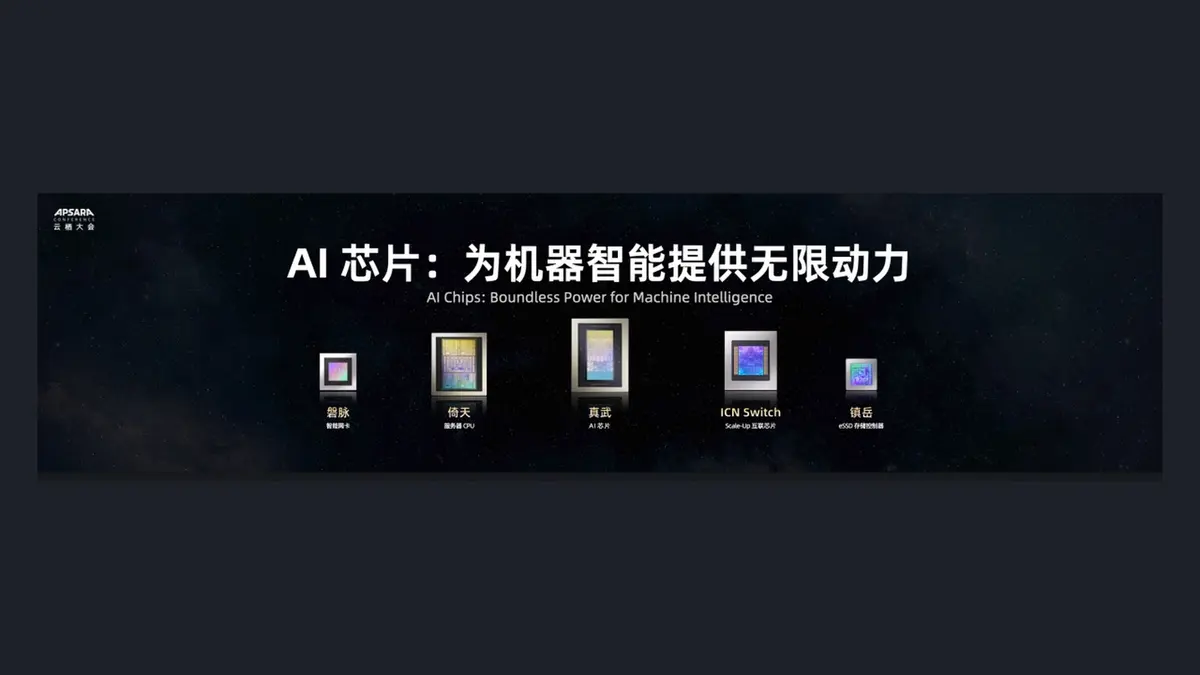
Alibaba used its 2026 Apsara Conference to introduce the Zhenwu V900, describing it as the most powerful AI chip in China today and as three times the performance of the Zhenwu M890 it succeeds. Eddie Wu, Alibaba's chief executive, gave the chip its first public airing in the keynote on 22 September, and framed it as one piece of a much larger argument about who supplies the computing behind machine intelligence.
The number Alibaba leads with is cluster size
The V900 was announced with a system figure rather than a benchmark: a single cluster built on the chip can support up to 500,000 cards, according to Wu, which is the kind of scale a frontier training run needs and the kind of claim that is hard to check from outside. Around the chip sits T-Head's data-centre range, which Wu described as four product lines rather than one: the Zhenwu series for GPU accelerators, the Yitian series for server CPUs, the Panmai series for smart network cards and a family of ICN interconnect chips. Alibaba's argument is that it is co-optimising all four together with its servers, supernodes, networks, models and inference engines, which is the same full-stack pitch every large accelerator supplier now makes.
A 20GW target is attached to the chip
The V900 arrived attached to an infrastructure commitment. Wu said the global data-centre capacity operated by Alibaba Cloud is targeted to surpass 20GW by 2032, which is a statement about electricity and land as much as about silicon. He also said the existing M890 AI Supernode already delivers high-efficiency inference for foundation models above 2 trillion parameters, and that Alibaba Cloud is bringing supernodes online at commercial scale this quarter. Put together, the roadmap is a bet that token demand keeps doubling while the cost of serving each token falls, which is only a safe bet if the chips keep getting better and the grid keeps getting bigger.
Tokens, and the model that eats them
Wu's keynote leaned on the scale of the demand he expects. In the upcoming age of machine intelligence, he said, demand for tokens will be virtually boundless, which requires chips to keep improving performance and scale of supply. One slide in the deck put the same thought more bluntly, claiming that machine thinking will exceed 1,000 times all of humanity combined. The practical release alongside the chip was Qwen Intelligence, an end-to-end product for partner mobile devices that Alibaba says will let handsets reason through and execute genuinely complex tasks, putting the same models that run in its cloud onto hardware in people's pockets.
What the keynote did not say
There was no production date, no price, no named customer and no independent benchmark. Three times an in-house predecessor is a figure Alibaba sets itself, and the company did not publish the memory capacity, memory bandwidth, per-card throughput or interconnect specification that would let anyone place the V900 against anything else on the market. That reticence is the honest limit of this announcement: the chip exists, the roadmap behind it is unusually specific about electricity capacity and unusually quiet about the silicon.
Our opinion
Alibaba is selling the number it controls. Three times an in-house predecessor is a claim about a roadmap, not about where the V900 sits against the accelerators it will actually compete with, and a keynote that lays out 20GW of 2032 data-centre capacity while declining to mention memory bandwidth is telling you which of those two things the company would rather be judged on. The 500,000-card cluster figure is the more revealing one, because it describes a system problem rather than a chip: keeping half a million accelerators fed is precisely where very large Chinese clusters have been weakest, and the ICN interconnect silicon is Alibaba's answer to it. Watch the electricity target instead of the chip. Data-centre capacity is measurable from outside the company, it shows up in permits and substations, and it cannot be softened later by a benchmark footnote. If Alibaba gets anywhere near 20GW, the V900 will have been a step in that story rather than the story itself.