Yandex open-sources an 80B model it trained alone
Yandex has released AliceAI Foundation, an 80-billion-parameter pretrained model built from scratch and published under Apache 2.0 with two new Russian-language benchmarks.
What Yandex actually put on the internet
Yandex has open-sourced AliceAI-Foundation-80B-A3B-Base, the pretrained stage of a large language model it says it trained entirely from scratch. The release went up on 21 September under the Apache 2.0 licence, which covers commercial as well as research use, with the weights, configuration files and a fine-tuning script published on Hugging Face as 49 shards of safetensors data.
The name is a specification in itself. The model carries 80 billion parameters in total but activates only 3 billion of them for any given token, because it is built as a Mixture of Experts: 512 experts in all, with the top ten routed experts and one shared expert switched on per token, spread across 48 layers that alternate between KDA blocks and gated-attention blocks. The context window reaches 262,144 tokens and the vocabulary runs to 129,024 entries, which is a wide tokeniser pitched at Russian as much as English.
The benchmark claims, and who is measuring them
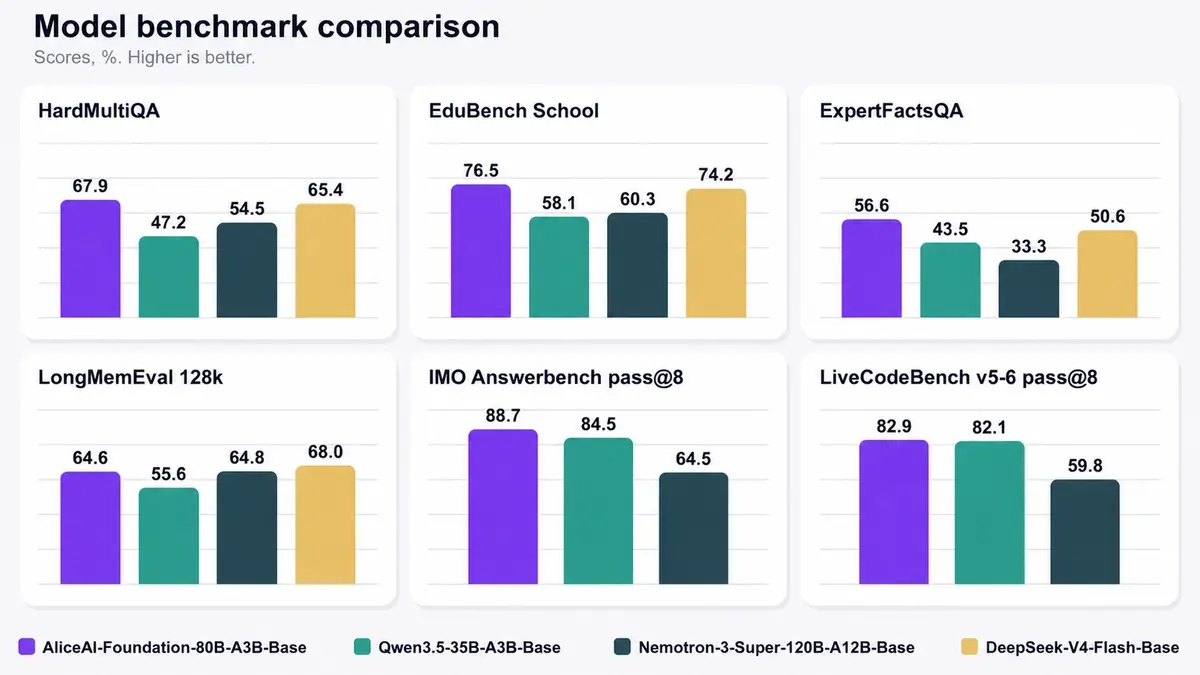
Yandex compares the model with Qwen3.5-35B-A3B-Base, GLM-4.5-Air-Base, NVIDIA's Nemotron-3-Super-120B-A12B-Base and DeepSeek-V4-Flash-Base using its own evaluation harness, with inference run through vLLM at temperature zero. Every figure below therefore comes from the company that built the model, and none of it has been independently reproduced yet.
On the Russian-language factual sets the gap is wide. On WikiWebFacts the model scores 86.5 against 62.4 for Qwen3.5, 70.2 for GLM-4.5-Air, 72.8 for Nemotron-3-Super-120B and 83.2 for DeepSeek-V4-Flash. On HardMultiQA it reaches 67.9 against 47.2, 48.6, 54.5 and 65.4 for the same four rivals. Neither benchmark existed in public form before this release, which is worth weighing when reading those numbers.
Maths and code are closer. On IMO Answerbench pass@8 the model scores 88.7, ahead of Qwen's 84.5 and well clear of DeepSeek's 64.5, and on LiveCodeBench v5-6 pass@8 it lands at 82.9 against Qwen's 82.1 and DeepSeek's 59.8. Yandex says it shares the lead with Qwen3.5 on olympiad-level maths and beats Nemotron-3-Super-120B on code-writing while activating a quarter of the parameters. It is not a clean sweep: on LongMemEval 128k it trails DeepSeek by 64.6 to 68.0.
Two benchmarks shipped alongside the weights
Yandex also published the two factual benchmarks it used. WikiWebFacts is built from short question-and-answer pairs drawn from online encyclopedias and frequent aggregated search queries, testing dates, definitions, events and people. HardMultiQA is built from an anonymised stream of queries to Alice AI and aims at rarer territory - medicine and law, IT and art - with questions that require picking several correct options, naming several facts that fit, or finding a factual error in a passage. Both are public, with reference answers and the full evaluation protocol.
Where the training gains reportedly came from
Two engineering changes are worth noting because they are the kind of work that outlives the model. Yandex rebuilt its optimizer so that data transfer between GPUs runs in parallel with computation rather than before it, which it says roughly doubled the speed of an optimisation step. The data pipeline now sends documents through a cascade of classifiers, with a bigger and costlier model working on fewer documents at each stage; Yandex says that cut the computation by more than tenfold while keeping about 95% of the useful documents, work it estimates would otherwise have taken more than 200,000 GPU hours. The training mix was also expanded in law, medicine and mathematics.
Why release it at all
AliceAI Foundation is explicitly not the finished product. Yandex describes it as an experimental model it is using to test architectural decisions for a future unified reasoning model, and that reasoning model is what will drive the agentic features of Alice AI, the company's assistant. So the pretrained release is a public look at the foundation the company intends to build on, and a way of buying outside scrutiny at the stage when scrutiny is still useful.
Our opinion
The licence is the story here, not the leaderboard. A Russian lab has handed out weights that activate 3 billion parameters at a time and run on a single well-specced machine, which puts a credible non-Western, non-Chinese entry into the shrinking club of models a company can host itself - and for anyone in a country that does not want its inference sitting on American or Chinese servers, that matters more than three points on a benchmark. Read the tables the way Yandex presents them: it wins the sets built to reward Russian factual knowledge, which it should, and it loses LongMemEval to a model twice its size. The more revealing detail is that the model being donated is the experimental one. The reasoning model that will actually power Alice AI stays closed, and the company is candid about that. Open-sourcing your testbed is a very different gesture from open-sourcing your product, and the gap between the two is where the argument about open weights lives.