Waymo adds Singapore to its global robotaxi map
Waymo has signed up with Singapore's transport ministry and Land Transport Authority to run a fully autonomous, all-electric ride-hailing service through its own app in 2028.
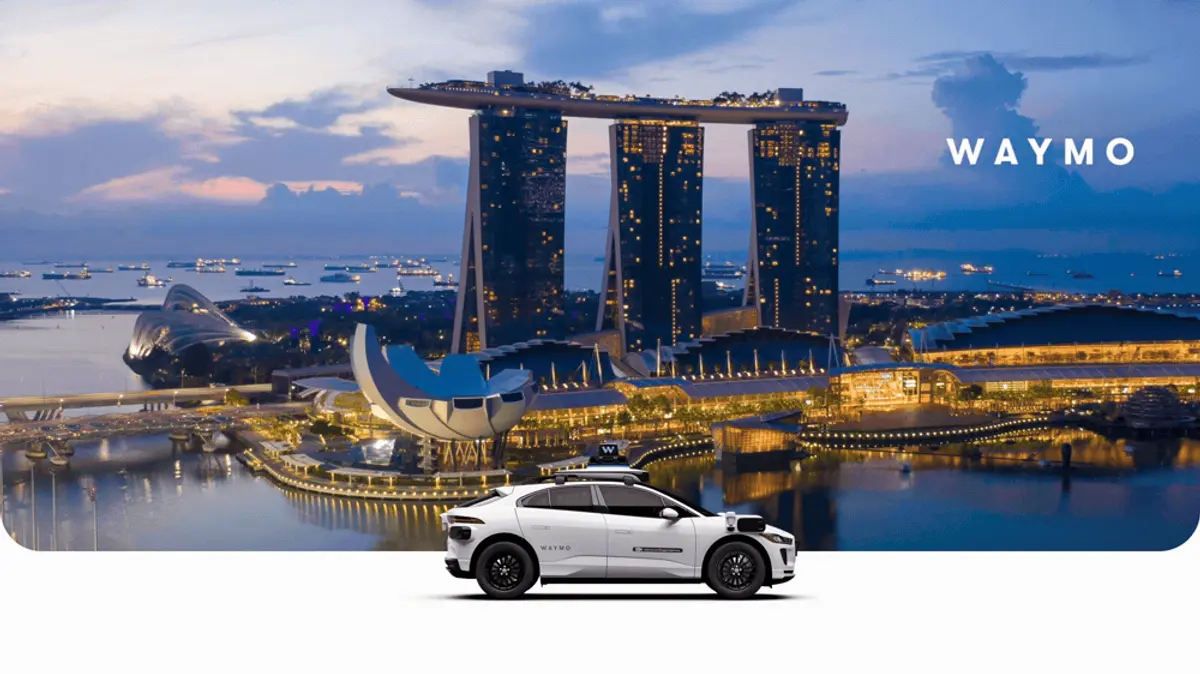
Waymo is going to Singapore. The company announced on 17 September that it intends to introduce a fully autonomous, all-electric commercial ride-hailing service to the city-state in 2028, working with Singapore's Ministry of Transport and the Land Transport Authority, and bookable through the Waymo app.
The roadmap, in order
The rollout is deliberately staged. An initial fleet of all-electric Jaguar I-PACE vehicles arrives in Singapore "in the coming months" as Waymo establishes local operations. Through 2027, trained autonomous specialists will conduct initial manual driving to adapt the Waymo Driver to local road geometry and, a detail that matters in a country that measures rain in buckets, monsoon weather patterns. The public commercial launch, when anyone with the app can hail a driverless car, is targeted for 2028.
The numbers Waymo is arriving with
Waymo is not turning up as an unknown quantity. The company says it has served more than 20 million fully autonomous rides and driven more than 300 million fully autonomous kilometres, and reports a 94% reduction in injury-causing crashes compared with human drivers in the US cities where it operates without a safety driver. It frames the Singapore service as a complement to mass transit rather than a rival to it, noting that in San Francisco more than a third of riders are picked up or dropped off near a transit station.
Why Singapore, and why now
Singapore has the three things an autonomous operator wants: dense but orderly roads, a transport authority already comfortable with the technology, and a government with a decarbonisation plan on the statute book. Waymo says its all-electric fleet supports the Singapore Green Plan 2030 and estimates that, at current scale, it keeps roughly 480 tonnes of carbon dioxide out of road travel every week. The same announcement names Tokyo, London and Munich as cities Waymo is working to launch in, so Singapore is one entry in a queue rather than a one-off.
Tekedra Mawakana, Waymo's co-chief executive, said Singapore "has built one of the safest, most efficient, and most forward-thinking transportation ecosystems in the world", adding that the company was committed to "listening to the community, creating high-skilled local operational jobs, and working hand-in-hand with national leaders".
Our opinion
Waymo has spent more than a decade insisting it is a safety company that happens to run cars, and Singapore is the first market where that line gets tested by a government that already half-believes it. The city-state has been trialling autonomous vehicles for years, it taxes car ownership hard enough that a robotaxi has an obvious economic pitch, and its public transport is good enough to be real competition. That is a far tougher exam than a sprawling American metro, and it is the right one. Two caveats before anyone hails a car. The 2028 date is Waymo's intention, and the company is explicit that regulatory approvals come first. And monsoon driving is not a marketing detail; it is the hardest sensor problem in the announcement. If the Waymo Driver handles it, the company buys credibility no US city could confer. If it does not, it does so in front of the regulator most likely to publish the reasons.
- Fully autonomous, all-electric commercial ride-hailing targeted for Singapore in 2028, booked through the Waymo app
- A fleet of electric Jaguar I-PACE vehicles arrives in the coming months, with manual readiness driving through 2027
- Run with Singapore's Ministry of Transport and Land Transport Authority, a year after 20 million US rides