SiPearl ships first Rhea1 CPUs to Bull for Jupiter
Europe's first exascale supercomputer has taken delivery of a processor designed on the continent, with Bull now fitting Rhea1 chips into the CPU blade of JUPITER at Juelich in Germany.
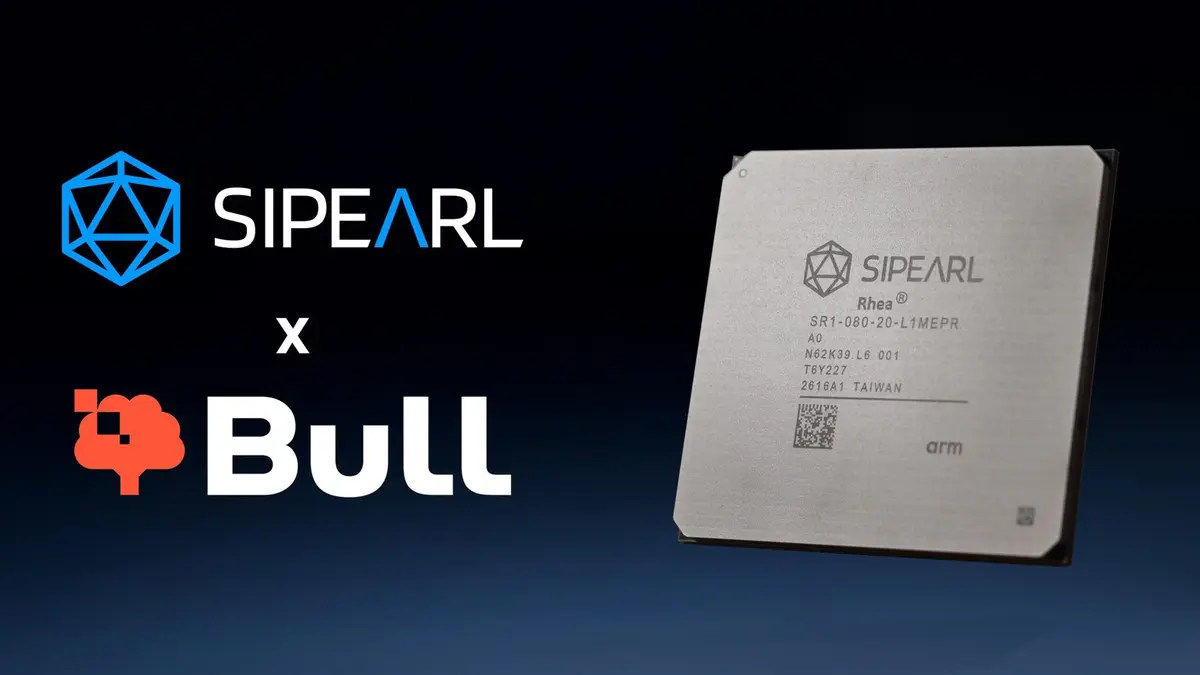
SiPearl has handed over the first Rhea1 processors to Bull, the company that will build them into JUPITER, Europe's first exascale supercomputer. The delivery, announced on 22 September, puts a European-designed CPU into a European-built platform for the first time, and moves Europe's most ambitious processor project out of the laboratory and onto an integration line.
A chip that stops being a promise
Bull has started fitting Rhea1 onto its BullSequana XH3000 platform for JUPITER, which is procured by the EuroHPC Joint Undertaking and hosted at the Juelich Supercomputing Centre in Germany. The work feeds JUPITER's CPU blade, the half of the machine that sits alongside its GPU partition, and clears the path towards the modular build-out of the full system.
For a programme that has spent years being described in the future tense, that matters more than any benchmark slide. Rhea1 began life inside the European Processor Initiative with the stated aim of giving European supercomputers sovereign hardware, and it now has a machine to power.
What is inside Rhea1
In a single package Rhea1 carries 80 Arm Neoverse V1 cores, each with two 256-bit Scalable Vector Extension units, four stacks of High Bandwidth Memory and four DDR5 interfaces. SiPearl is aiming the part at the most demanding high-performance computing workloads and at AI inference, and it leans on the in-package HBM for a byte-per-flop ratio it describes as unrivalled. The die is being manufactured at TSMC, and SiPearl calls it the most complex server CPU ever designed in Europe.
The company also makes two claims that read as much political as technical: the chip is back-door free and kill switch free, language aimed squarely at buyers who do not want their national research capacity governed from outside Europe.
Numbers still to come
SiPearl says benchmarking in its own laboratories is producing very encouraging performance, and that in some cases results are exceeding expectations. It is not publishing those figures yet: the data is still to be consolidated and is promised for this autumn. What is already unambiguous is the commercial weight of the order. The equipment supplied for JUPITER is SiPearl's first order for Rhea1, and therefore its first significant revenue.
What the partners said
Anders Dam Jensen, executive director of EuroHPC JU, framed the delivery as the moment European processor work became deployment: "Through the European Processor Initiative, EuroHPC JU has supported the development of a European processor that is now moving from innovation to deployment in JUPITER, Europe's first exascale supercomputer."
At Juelich, where the machine will live, director Thomas Lippert pointed to the memory design as the reason the CPU half of JUPITER looks the way it does, saying Rhea1's "high memory bandwidth is particularly well suited to applications that benefit from efficient access to large amounts of data."
Bruno Lecointe, who leads high-performance computing, AI and quantum at Bull, called it a demonstration of what European partners can do when vision meets execution, while SiPearl chief executive Philippe Notton called the CPU cluster of JUPITER being fitted with European hardware "a first in Europe."
Our opinion
Sovereignty stories are usually told at the glamorous end of the stack, which is why they usually disappoint. A CPU blade is a dull place to start, and that is precisely what makes this delivery worth noticing: Rhea1 has crossed from a funded ambition into a rack that someone else has to operate. The scepticism is not unreasonable either. SiPearl's own performance data is unpublished, its benchmark claims are self-reported, and one order for one machine is not a market. But the industry test for a processor is not a specification sheet, it is whether a systems vendor will weld it into a shipping platform, and Bull has now begun to do exactly that. If the autumn figures land anywhere near what SiPearl is hinting at, Europe will have bought itself a genuine seat at a table it has spent three decades paying to sit near.