Samsung unveils Odyssey gaming monitors with 720Hz OLED and 1,110Hz IPS modes
Samsung’s gamescom lineup includes 49-inch, 42-inch and 32-inch OLED monitors plus a 27-inch Fast IPS display aimed at extreme refresh rates.
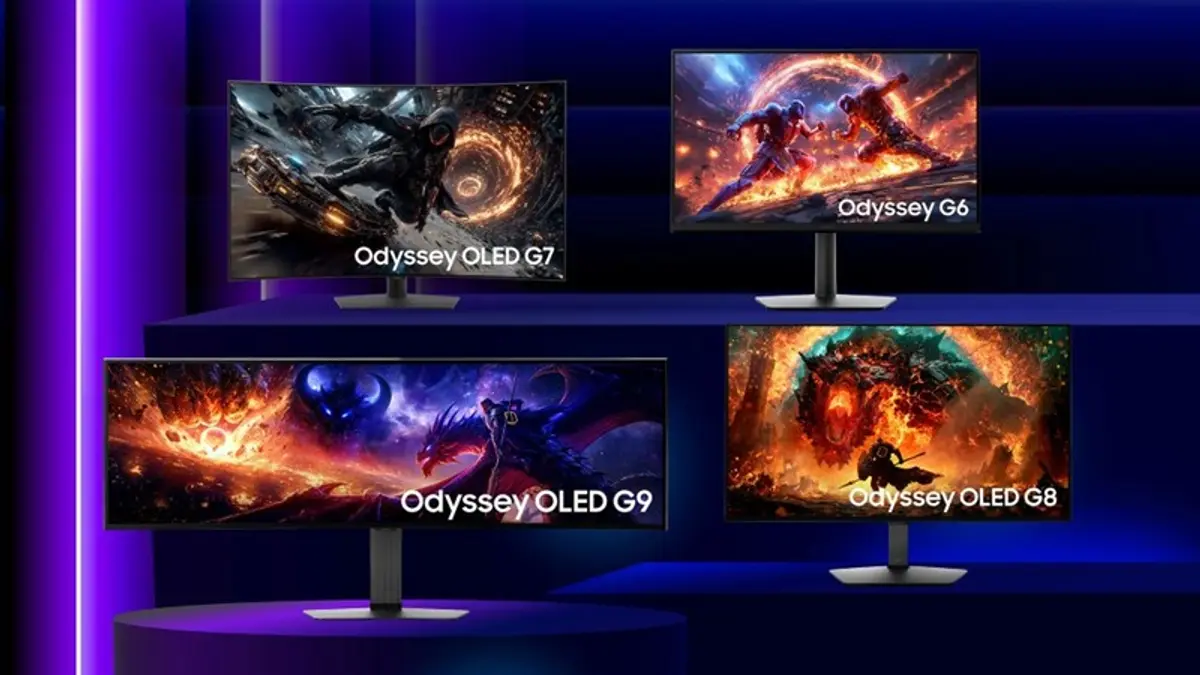
Samsung has used gamescom 2026 to show off a frankly excessive new batch of Odyssey gaming monitors, including OLED screens with refresh rates up to 720Hz and a Fast IPS display that can reach 1,110Hz at a lower resolution.
The company’s new lineup includes the 49-inch Odyssey G95SJ, 42-inch Odyssey G75SJ, 32-inch Odyssey G80SJ and updated 27-inch Odyssey G60H. Samsung has not announced pricing in the available report, and most of the new displays are not expected until the first half of 2027.
Odyssey G95SJ: 49 inches of 360Hz OLED
The Odyssey G95SJ is a 49-inch super-ultrawide OLED monitor using Samsung’s fifth-generation Penta Tandem QD-OLED panel. It runs at a Dual QHD resolution of 5120 by 1440 with a native 360Hz refresh rate.
Its dual-mode setting can switch to 2560 by 720 and raise the refresh rate to 720Hz. TFTCentral reports a 0.03ms grey-to-grey response-time specification and peak brightness of 1,300 nits.
The panel uses an RGB-stripe sub-pixel layout intended to improve text clarity. Samsung says the five-layer structure is up to 1.3 times more efficient and offers up to twice the lifetime of previous-generation panels.
Odyssey G75SJ is a 42-inch 4K OLED
The Odyssey G75SJ moves in the opposite direction, using a large 42-inch 16:9 WOLED panel with a 1000R curve. It offers 3840 by 2160 resolution and a 165Hz refresh rate.
Samsung’s Glare-Free coating is designed to reduce reflections, with TFTCentral reporting that it is 54 per cent less glossy than conventional anti-reflection film. The monitor is also listed with a 0.03ms grey-to-grey response-time specification.
The G75SJ is expected to launch in the first half of 2027, with pricing and further availability details still to come.
Odyssey G80SJ offers three refresh-rate modes
The 32-inch Odyssey G80SJ combines a 4K 3840 by 2160 QD-OLED panel with a native 360Hz refresh rate. It uses the same fifth-generation Penta Tandem QD-OLED approach and RGB-stripe layout as the G95SJ, along with Glare-Free coating.
Its triple-mode system offers 4K at 360Hz, 2560 by 1440 at 520Hz or 1920 by 1080 at 680Hz. That gives players the option of prioritising image detail or speed depending on the game, graphics hardware and tolerance for pixels becoming a little more abstract.
The G80SJ supports adaptive sync, AMD FreeSync Premium Pro and NVIDIA G-Sync Compatible systems. It is certified for VESA DisplayHDR True Black 600 and includes DisplayPort 2.1 UHBR20, two HDMI ports, USB-C with 96W power delivery, a USB hub and KVM switch.
The Odyssey G60H reaches 1,110Hz at 720p
The 27-inch Odyssey G60H uses a Fast IPS panel with 2560 by 1440 resolution and a native 600Hz refresh rate. Samsung now says it can reach 1,110Hz when the resolution drops to 1280 by 720, up from the 1,040Hz figure shown at CES.
The monitor is expected to launch in Q4 and carries a listed 1ms grey-to-grey response-time specification. As with the other extreme refresh-rate modes, the headline figure only makes sense for a narrow set of competitive games and systems capable of producing enough frames to feed it.
Availability and pricing
TFTCentral reports that the G95SJ, G75SJ and G80SJ are expected during the first half of 2027, with more information and pricing likely nearer to CES in January. The G60H is expected during Q4, but Samsung has not provided a price in the available announcement details.
The monitors were presented at gamescom in Cologne, while the G80SJ and G60H were not on the show floor according to TFTCentral’s report. Release timing and specifications may change before retail launch.
Our opinion
Samsung has clearly decided that 240Hz is now embarrassingly slow, which is a bold position to take when most games, graphics cards and human eyeballs are still perfectly content below it.
The G95SJ is the most immediately exciting model: 49 inches of OLED, 360Hz at Dual QHD and a 720Hz mode for people who believe every millisecond is a personal insult. The G80SJ is arguably the more sensible technical showcase, offering 4K at 360Hz while keeping faster modes available for competitive play.
The G60H’s 1,110Hz number is excellent headline material but less useful in practice. At 720p, the image is giving up a great deal of detail to chase a refresh rate that only a very small audience can meaningfully exploit.
The biggest problem is the one Samsung has not answered yet: price. OLED gaming monitors are already expensive, and these new panels are pushing refresh rates and connectivity into enthusiast territory. Until Samsung publishes pricing and independent testing confirms brightness, motion handling, text clarity and longevity, admire the numbers from a safe distance and keep your wallet in its drawer.