Samsung puts a Heart Health Score on Galaxy Watch
Samsung's World Heart Day explainer folds sleep, activity, vascular load and BMI into a single Heart Health Score on the Galaxy Watch and Samsung Health.
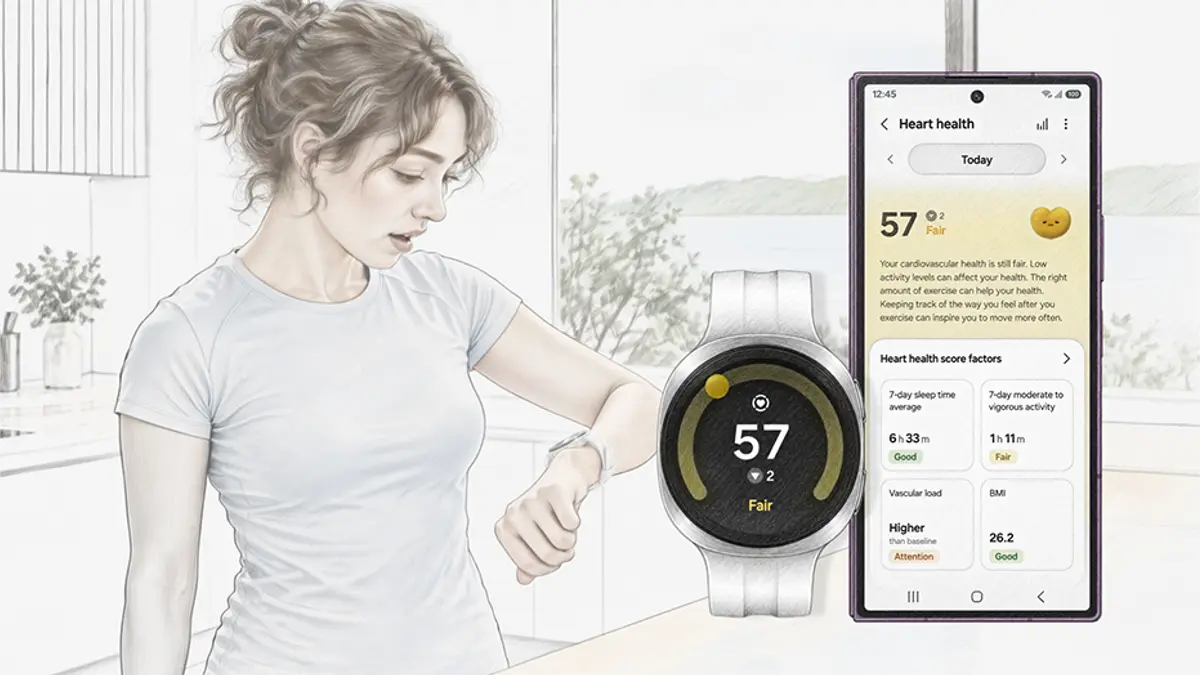
Samsung marked World Heart Day on 29 September with a long explanation of how its Galaxy Watch line handles heart monitoring, from a single Heart Health Score in Samsung Health to an electrocardiogram taken with a finger on the side of the case. The framing is prevention: the company wants the watch to make a change visible before it turns into a symptom.
One number built from four measures
The Heart Health Score tracks and analyses health indicators including sleep duration, daily activity level, body composition and vascular load, then compresses them into one figure that Samsung Health displays with a plain-language label. Samsung's worked example is a missed run: activity at moderate-to-high intensity falls, the score drops, and the watch suggests going for a run. The company points to American Heart Association guidance that diet, exercise, sleep, weight, blood pressure, blood sugar, cholesterol and smoking cessation are the measures that matter most for cardiovascular health.
Samsung's own artwork breaks the same score into its component factors, listing seven-day sleep time, seven-day moderate-to-vigorous activity, vascular load and body mass index alongside the headline number. The intent is legibility rather than diagnosis, and the difference matters: a score that dips because you stopped walking is doing its job, while a score that looks healthy says nothing about an undiagnosed problem.
What the watches actually measure
Galaxy Watches carry a BioActive Sensor that combines an optical heart rate sensor (PPG), an electrocardiogram sensor (ECG) and a bioelectrical impedance analysis sensor (BIA). Blood pressure from the wrist requires calibration once every four weeks against a home blood pressure monitor, after which readings are available from the watch. An ECG takes about 30 seconds with a finger on the side electrode, and Samsung says the trace can flag signs of abnormal heartbeats such as atrial fibrillation or ectopic beats.
The more consequential feature is the Irregular Heart Rhythm Notification, which watches heart rhythm through the day and raises a notification if abnormal signals repeat. Samsung claims that in several countries those notifications have led to early detection of risks such as atherosclerosis or myocardial infarction, though the announcement gives no figures behind the claim.
Overnight, the watch analyses five vital signs: heart rate during sleep, heart rate variability, respiratory rate, skin temperature and blood oxygen saturation. Each is compared with the wearer's own baseline, and a meaningful deviation produces a morning notification rather than a dashboard nobody opens. Samsung Health can also share selected data, including steps, blood pressure, heart rate and medication adherence, with nominated family members, which is the feature most likely to be used by someone buying a watch for a parent rather than themselves.
Our opinion
Samsung is selling reassurance, and reassurance is the easiest thing to oversell in consumer health. A single number that moves when you skip a jog is a behaviour nudge dressed up as a metric, and that is fine as long as nobody mistakes it for a cardiac risk assessment. The Heart Health Score's real value is that it collapses four indicators into something a person will actually look at on a Monday morning, which is more than most health dashboards achieve.
The genuinely interesting claim is the irregular rhythm notification, because that is the one piece of this that finds people who did not know they had a problem. It is also the claim Samsung leaves thin: several countries, some early detections, no numbers, and a photo caption noting that the images are simulated for illustrative purposes. Blood pressure and ECG features of this kind also only reach a market once regulators clear them, so availability varies by country. Both caveats matter, because the value of the whole package depends on a calibration habit at home and on a notification that a cardiologist, not a score, ends up interpreting.