OpenAI Academy branches out to builders and teachers
OpenAI has expanded its Academy training programme to fourteen courses across four learning paths aimed at knowledge workers, developers, leaders, educators and students.
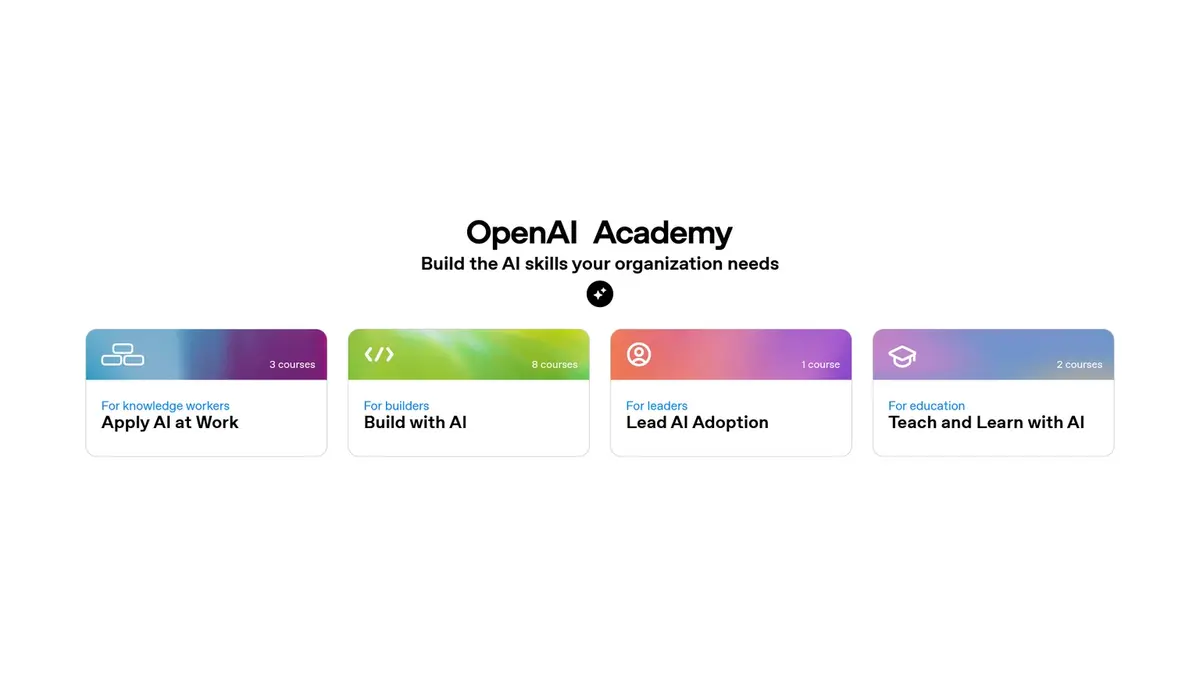
OpenAI has expanded its Academy training programme from a single introductory course to fourteen, grouped into four learning paths, in an announcement dated 21 September. The company frames the courses as part of deployment rather than marketing, and each one ends in an assessment that awards a badge when a learner passes.
What the four paths cover
Apply AI at Work holds three courses for knowledge workers, moving from writing clear instructions and adding context to directing larger pieces of work with agents. Build with AI is the largest path at eight courses, aimed at developers using Codex or building on the OpenAI API; it covers planning and implementing changes across the software development lifecycle, solution design, evaluations, agents, retrieval and running AI systems in production. Lead AI Adoption is a single AI Leadership course about finding where AI creates value, setting ownership and governance, and drafting an adoption roadmap. Teach and Learn with AI covers AI for Educators and AI for College Students.
How organisations are meant to use it
OpenAI suggests companies fold Apply AI at Work into onboarding, hand Build with AI to technical teams and put AI Leadership into executive or champion programmes, while schools pair AI Foundations with the educator and student courses. A separate deployment guide sets out how to introduce the courses, engage managers, build participation and track progress. The educator course tells teachers to work from source material they have permission to use and to check the model's answers against their own learning objectives. The courses sit on the Academy site, and OpenAI says they will keep changing as its models, products and guidance change.
Our opinion
The interesting decision here is the assessment. Most vendor training stops at a library of videos, and a pass-or-fail check with a badge attached turns the Academy into something a company can point at in a procurement review or an internal audit, which is a far stronger adoption lever than free courses on their own. There is a straightforward commercial logic underneath it too: the eight-course developer path is, in substance, onboarding for Codex and the API, so the people most likely to specify an AI stack are being taught on OpenAI's terms. That does not make the expansion a bad idea. The educator track, which asks teachers to supply their own material and to check answers against their own objectives, is a more careful framing than most vendor curricula manage. Teams adopting it should still read the badges as a record of attendance rather than proof of competence, and judge the courses by what a learner can build once they finish.