NVIDIA's Vera Rubin NVL72 posts 3.7x MLPerf throughput on debut
NVIDIA's Vera Rubin NVL72 delivered up to 3.7x the throughput of GB300 NVL72 in its first MLPerf Inference preview submission, while a four-rack, 288-GPU GB300 system scaled at 99% efficiency.
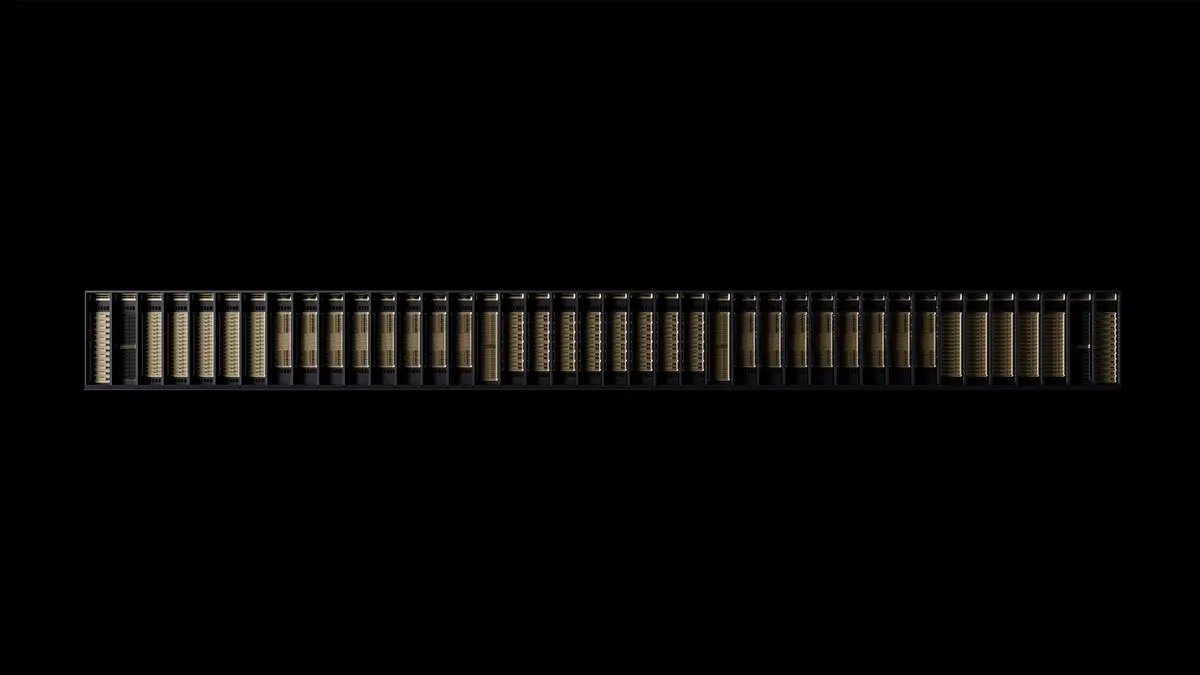
NVIDIA used the 16 September publication of MLPerf Inference v6.1 to put the first public performance numbers on its next-generation data-centre platform. In a preview submission, one Vera Rubin NVL72 system produced up to 3.7x the throughput of a GB300 NVL72 system built on the current Blackwell Ultra generation.
The entry covers two of the heaviest benchmarks in the suite. On Qwen3-VL, Vera Rubin NVL72 ran up to 3.7x faster than GB300 NVL72 across the offline, server and interactive scenarios, served through vLLM with NVIDIA's Dynamo inference framework. On DeepSeek-R1, running on TensorRT-LLM, the gap was up to 2.5x.
A preview result with real entries behind it
NVIDIA submitted preview figures rather than a full slate, and MLCommons has verified them inside the v6.1 round dated 16 September. Both architectures carry their own result entries for the comparison: Vera Rubin in 6.1-0106 and 6.1-0074 for DeepSeek-R1 and Qwen3-VL, with the GB300 points in 6.1-0073 and 6.1-0074. Nebius also submitted Vera Rubin NVL72 preview results.
The gains come from full-stack changes rather than a larger die alone. Vera Rubin leans on NVFP4 precision to shrink the memory footprint of model weights, attention and the KV cache. Its sixth-generation NVLink scale-up interconnect, paired with the NVLink Switch, moves 10x the packet rate at a third of the latency of off-the-shelf Ethernet. The submissions also use disaggregated serving, splitting prefill from decode with large-scale expert parallelism, which is the technique that matters most for the mixture-of-experts layers inside DeepSeek-R1 and Qwen3-VL.
The scaling figure is the one buyers should read
Efficiency, not a single-system score, decides what a rack is worth. NVIDIA scaled a DeepSeek-R1 submission from one GB300 NVL72 rack of 72 GPUs to four racks and 288 GPUs and reported 99% scaling efficiency in the offline scenario, so throughput grew almost exactly in proportion to the hardware added. On the WAN 2.2 text-to-video benchmark, GB300 NVL72 reached 0.65 720p videos per second at 5.7 seconds per video, nine times the throughput and 7.5x lower latency than a single node.
Software carries part of the load too. NVIDIA lifted GB300 NVL72 performance on Qwen3-VL by up to 1.6x over its v6.0 figures using a lower-precision KV cache, extra kernel fusion and better kernels. Optimisations made after the submission deadline, on GPT-OSS-120B and DLRMv3, have not been verified by MLCommons, so they stand as vendor claims rather than benchmark results.
Agents are moving the goalposts
The measurement itself is shifting. NVIDIA cites SemiAnalysis's AgentX suite, where Vera Rubin NVL72 showed 30x the performance of GB300 NVL72 in preview testing, and points to an incoming MLPerf Endpoints benchmark intended to standardise how agentic inference, where a system reasons and acts across several steps, gets scored. The v6.1 round added work at the small end as well: NVIDIA submitted Jetson AGX Thor results using TensorRT Edge-LLM on a new Edge-Agentic benchmark running Qwen3.6-27B.
Nineteen partners took part across the round, eight of them on multi-node Blackwell NVL72 systems. That list runs from ASUS, Azure, Cisco, CoreWeave, Crusoe, Dell, Fujitsu, Giga Computing, HPE, Inventec, Lambda and MiTAC through to Nebius, Oracle Cloud Infrastructure, Quanta Cloud Technology, Red Hat, Supermicro and Wiwynn.
Our opinion
MLPerf has spent years batting away the charge that vendors shop for flattering configurations, and a preview entry is the format most exposed to it: fewer benchmarks, no matching full submission from the part it replaces, and a number that lands months before anyone outside a hyperscaler can buy the hardware. To NVIDIA's credit, its own footnotes draw the line properly, splitting what MLCommons verified from the post-deadline optimisation claims on GPT-OSS-120B and DLRMv3 rather than folding the two together.
What lifts this round above a routine generational speed-up is the 99% scaling figure sitting beside the 30x AgentX result in the same announcement. If inference is shifting from answering single prompts to running multi-step agents, then throughput per rack stops being the number that decides a contract and cost per completed task starts. That is a contest NVIDIA is currently winning against benchmarks it helped set the rules for, which is exactly why the arrival of MLPerf Endpoints will matter more than another 3.7x.
- Vera Rubin NVL72's first MLPerf Inference preview submission reached up to 3.7x the throughput of GB300 NVL72 on Qwen3-VL and up to 2.5x on DeepSeek-R1
- A 288-GPU GB300 NVL72 submission across four racks hit 99% scaling efficiency, and GB300 performance on Qwen3-VL improved up to 1.6x over v6.0
- NVIDIA reports 30x the GB300 NVL72 score on SemiAnalysis AgentX in preview testing, with an MLPerf Endpoints benchmark for agentic inference on the way