NVIDIA's Kumo Tabular predicts tables in one pass
NVIDIA has released an open foundation model that predicts the labels of new rows in a single forward pass, with no training, no tuning and no feature engineering.
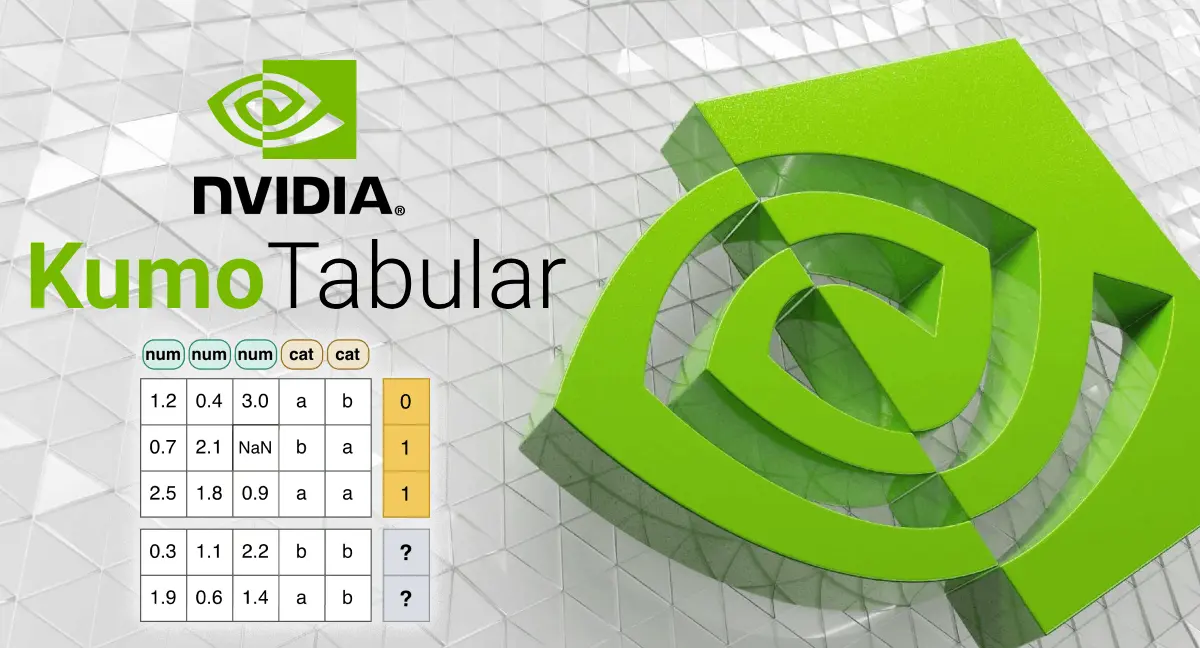
NVIDIA has published Kumo Tabular, an open foundation model for tabular data that predicts the labels of unseen rows in a single forward pass, with no training, no tuning and no feature engineering. It arrives as part of the NVIDIA Kumo Structured collection and is available now on Hugging Face.
What NVIDIA actually shipped
Tabular data is the backbone of enterprise machine learning. Customer records, transactions, sensor logs, claims and orders all live in tables, and predicting churn, default, demand or price from them is one of the most common tasks in industry. For two decades the workhorse has been gradient-boosted trees, and they work well. NVIDIA's argument is that the lifecycle around them, not their accuracy, is the problem: every new dataset means retraining, retuning and revalidating a model before it earns its keep.
Kumo Tabular borrows the idea behind in-context learning from large language models. A model pretrained on millions of tables reads a labelled table as its context and returns class probabilities or numeric predictions directly, without updating a single weight.
Under the hood it is a Transformer built around the structure of a table, using column, row and in-context attention in the manner of TabICL and TabPFN. Cells are grouped into tokens; numerical and categorical values pass through Fourier features with separate weights, and missing values need no imputation. Row embeddings alternate column attention, which learns whether a value such as 42 is typical for its column, with attention across a row. A final Transformer then lets context rows attend to each other while query rows see only the context.
That last detail matters for speed. Because the context never looks at the queries, its keys and values are computed once and can be reused for follow-up predictions on the same table. NVIDIA also added a length-aware attention temperature so that attention does not dissolve when an inference table is far larger than the tables a model saw during training.
Trained on synthetic tables, not customer data
Kumo Tabular is pretrained entirely on artificial tables. Each training table is sampled from a structural causal model that draws a random causal graph, evaluates it from root to leaf using randomly drawn linear maps, small neural networks, trees or Gaussian processes, and designates which nodes become columns and which becomes the target.
NVIDIA built real-world messiness into the generator rather than hoping for it. Values go missing in several patterns, some features are coarsened so that duplicate rows may disagree on their label, some categorical columns carry many levels, and regression targets can be heavy-tailed. Three model sizes are released, and classification and regression are trained separately.
The benchmark claims
NVIDIA ran all three sizes with default settings against the full TabArena leaderboard, which spans tuned gradient-boosted trees, AutoGluon and the newest tabular foundation models. Kumo Tabular ranks first overall with an ELO of 1950, and NVIDIA says it runs 17 times faster than LimiX-2 under a uniform single RTX 6000 Pro evaluation setup.
The model also placed first on BeyondArena with an ELO of 1418 and an Improvability score of 7.78 per cent, took the top overall ranking on TALENT across classification accuracy, classification log-loss and regression RMSE, and scored strongly on ScoringBench.
The limits are worth stating plainly. Kumo Tabular handles numerical and categorical columns only, so text, images and timestamps have to be turned into features first using the built-in preprocessing recipes. A single forward pass covers up to ten classes, which the library extends with error-correcting output codes, and accuracy can degrade on tables well outside the training ranges or when query rows come from a different distribution. The supporting library is GPU-native, downloads weights from the Hub on first use, and supplies the preprocessing, ensembling and many-class handling NVIDIA used in its own evaluations.
Kumo Tabular is released under the OpenMDW License Agreement version 1.1. NVIDIA says its training recipe and the artificial data generators will follow soon.
Our opinion
The leaderboard is the least interesting thing here. Tabular foundation models trade blows every few months, and a first-place ELO on a benchmark NVIDIA chose to enter proves that the model is competitive, not that it is decisive. What genuinely distinguishes Kumo Tabular is the combination of an open licence, published weights and a promised open training recipe.
That combination attacks the real blocker in enterprise machine learning, which is never the model architecture. It is the audit trail. A bank cannot answer a regulator's question about why a customer was declined if the answer is a foundation model nobody outside the vendor can retrain, inspect or reproduce. Gradient-boosted trees won the last decade partly because they are cheap, explainable and boring. If a pretrained model can beat a tuned tree while keeping its data-generating process in the open, it removes the strongest argument for staying where it is. The catch is the second half of that sentence: until the recipe actually lands, Kumo Tabular is an open model with a closed mind, and reproducibility remains a promise rather than a property.