This 128-byte USB drive uses magnetic-core memory
A creator’s dinner-plate-sized USB experiment uses 128 bytes of magnetic-core memory and rewrites data after every read.
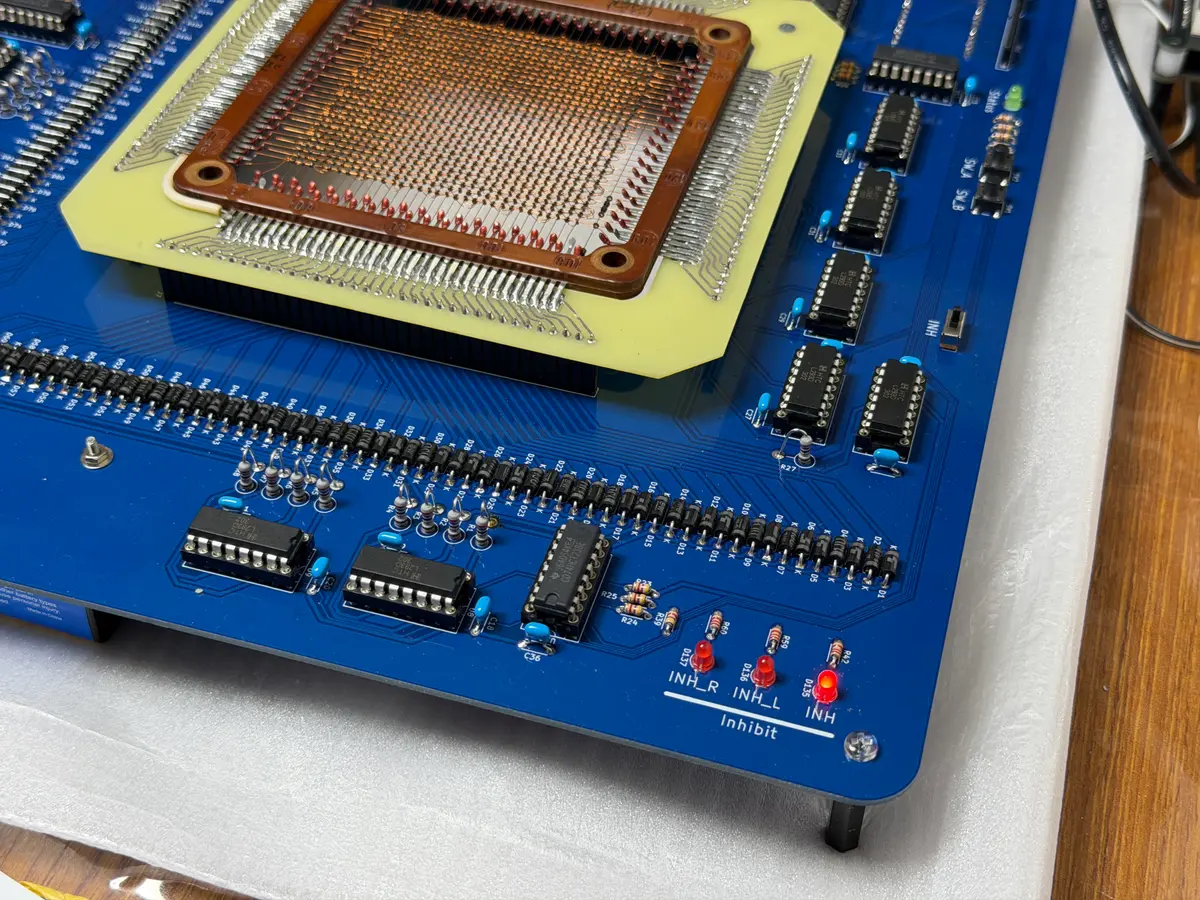
As Tom's Hardware reports, the device uses ferrite magnetic-core memory, a technology that predates integrated circuits, wrapped in a USB Type-A interface. A Raspberry Pi Pico acts as the controller, handling the USB presentation and rewriting data after it has been read. Supporting electronics include driver circuitry, sense amplifiers and LEDs.
The visual centrepiece is a *32 × 32 LED array*. Tom's Hardware says each LED corresponds to a magnetic core, making the 1,024-light grid a handy display of the memory's activity. That number also lines up neatly with 128 bytes, although there is no complete public schematic to independently verify every implementation detail.
The creator's 29 August 2026 post says the device successfully moved a text file to another PC, where it was opened in Windows Notepad. A planned demonstration at Maker Faire Tokyo 2026 was also mentioned, though that appearance has not been independently confirmed. Windows reportedly shows about 6.5 KB, but that is the Pico's USB presentation rather than the magnetic-core storage capacity. The usable memory remains 128 bytes.
Magnetic-core memory stores bits by magnetising tiny rings. The catch is wonderfully brutal: reading a bit destroys it. The controller must immediately rewrite the data if it is going to survive, so every file transfer is also a small act of reconstruction.
That helps explain the device's absurd proportions and tiny payloads. According to Tom's Hardware, it can display monochrome BMP images of roughly *32 × 28 pixels* — less “photo library” and more “pixel-art postage stamp”. There is no practical argument for choosing this over a normal flash drive. Its value is educational: it makes invisible memory behaviour visible, one glowing core at a time.
This is not a product launch so much as a lovingly engineered argument against convenience. The device turns a forgotten memory technology into a working USB experiment, complete with destructive reads, a Pico-powered rewrite cycle and a spectacular LED status panel. It is large, slow and comically constrained, but those flaws are the point.
Calling it the world's first would be too strong without an independent survey of every magnetic-core USB experiment ever made. “Maybe the world's first,” as @dydt_Nao puts it, is the honest version. Either way, this is exactly the kind of gloriously odd hardware project worth watching — especially if the Maker Faire demonstration happens.
*Sources:* Creator @dydt_Nao on X; Tom's Hardware.