Mac mini M6 and Mac Studio M5 Ultra are on sale now
Apple's new desktops are on sale, with the Mac mini starting at $899 and the Mac Studio with M5 Ultra at $5,499 — and Thunderbolt 5 clustering that Apple says triples distributed AI inference.
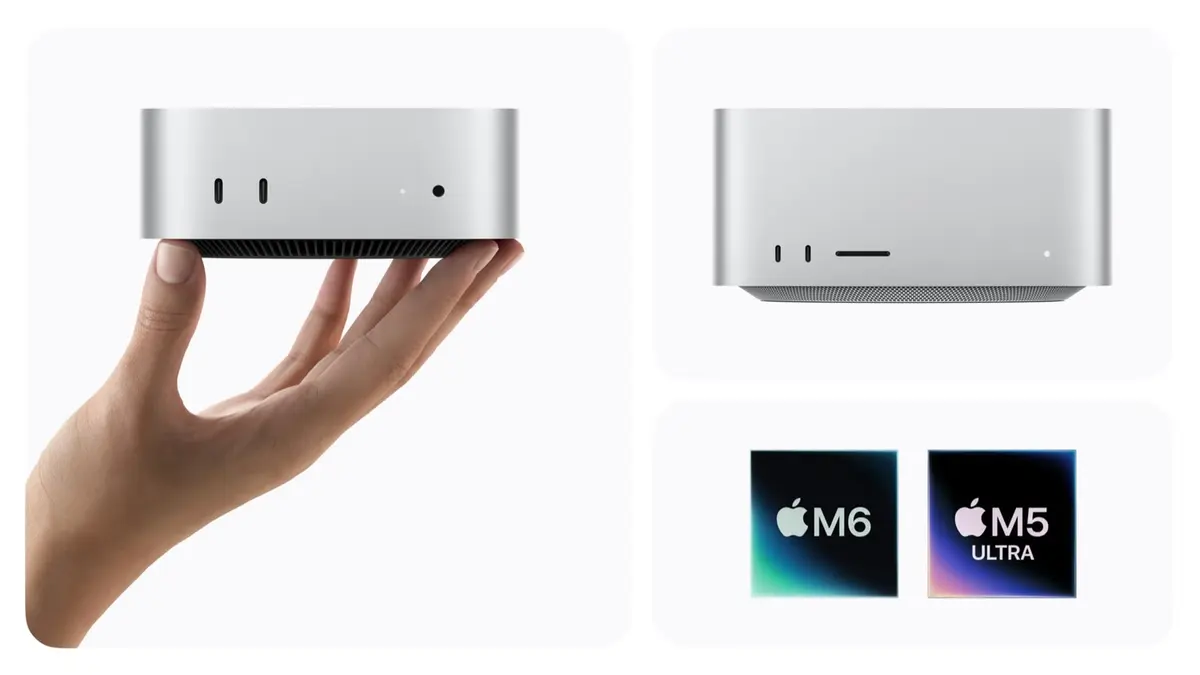
Apple's autumn desktop refresh is now something you can buy. The Mac mini with M6 and M5 Pro and the Mac Studio with M5 Max and M5 Ultra went on sale on 22 September at Apple Store locations, on apple.com and in the Apple Store app, which turns a pair of chip announcements from August into products with prices attached.
The prices, since that is the news
Mac mini with M6 starts at $899, and the M5 Pro version starts at $1,699. Mac Studio with M5 Max starts at $2,499, and the M5 Ultra model starts at $5,499. Students and educators get a Mac mini with M6 from $799 under Apple's year-round education pricing, which is the cheapest way into Apple's first 2-nanometre desktop silicon.
The two families split along familiar lines. The Mac mini with M6 pairs a 12-core CPU and 12-core GPU with Apple's Dual 16-core Neural Engine, starts at 16GB of unified memory and tops out at 32GB with 170GB/s of bandwidth. Apple claims up to four times the AI performance, twice the graphics and storage performance and 40 per cent more CPU performance than the previous generation. Step up to M5 Pro and you get up to 18 CPU cores, up to 20 GPU cores and up to 64GB at 307GB/s.
Studio gets the memory and the clustering
Mac Studio with M5 Max is an 18-core CPU machine with up to 40 GPU cores and up to 128GB of unified memory. M5 Ultra goes further again: up to 36 CPU cores, up to 80 GPU cores and up to 512GB of unified memory at 1.2TB/s, which Apple rates at up to 4.3 times the AI performance and up to 1.8 times the graphics performance of the model it replaces. That memory ceiling is the number that decides whether a large model runs locally or keeps paying rent on someone else's GPU.
Both desktops ship with Wi-Fi 7, Bluetooth 6 and 2.5Gb Ethernet, with a 10Gb option. Both carry Thunderbolt 5 at up to 120Gb/s, and Mac Studio adds Thunderbolt 5 with Remote Direct Memory Access, which lets several Mac Studios be clustered and, Apple says, run distributed AI inference up to three times faster than a single system. A Mac Studio also drives up to eight displays, or four Studio Display XDR panels at 5K and 120Hz.
Our opinion
The interesting machine here is the $1,699 Mac mini with M5 Pro, not the $5,499 Mac Studio. Apple has spent years keeping pro-grade CPU and GPU core counts behind a tower-shaped paywall, and an 18-core Mac mini with 64GB of memory in the same small chassis is a genuinely awkward product to argue against for anyone doing video or local model work at a desk. The Studio remains the machine you buy when you already know why you need 512GB.
The clustering feature is the one to watch rather than the one to buy. Multi-machine inference over RDMA is a data-centre idea arriving in a desktop format, and three times the performance of a single system is a claim that says more about how badly a single machine scales than about how well several do. Treat the figure as Apple's own measurement and wait for independent numbers before planning a rack of Mac Studios. The prices, at least, are real today.