Liquid AI's DSpark speeds up on-device vision models
Liquid AI's new DSpark drafter adds 280 million parameters to its 3B vision model and returns decoding up to 3.13 times faster on a laptop, without changing a word of the answer.
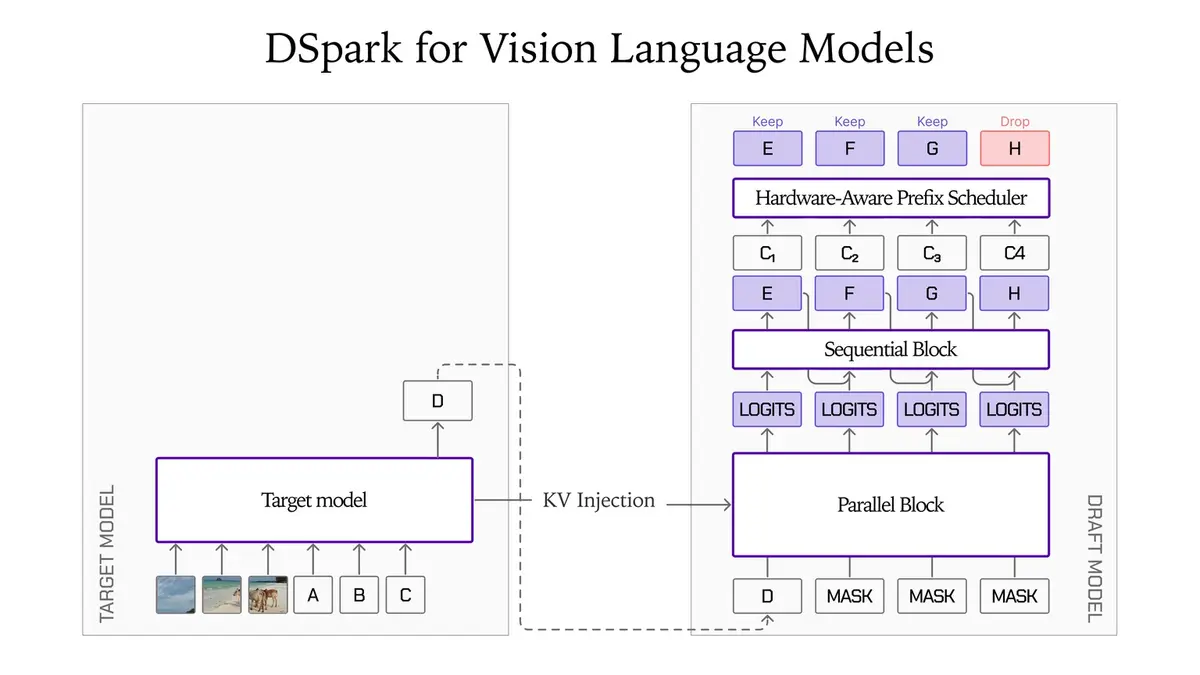
Liquid AI has published LFM2.5-VL-DSpark, a speculative decoding drafter built for LFM2.5-VL-3B, the three-billion-parameter vision-language model the company shipped in August. The drafter is deliberately small at roughly 280 million parameters, an 8.9 per cent addition to the model it accelerates, and it does not change what the model says. It only changes how quickly it says it.
Speculation without the accuracy gamble
Speculative decoding works by pairing a large target model with a much smaller draft model. The drafter proposes a block of candidate tokens, and the target model verifies every one of them in a single pass, keeping the ones it agrees with and throwing the rest away. Because the target has the final say, the output is identical to running the model alone, which is what makes the technique a bargain rather than a trade-off. Liquid AI's drafter uses the same recipe as its text drafters: it taps a fixed set of the target's hidden layers and conditions on those states to build its proposals. Image patches and text tokens are projected into one shared representation first, so the drafter reads vectors of the same size either way.
Where the speed actually lands
The numbers are measured on six vision tasks covering general visual question answering, text-heavy questions, image captioning, chart reading, complex reasoning and multi-turn conversation. With MLX on an M5 Max, decoding runs between 2.30 and 3.13 times faster depending on the task, and end-to-end latency improves by 1.56 to 2.62 times. With llama.cpp on an M3 Ultra the decoding gain is 1.57 to 2.14 times, with 1.30 to 1.77 times end to end. On an H100 the drafter is worth up to 2.66 times on decoding and 1.64 to 2.27 times overall. The shipped drafter uses four attention layers and a proposal block of eight, and it works out of the box with llama.cpp, MLX-VLM and SGLang.
The ceiling is prefill, not decoding
The part of the post worth more than its speed table is the limitation section. Speculative decoding accelerates decoding and nothing else, so image encoding and prefill are untouched. On a laptop or a phone those stages are a far larger share of the wall time than they are on a data-centre GPU, which means a threefold decoding win translates into something much more modest once the prompt has been processed. That is ordinary Amdahl's law, and it is a useful corrective to the way drafters are usually marketed.
Our opinion
Liquid AI deserves credit for publishing the ceiling alongside the peak, because most drafter announcements stop at the biggest number in the bar chart. The 8.9 per cent parameter cost is the figure that actually matters on a phone, where every megabyte is spoken for, and the day-one llama.cpp and MLX support is what separates a research artefact from something a developer can ship this week. The honest question left open is how often a drafter helps in a real app: camera assistants and document scanners spend their time on encoding and first-token latency rather than on long generations, which is exactly where this technique contributes least. Fast open-weight vision models matter more than fast ones that stay behind an API, and this is a step towards that.